Whoops on a Dirt Bike: Why Speed Stabilizes You Instead of Throwing You Off
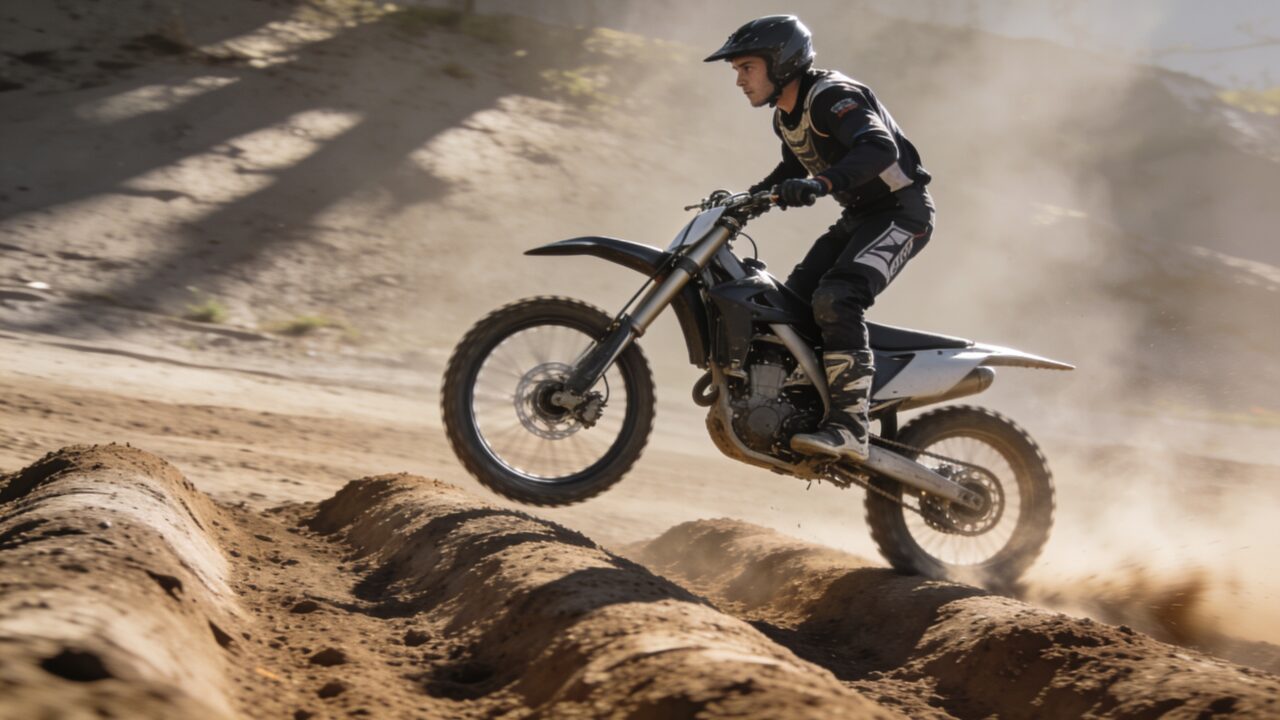
Getting through a set of whoops rests on a principle that feels backwards: speed up instead of slowing down. At the right speed, the bike skims across the tops of the bumps instead of diving into every trough, which stabilizes the line. Too slow, and each bump becomes an isolated hit that unsettles the bike a bit more than the last, until you lose it.
The skimming principle
A whoop section is a tight series of small, fairly even bumps. Below a certain speed, the bike follows the terrain: it rises and falls over each bump individually, which beats up the suspension and your body on every hit and quickly becomes unmanageable once the rhythm speeds up beyond your control anyway.
Above a threshold speed, different for every whoop section, the bike stops fully dropping into the troughs — it skims across the tops, a bit like a stone skipping on water. That speed takes commitment and confidence, which is why whoops stay an obstacle reserved for riders who’ve already locked in their fundamentals, especially throttle and clutch control and the jump management covered in the how to jump article.
Getting the technique right
Stay standing, in a position slightly further back than your usual base stance, to keep the front light and help it skim the tops. Legs absorb continuously, almost like a living shock absorber, without ever stiffening despite the frequency of the hits.
Throttle stays constant and committed from the moment you enter the section. Any hesitation or throttle chop in the middle of the whoops kills your skimming speed and drops you back into the regime where every bump becomes an isolated hit again, often at the worst moment.
Eyes stay on the exit of the whoop section, never on the bump right in front of you. Fixating on each individual bump slows your reactions and gets you anticipating a crash instead of maintaining the commitment the section demands. If the front starts to drift or you feel a loss of control coming on, the counterintuitive but effective reaction is often to hold or slightly increase throttle rather than chop it, unless the loss of control is already too far gone to recover.
Mistakes that cost you control
The most common: slowing down out of apprehension in the middle of the section. That reflex, sound advice in plenty of other riding situations, is exactly backwards here. Slowing down in whoops drops the bike into every trough and amplifies the instability instead of reducing it.
Sitting down to “absorb” the hits is another classic mistake among riders new to whoops. Sitting cuts your dynamic absorption with the legs, exactly the opposite of what the riding stance article recommends on rough, high-speed terrain. Eyes locked on the next bump instead of the section exit fragments your riding bump by bump instead of treating the section as one fluid whole, which slows reactions and adds fatigue.
FAQ
Why speed up through whoops when it feels dangerous?
Because at sufficient speed, the bike skims across the tops of the bumps instead of diving into every trough, which genuinely stabilizes the line. Slowing down keeps the bike in contact with each bump individually, which destabilizes it further with every hit.
Find all the riding fundamentals on the riding technique page.