Dirt Bike Riding Stance: The Base Position for Everything Else
Contents
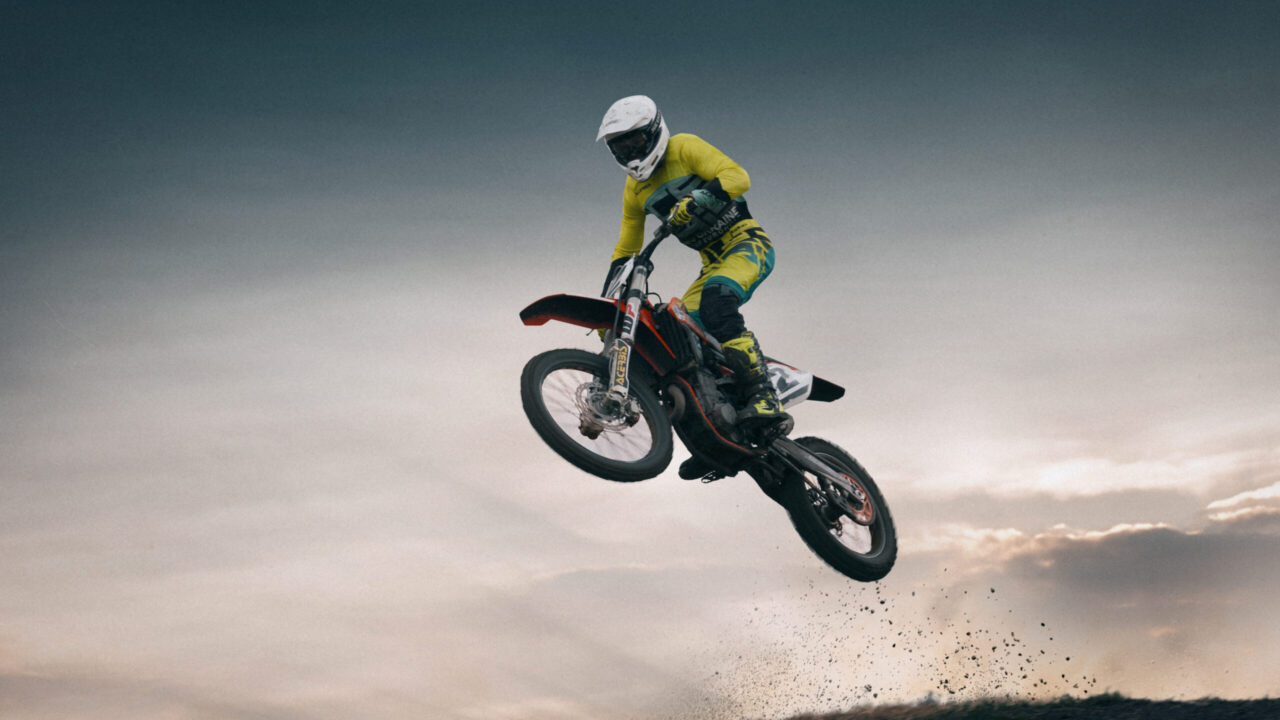
The base stance on a dirt bike is standing on the balls of your feet on the pegs, knees bent, chest forward over the tank, elbows up near wrist height, eyes far down the track. It’s the neutral posture you come back to between every corner and every bump, and it sets how fast you can react when the ground changes without warning.
What each contact point does
Read the stance from the ground up. Every level has a job, and when one gives out, the rest cover for it badly.
Feet
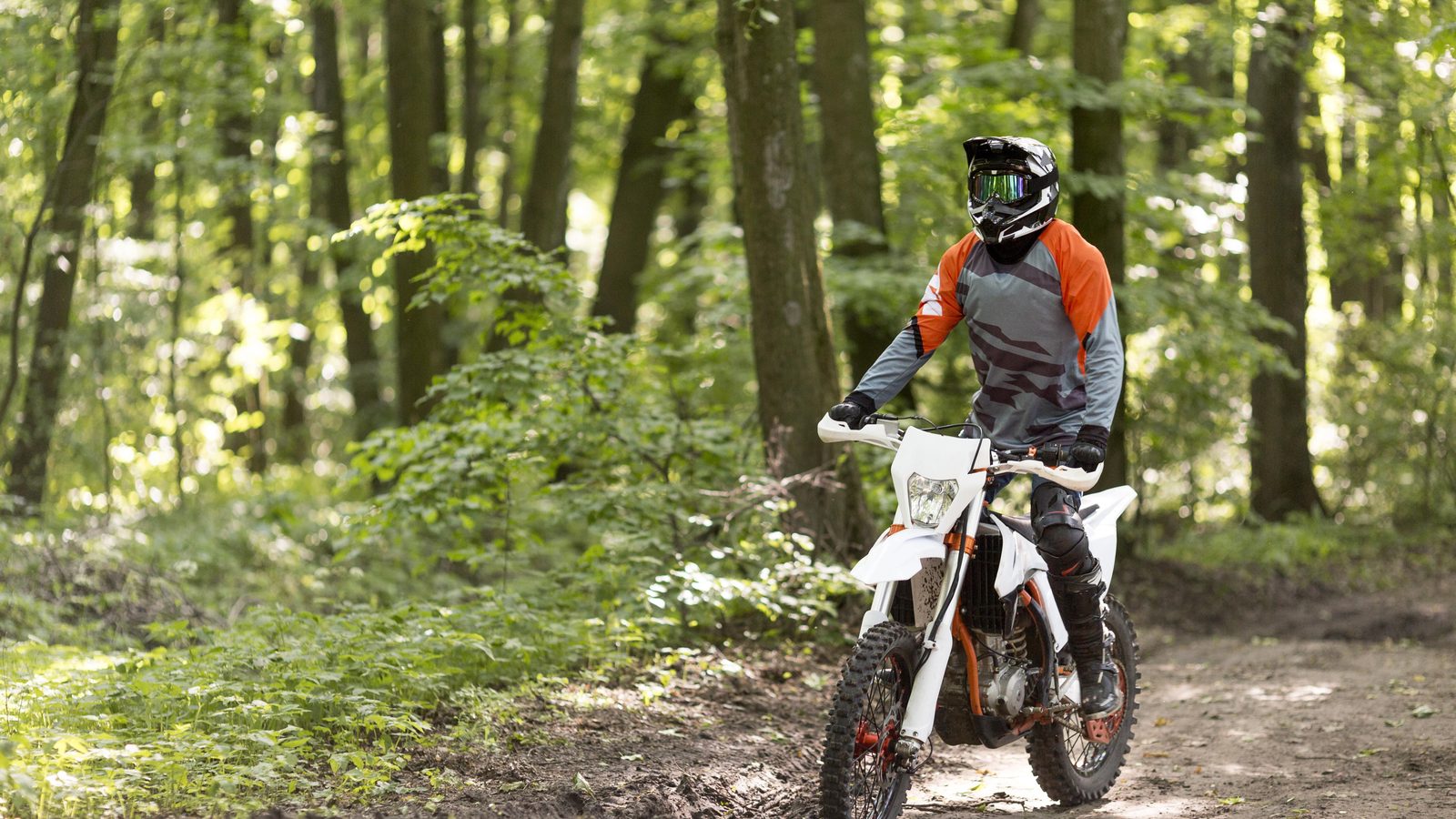
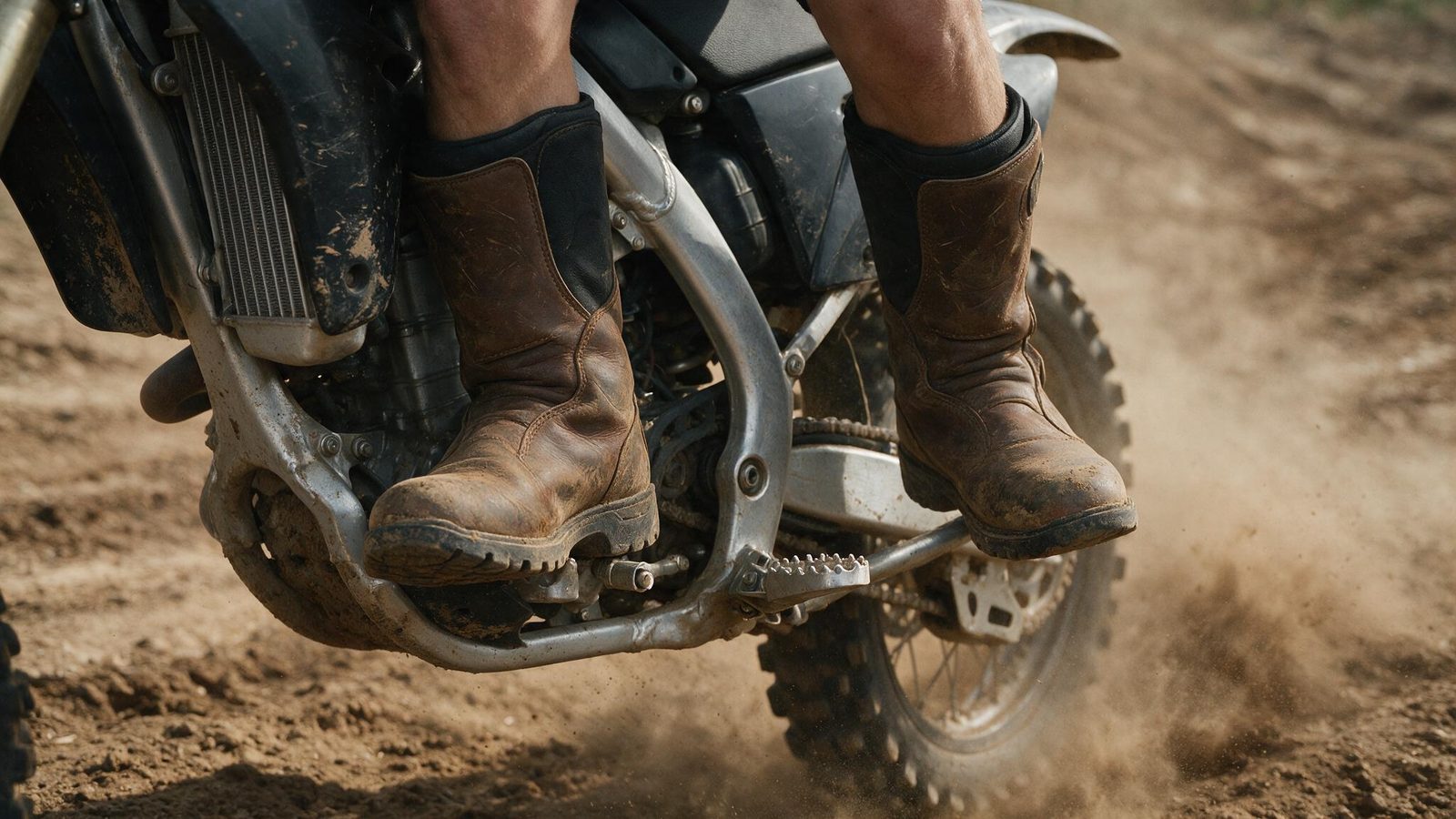
Your weight sits on the balls of your feet, never mid-sole and never on the heel. From there the ankle keeps some travel and works as your first shock absorber. Keep the heels low, just below peg level: that rearward pressure is what stops your boots sliding forward when you get back on the gas. The shifter and rear brake pedal end up under your toe without moving the whole foot.
Knees and hips
Knees stay bent, always. A locked knee absorbs nothing, so the hit travels up into the hip and then the lower back. Hips stay over the pegs or slightly ahead of them, not drifting back toward the seat. Most riders whose backs ache after thirty minutes are riding with stiff legs and their weight too far rearward.
Arms and hands
Elbows up, roughly level with your wrists. It feels wrong for the first few sessions, and it should: this isn’t a resting position, it’s a working one. Bent arms leave you room to absorb hits and to steer. Straight arms leave you nothing. On the grips, hold enough to stay attached and no more. A death grip pumps every vibration into your forearms and blows them up in two laps.
Eyes
Look two or three seconds ahead, not at the front wheel. It’s the cheapest gain on this whole list and the first thing riders drop as soon as the section gets technical. Your eyes come down, and the rest of your body curls up behind them.
Why standing absorbs better than sitting
Seated, your hips are bolted to the bike. Everything the rear wheel takes runs up your spine, and your whole body mass rises and falls with the seat. Standing, your legs become an extra suspension unit: the bike moves under you while your chest stays roughly level.
There’s a second effect that’s less obvious. Standing lowers the combined center of gravity of rider and bike, because your weight moves from the seat down to the pegs. The bike leans and picks up more easily. That’s the same reason you stand before a set of whoops or a run of bumps.
None of this means standing from gate to flag. On a smooth straight, sitting costs less energy for the same lap time.
Mistakes that break the stance
Sitting by default. It’s a street-riding reflex and the most expensive of the four. The moment the ground turns rough, sitting takes away your mobility exactly when you need it.
Locked-out arms, the second classic. They show up when a rider gets tired or tense, and they speed up the fatigue: every impact goes straight to the shoulders and neck, you tense harder, and the loop closes.
Knees clamped to the tank all the time. That lock earns its place in cornering, and again under hard braking. On a rough straight it just stops your legs from working.
An upright chest, last. It unloads the front tire, which then washes out in ruts and pushes wide on hardpack. Plenty of riders fix that by pulling on the bars, which moves them even further back.
Matching the stance to the terrain
The base stance isn’t a fixed shape. It’s a starting point, and you move away from it based on what the ground asks for.
| Terrain | Stance | Check |
|---|---|---|
| Smooth straight | Seated, relaxed upper body | Breathe out, loosen the hands |
| Bumps, whoops, square edges | Standing, deep knee bend, chest low | Your chest doesn’t bounce |
| Rut or berm | Standing or sat forward on the seat, inside knee guiding | Eyes on the exit |
| Downhill | Standing, hips back, arms bent | Weight stays on the pegs |
| Jump landing | Standing, legs loaded and ready to fold | Knees take the hit, not the elbows |
Each case gets its own guide: hill climbs and descents, landing a jump, rut cornering.
Three drills that lock it in
- Ride ten minutes in a straight line, standing, at a moderate pace on flat ground. Don’t look at the speedo or the front wheel. Hold your attention on one thing only: the contact between the ball of your foot and the peg. When your calves start burning, you’re doing it right.
- Take a mildly bumpy section, still standing, at a slow pace. Get someone to film you from the side, or prop your phone on a post. If your helmet rises and drops with every bump, your knees aren’t folding enough.
- Alternate seated and standing every five seconds for a full lap, without worrying whether the choice suits the terrain. The point is mechanical: make the transition automatic. After two or three sessions you’ll be up before you’ve decided to stand.
Once the base holds, throttle and clutch control and cornering position stack on top of it. Neither one replaces the neutral posture.
FAQ
Do you always ride standing on a dirt bike?
No. Stand for rough ground, bumps, landings, and most corners. Sit on smooth straights and some fast sweepers, where sitting costs less energy for the same result. A comfortable rider switches several times a lap without thinking about it, based on what the ground sends up.
Why do my forearms pump up after twenty minutes?
Almost always a death grip or straight arms. You’re carrying your weight through your hands instead of your legs, the muscles stay contracted, and blood flow drops off. Check your upper body first: when the hips slide back, the arms take over. Badly angled levers and low bars make it worse.
How do I know if my stance is right?
Get filmed from the side on flat ground at a steady speed. Three markers show up immediately: chest leaning forward over the tank, knees clearly bent, elbows raised near horizontal. If your elbows hang down by your ribs and your arms are straight, you know where to start.
Is attack position the same as base stance?
In most paddocks, yes, both terms describe the same standing posture. Some riders reserve “attack position” for a lower, more forward variant taken just before an obstacle or a hard drive, with the base stance being the travelling posture between sections. The difference is how deep you fold, not the underlying idea.
My boots keep sliding off the pegs. What do I fix?
Start with the pegs themselves: worn, rounded teeth stop biting, and they’re replaceable. Then look at your boot soles, which wear in the same spot. On technique, keep the heel low rather than flat, because that rearward pressure is what holds you in place when you get on the gas.
Find all the riding fundamentals on the riding technique page.
Editorial content. PiloteMX offers no on-site service, no parts or gear sales, no quotes and no bike repairs. Working on a bike and riding it carry risk: what you do with this guide is your own responsibility.