How to Jump a Dirt Bike: Takeoff, Flight, and Landing
Contents
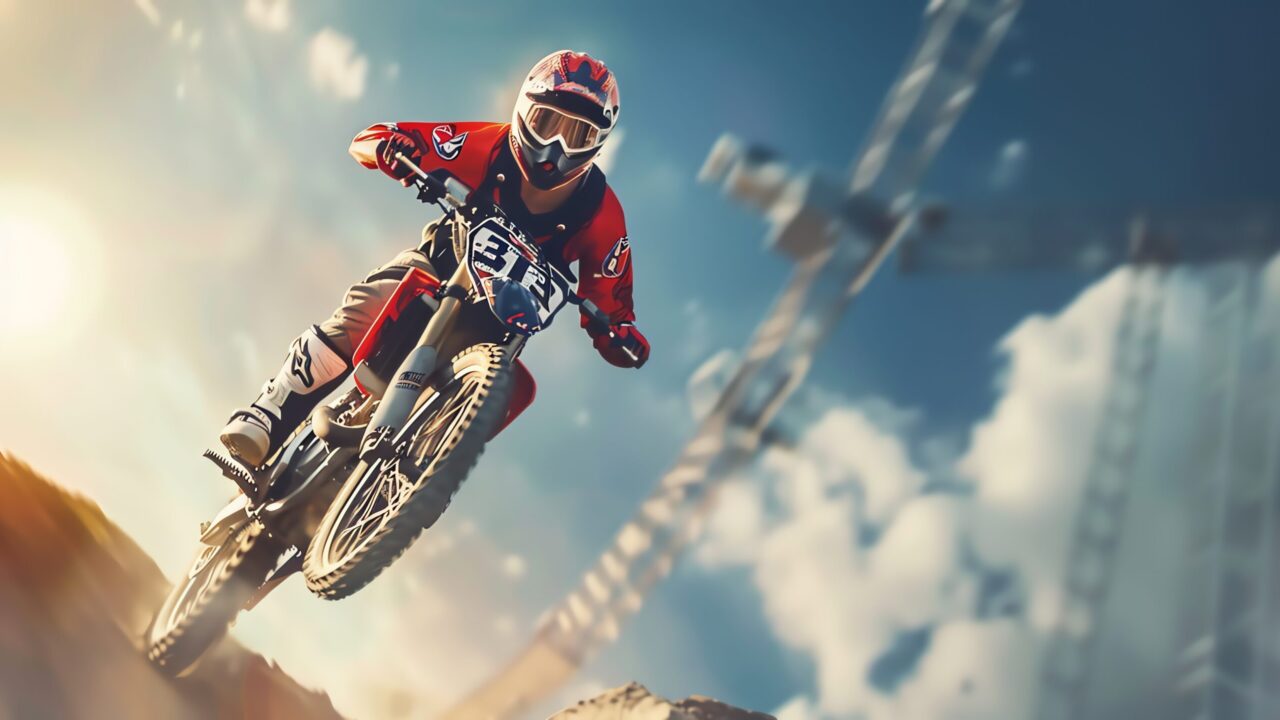
To jump a dirt bike well, you reach the base of the face at a steady speed, ease off the throttle slightly as the front wheel hits the ramp, stay compact in the air, and look at your landing zone before the wheels have even left the ground. A jump is decided almost entirely before takeoff, not in flight.
The jump is won in the meters before the face
Approach speed sets the whole trajectory. A steady speed over the last few meters gives you a predictable takeoff: you know where you’ll come down before you leave the ground. A speed that moves around — a last-second blip, a reflex finger on the brake — changes the bike’s angle in the air and turns the landing into a guess.
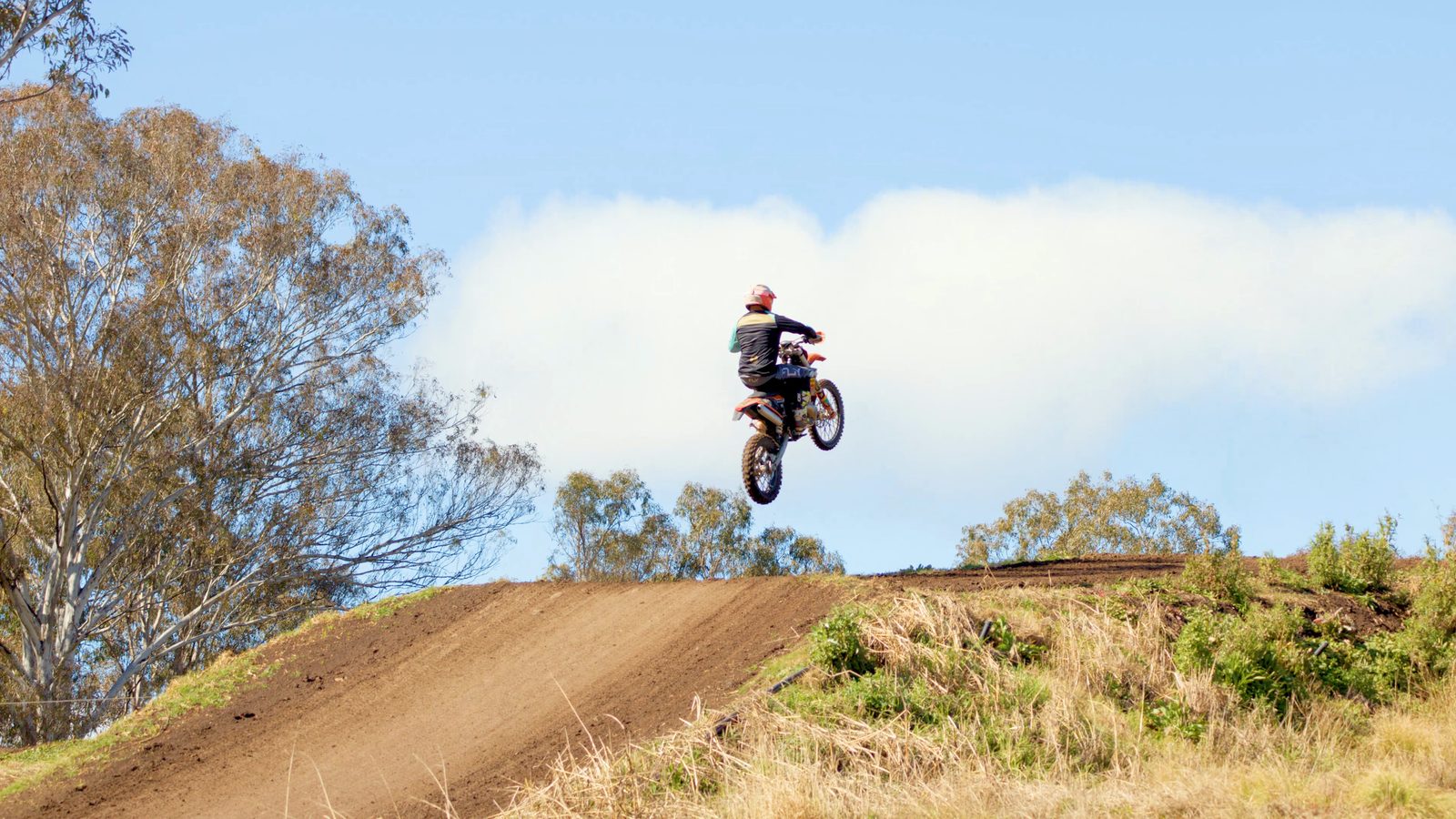
That speed gets sorted out well upstream, in the corner or the straight leading to the obstacle. If you’re still correcting in the last two meters, the approach was wrong. Take another lap, come in slower, give yourself time to settle. Most riders who get caught out in the air made their mistake ten meters earlier, under braking.
Takeoff: what your right hand decides
The instant the front wheel loads the face, your throttle input sets your attitude in flight. Hold it or open it and the front rises — handy on a short tabletop, risky on a gap where you launch nose-high. Ease off slightly and the bike leaves flatter. That suits the large majority of track jumps.
The rest of your body does almost nothing at that moment. Knees pinched, arms loose, chest over the bars. The classic trap is pulling on the bars to “help” the bike up. It comes up on its own — the face does the work. Pulling only adds an input you’ll have to undo in the air.
| Jump type | What changes | Input at the face | The trap |
|---|---|---|---|
| Tabletop | Flat top, mistakes forgiven | Steady throttle, slight roll-off | Feeling safe and coming up short |
| Double | A gap between two faces | Speed locked in before the face, no corrections left | A finger of brake at the last second and you case it |
| Gap | No middle section to bail onto | Clean roll-off to leave flat | Launching nose-high and landing rear wheel first |
| Corner-exit jump | The bike is still leaned over | Stand it up before the face, then roll off | Taking off sideways and landing crossed up |
In the air, you’re managing an attitude
Once the wheels are off, your job changes. You’re not steering anymore, you’re correcting an angle. Body stays gathered: knees pinched, elbows bent, eyes on the landing zone instead of the top of the arc. You go where you look, in the air the same as on the ground.
If the nose climbs too much, firm pressure on the pegs with a small forward shift of the chest brings it back. If the nose drops, do the opposite: chest back a little, weight off the pegs. These corrections are slow and progressive. A sharp input in the air amplifies the problem instead of fixing it.
There are more advanced corrections — a stab of rear brake to drop the front, a blip of throttle to bring it up. Learn those on small jumps with someone experienced watching. Trying one for the first time over a big double is how you buy a crash.
The landing is set up at the top of the arc
At impact it’s already too late to organize anything. As soon as you pass the high point, get your legs slightly bent, spread the weight across both wheels if the terrain allows, or favor the rear wheel when the landing slope is steep.
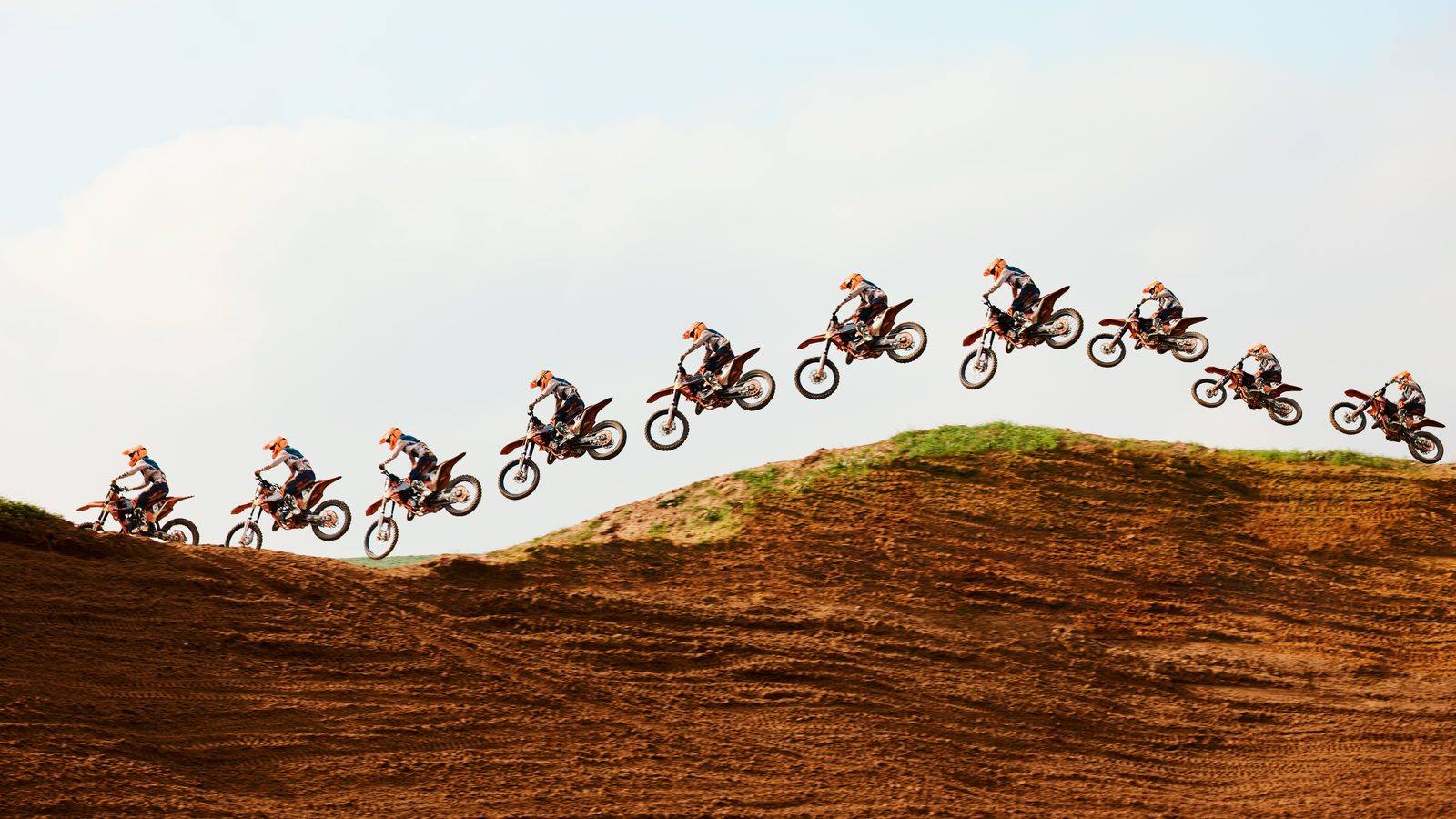
Your arms should be neither locked out nor fully folded at touchdown. That margin of flex is what soaks up the hit instead of your body. Straight legs send everything into your back and wrists, and that’s one of the first causes of pain for new riders. More technical jumps need their own work, covered in the guide on jump landings.
The mistakes that show up most
Plenty of riders open the throttle at the face out of reflex, convinced more gas means more control. It’s usually the opposite: excess throttle pitches the bike nose-up and complicates the landing, especially on a flat jump or a double.
Eyes glued to the face instead of the landing zone is the other big one. Stare at the top of the jump and you freeze in the air rather than adjusting toward where you’re actually coming down.
A body that stiffens in flight is the same problem in another form: a tense rider stops making the small posture corrections that fix the bike’s attitude. That stiffness comes from apprehension. The smaller you jump, the looser you stay — but you have to accept spending a long time on obstacles that feel too easy.
Then there’s the habit that does the most damage: chasing height. Height doesn’t make you faster. A flat, short jump that puts you back on the gas early beats a great photo in the air followed by a scrappy landing.
Three sessions to build the move
Start on a simple, rolling jump with no real flight distance. Work it in laps until the move is automatic before going bigger.
- Controlled takeoff. Ride the jump at a moderate speed and think about nothing but the roll-off at the face. The goal isn’t height, it’s a flat, repeatable launch, ten times in a row.
- Compact flight. Same obstacle, work the position in the air: knees pinched, elbows bent, eyes on the landing. Film yourself if you can — it’s the only way to see that your body is stretching out while you think it’s gathered.
- Absorbed landing. Focus only on the touchdown: legs folding at impact, arms following through. If a jolt runs up into your back, your legs didn’t absorb enough. Go back to a smaller jump.
Only move to a bigger obstacle or to whoops once those three steps are smooth. If the move falls apart, drop back a level — your riding stance is almost always the culprit. The corner that follows a jump is its own job, handled in cornering position.
FAQ
How do you jump a dirt bike properly?
Manage approach speed well before the face, ease off the throttle at takeoff so the bike leaves flat, and set the landing up from the top of the arc rather than at impact. Height is never the goal for a rider who’s progressing — consistency is. Ten identical takeoffs beat one spectacular jump followed by three rough ones.
What are the different types of dirt bike jumps called?
A tabletop has a flat top between takeoff and landing. A double is two faces with a gap in the middle, a triple strings three together. A gap is a jump over open space with nothing in between. A step-up sends you to a landing higher than the takeoff. The basic move doesn’t change from one to the next — only how much flight distance you have to judge.
Should you use the brake in mid-air?
Not as normal practice. Braking in the air doesn’t usefully slow the bike and it upsets the attitude. Speed gets sorted on the ground, before takeoff. The rear brake is only an attitude correction when the nose comes up too far, and that’s a move to learn on small jumps before you rely on it anywhere else.
Find all the riding fundamentals on the riding technique page.
Editorial content. PiloteMX offers no on-site service, no parts or gear sales, no quotes and no bike repairs. Working on a bike and riding it carry risk: what you do with this guide is your own responsibility.