Getting Dirt Bike Helmet Sizing Right
Contents
Dirt bike helmet size comes from measuring your head circumference at its widest point, just above the eyebrows and ears, then reading that figure against the manufacturer’s own chart — never a generic one. Every brand builds around its own interior shape, and two helmets labelled the same size will not feel the same on your head.
Measuring your head without getting it wrong
The measurement takes two minutes and everything else depends on it. Do it before you open a single catalogue.

- Use a soft tailor’s tape. A rigid builder’s tape will not follow the curve of a skull.
- Wear your hair the way you wear it to ride. No bun, no cap.
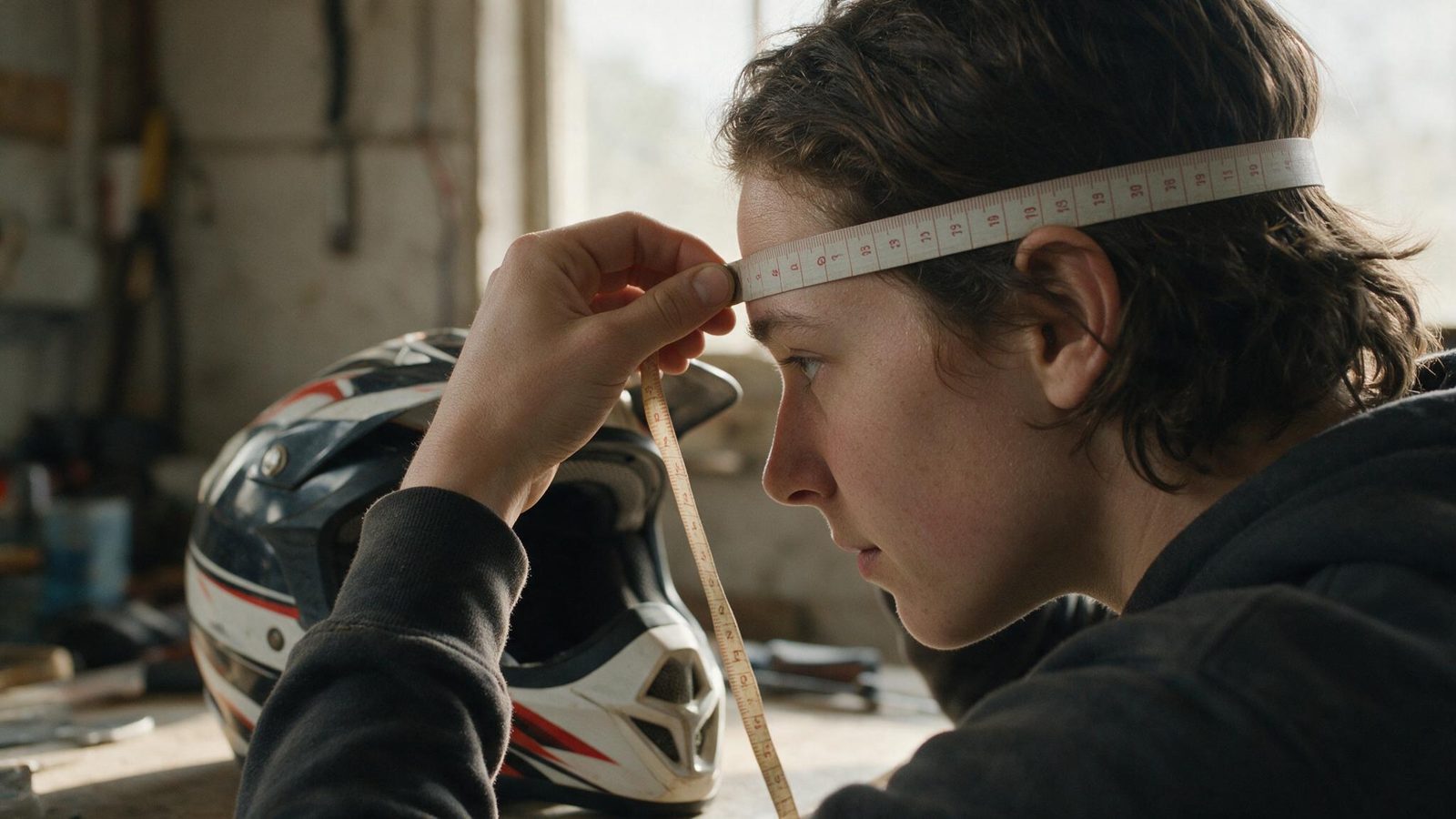
- Run the tape horizontally around your head, about two centimeters above the eyebrows and ears.
- Hunt for the widest point: slide the tape a few millimeters up and down, and keep the largest reading.
- Keep the tape flat against your head, neither digging into your hair nor hanging loose.
- Repeat twice more. If the numbers jump around, it is the tape moving, not your head.
- Read the result against the chart for the brand you are looking at, not some generic chart you found online.
Get someone to help if you can. Measuring yourself in a mirror, the tape always creeps down at the back and you end up with a number that is too small.
The number gives you a size, not a shape
Two skulls with identical circumference can be built very differently. One long oval front to back, one almost round, one tall across the top. A tape measure sees none of that, and it is exactly what decides whether a helmet is comfortable.
Each manufacturer designs its inner shell around a house reference shape. That is why the same centimeter figure lands perfectly with one brand and squeezes your temples with the next. The number tells you which size to try first; it does not tell you which helmet to buy.
A shell too round for an oval head presses on the forehead and the back of the skull while leaving gaps at the sides. Too oval for a round head, it crushes the temples. In both cases the centimeter size was right and the shape was wrong. Safety standards say nothing about interior shape, and the shell criteria are covered separately in choosing a helmet.
What to check once it is on your head
Try helmets on standing up, calmly, and keep each one on for several minutes. Thirty seconds in front of a mirror reveals nothing.
The helmet should not rotate around your head when you turn your skull left and right — the skin of your forehead should move with it, rather than the shell sliding over it. Same going up and down. Then grab the rear edge with the strap fastened and try to roll the helmet forward off your head. If it comes off, it is too big, whatever the chart said.
A vague overall snugness that fades after a few minutes is normal on a new helmet whose foam has not taken your shape yet. A sharp, specific pressure point will not fade. If you already know which goggles you ride in, bring them along: the brow opening and your goggles have to agree with each other.
Too big, too small: reading the symptoms
| What you feel | What it means | What to do |
|---|---|---|
| Pressure at the forehead or temples that persists after several minutes | One size down, or an interior shape too narrow for your skull | Try the next size up, then another brand if it persists |
| The helmet rotates when you shake your head | Too big | Drop a size before adjusting anything else |
| It rolls off forward with the strap fastened | Too big, or wrong shape at the rear | Rule that model out — it will not stay on in a crash |
| Tight on the cheeks but fine over the skull | Cheek pads too thick | Check whether the brand sells pads in other thicknesses |
| Gaps at the sides, contact only front and back | Shell too round for your oval head | Change brand rather than size |
Tight cheeks on a new helmet are a decent sign: those pads compress fastest. A tight skull is not — the crown padding moves far less over time.
Foam compresses: fit shifts over the seasons
A helmet worn regularly grows roomier over the months. The liner absorbs sweat, heat and pressure, and it never quite returns to its original thickness. That is normal aging, not a sizing mistake made at purchase.
What should worry you is the size of the gap. A helmet that starts rotating on your head when it used to hold has lost its fit and will not get it back. Adding a skull cap to take up the slack only moves the problem: the shell still shifts on the padding. At that point you replace it, crash history or not.
Do not store a helmet crushed under a bag or baking in a car in the sun. The foam keeps the deformation, and the day you find it hollowed out, it is hollowed out for good.
Kids: recheck rather than anticipate
A child’s head changes fast. A helmet that fits in September can float by spring, and nobody notices until there is a crash. Redo the measurement and the fit tests every few months, alongside the rest of the kids’ gear.
The instinct to fight is buying a size up so it lasts longer. A helmet that floats rolls off on the first impact or ends up sideways, and the child finishes the crash bare-headed. Buying one helmet too many beats riding a season in one that does not stay put.
FAQ
How do I know if my helmet is too small or too big?
Too small, it creates painful pressure points that never fade, mostly at the forehead and temples, and you come away with a red mark. Too big, it rotates when you shake your head, slides forward when you tilt down, and rolls off when you pull on the rear edge with the strap done up. That last test tells you the most.
Can I buy a dirt bike helmet online?
Yes, provided you already know the brand and model that suits you because you have worn that interior shape before. For a first helmet, go to a shop: skull shape does not show up on a product page or a size chart. Failing that, pick a retailer whose return policy still covers a helmet you have tried on indoors.
Will a tight helmet break in to fit my head?
Cheek pads compress noticeably, crown padding much less. So cheek pressure on a new helmet usually sorts itself out within a few rides. A hard spot on the forehead or temples stays put — that is a shape mismatch, not a break-in period. Do not spend seasons persevering with a helmet that hurts.
Should the tape be tight or loose?
Neither. Keep it flat against the head, without digging into your hair or sagging away from it. Pull it tight and you read a size down, then order a helmet that squeezes. Leave it slack and you buy too big. Have someone else measure you, and take the reading two or three times.
More gear guidance in the gear section.
Editorial content. PiloteMX offers no on-site service, no parts or gear sales, no quotes and no bike repairs. Working on a bike and riding it carry risk: what you do with this guide is your own responsibility.