Helmet Safety Standards: What They Actually Guarantee
Contents
For a dirt bike helmet sold in Europe, the reference is ECE 22.06 certification, which is gradually replacing the older ECE 22.05 with broader test protocols. It certifies that a new helmet passed a series of trials in an independent laboratory. It says nothing about whether that helmet suits your head, or what it is worth after a crash.
What a certification actually tests
A safety standard is not a marketing badge. It is a test protocol a helmet has to pass before it earns the right to be sold. The trials cover a short list of specific points:
- impact absorption, across several shell zones and at several impact speeds;
- resistance to penetration by a sharp object;
- chin strap strength and the behaviour of its buckle, including how far it slips under load;
- a minimum field of view, which drives your peripheral vision.
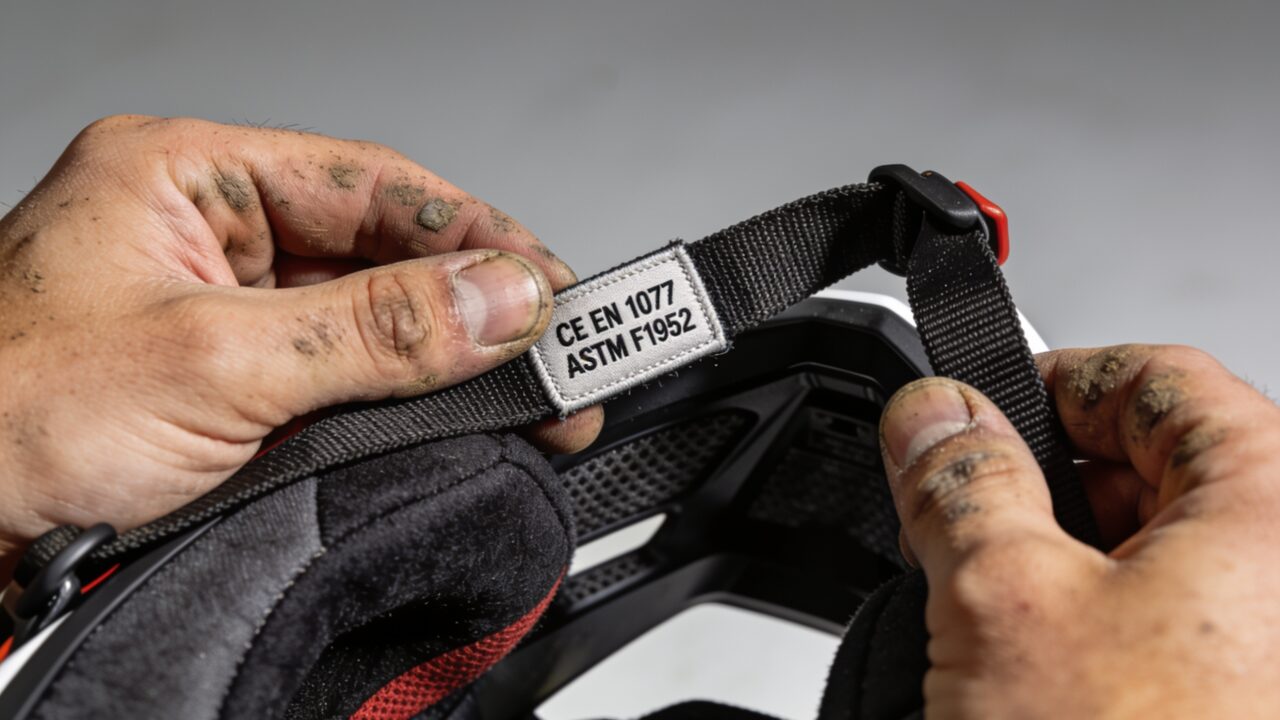
Those trials are run by accredited independent labs, not by the brand. That is the whole point of the system: nobody grades their own homework. Once a model passes, it gets a traceable certification number, and that number has to appear on a label sewn inside the shell. The guide on choosing a helmet covers the rest of the criteria, but this one comes before all of them.
ECE 22.06 against 22.05: what changed
ECE 22.06 has been phasing in since 2020. The main gain is coverage: it tests more shell zones than 22.05 did, including low points near the jaw and the back of the neck, areas the older standard simply did not look at. In a dirt bike crash, those zones often take the hit before the top of the skull does.
It also widens the range of impact speeds. The old standard validated a single crash configuration; the new one tries to represent the real spread of crashes, from fast glancing contacts to slower, blunter impacts.
Helmets still certified to 22.05 stay legal through the transition period, and a good 22.05 helmet that fits properly protects you better than a 22.06 that is a size too big. But if you are buying new today, there is no reason to settle for the older standard.
ECE, DOT, Snell: what you’re looking at
| Standard | Status | What it is worth to you in Europe |
|---|---|---|
| ECE 22.06 | Mandatory, verified by an accredited lab | The one that counts: without it, no supervised track |
| ECE 22.05 | Older version, end of transition | Still valid, but stop buying it new |
| DOT | US standard, different protocols | Does not replace ECE, even on a name brand |
| Snell | Voluntary certification, independent body | A bonus, never a substitute for ECE |
American and European protocols do not compare term for term. They measure different things in different ways. A helmet can carry both DOT and Snell and still be unusable in a European race paddock. The reverse holds too. Keep it simple: to ride here, you are looking for the ECE mark, and everything else is extra.
Finding and reading the label before you buy
- Push the cheek pad aside or lift the strap: the label is sewn in, rarely glued.
- Read the standard printed on it, then note the certification number next to it.
- Check that the label sits in the original liner, not stitched on or re-glued later.
- If a used helmet leaves you unsure, have that number checked with the certifying body.
- Then look inside the shell: pads present, not crushed, no old damp stains.
A missing label, an unreadable one, or one that has obviously been added should make you put the helmet back down. On online marketplaces that is the most reliable counterfeit signal you have, far more telling than the price or the quality of the paint. A tight budget is no excuse here either: the guide on gearing up on a budget shows where to save, and the helmet is not on that list.
What certification does not guarantee
It certifies a new helmet, in lab conditions, on a standardized headform. Three things escape it completely.
First, your head shape. A certified helmet that moves on your skull gives up a large share of its effectiveness, because the shell has to stay locked to the head through the impact. The guide on helmet sizing walks through the method; the principle fits in one sentence: it is the shape of the helmet, not just the size, that has to match yours.
Second, actual use. A certified street helmet is still a street helmet: shorter chin bar, ventilation designed around continuous airflow, no room for goggles. On a dirt bike you breathe hard, you ride slowly through dust, and you crash differently.
Third, how it works with the rest of your kit. If you wear a neck brace, the base of the helmet has to be able to contact it without loading your cervical spine.
FAQ
Is a DOT-certified helmet valid in Europe?
No. Europe requires ECE certification, and a helmet marked DOT only is not legally recognized, on the road or in organized competition. Plenty of helmets imported from the United States carry the American mark alone, including from well-known brands. Check the label before you order from abroad, not after the box arrives.
Should I replace a 22.05 helmet that is still in good shape?
Not urgently. As long as it is within its service life, has taken no impact, and its pads still hold your head firmly, it is doing its job. Move to 22.06 when you replace it naturally. A recent helmet that fits you well beats a new one bought in a rush in the wrong shell shape.
Do all certified brands protect the same?
They all clear the same minimum threshold, measured with the same protocol. Above that threshold, performance varies with shell materials, foam density and internal design. Certification tells you a helmet is acceptable, not that it is the best one. Beyond that, comfort and how firmly it holds your head stay the most useful criteria.
Find all the gear guides in the dirt bike gear section.
Editorial content. PiloteMX offers no on-site service, no parts or gear sales, no quotes and no bike repairs. Working on a bike and riding it carry risk: what you do with this guide is your own responsibility.