Beating Fog on Your Dirt Bike Goggles: What Actually Works
Contents
Fog forms when warm, humid air from your breath and sweat hits a colder lens. Anti-fog spray alone on a single lens will not get you through a session. What actually works is a dual-pane lens plus ventilation that clears moisture before it settles. Everything else is comfort around the edges.
What triggers the fog
Two moisture sources work against you: the air you breathe out, which rises from the helmet’s chin bar, and what you sweat off your forehead. That loaded air reaches the inner face of the lens, chilled by outside air, and condenses into fine droplets. Your vision goes milky in seconds.

The temperature gap does the rest. The colder it is outside and the hotter your face is, the faster the condensation. That is why the worst moment is often the start: you are already warm from pushing the bike around and you are still riding slowly.
Speed is your ally. Down a fast straight, airflow crosses the goggle and dries the lens. On a technical climb, in deep sand, sitting on the gate, that flow disappears exactly when you are producing the most heat. Which is why the goggle itself counts as much as the lens treatment.
Dual-pane lenses, the real answer
A dual-pane lens is two layers separated by an air gap. Same principle as a double-glazed window: the inner layer stays close to your face temperature, so moisture no longer finds a cold surface to settle on.
The difference against a treated single lens is obvious as soon as it turns cold or wet. It is the only solution that addresses the cause rather than the symptom, which is why riders who go out through winter use nothing else.
The tradeoff: it costs more, and the inner layer is delicate. It scratches easily and can delaminate if water works its way between the two panes. A dual-pane lens that has taken on water turns milky and cannot be repaired.
Treatments and sprays: what they actually do
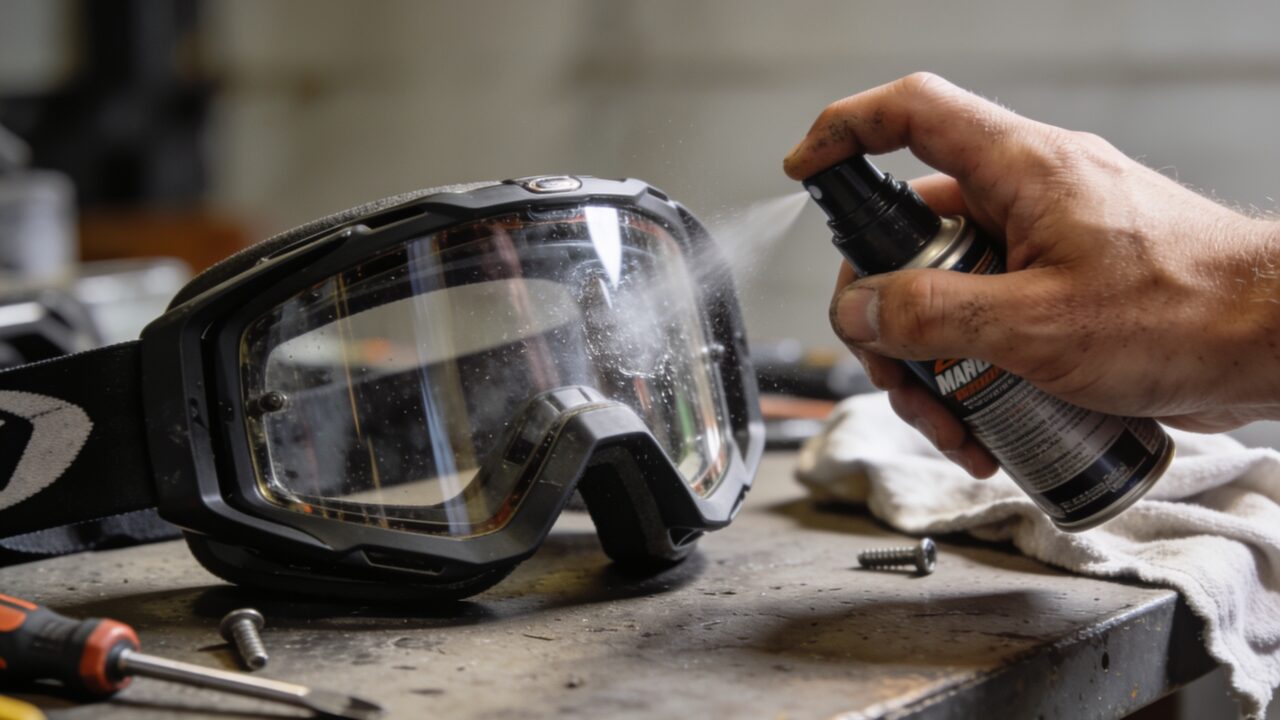
An anti-fog treatment does not stop condensation. It changes its shape. By lowering the surface tension of water, it spreads droplets into a continuous film, transparent instead of milky. The moisture is still there, you simply see through it.
That treatment wears off. Repeated cleaning, rubbing and mud strip it gradually, which is why sprays and wipes exist. Apply to a clean, dry lens, never to a surface still damp or dusty: the product bonds badly and you end up with the opposite of what you wanted.
Do not overdo it either. A thick coat leaves a haze that scatters light when you ride into the sun, which bothers you more than a bit of fog. A scuba or ski product does not transfer without checking, because some formulations attack coatings already on the lens.
Ventilation does half the work
A well-vented goggle clears humid air before it reaches the lens. Lower intakes let cool air in, upper outlets push warm air out. If the foam is soaked or the ports are packed with dried mud, the circuit stops working and no lens compensates for it.
Ventilation checkpoints
- To inspect
- upper and lower goggle ports, clear of dried mud
- Foam
- dry before you ride, never stored damp
- Nose
- exhaled air should exit downward, not toward the lens
- Helmet
- front vents open in cold weather
- When it matters most
- the start, slow climbs, sand, damp days
The neck tube is the usual culprit. Pulled up over the nose to stay warm, it sends every breath straight under the lens. Drop it below your chin and you solve half the fogging cases without buying anything. The full subject sits in the guide on rain and cold-weather gear, and your helmet vents matter too.
On track: what to do when it fogs
- Pull off the racing line and stop working: you stop producing heat.
- Lift the goggle off your face for a few seconds, without removing it, to pull air through.
- Drop the neck tube below your chin if you had it pulled up.
- Check the vent ports and clear dried mud with a finger, not with a cloth across the lens.
- If the inside is wet, blot it dry with a clean microfibre, dabbing rather than rubbing.
- Ride gently at first so airflow dries the lens, then pick the pace back up.
What makes it worse
Wiping the inside of a dual-pane lens with whatever is at hand is mistake number one. The inner layer is soft and scratches on the first grain of sand. Those scratches hold moisture and become permanent fog starters.
Storing a wet goggle in a closed bag comes right behind. The foam stays loaded with water, the lens hazes, and your next ride starts fogged. Air dry it, foam facing up, along with the rest of the routine described in the guide on gear maintenance.
Last habit to drop: stacking solutions. Anti-fog spray on a dual-pane lens adds nothing and can attack the inner layer. Pick one strategy and stay with it.
FAQ
Does a dual-pane lens eliminate fog completely?
It cuts it sharply, it does not eliminate it. In damp cold combined with hard effort, light condensation is still possible, especially when stopped. The difference is that it clears as soon as you pick up speed instead of settling in. If your dual-pane fogs permanently, look for water that has worked its way between the two panes.
Should I re-treat the lens before every ride?
No, not while the original treatment still works. The sign that it is fading is clear: fog forms as distinct droplets instead of an even film. Re-apply then, on a clean dry lens. Re-applying on principle every time builds up product, leaves a haze when you ride into low sun, and protects no better.
Why does it fog more on climbs than on straights?
Two effects stack up. You are working far harder, so you produce more heat and water vapour. And you are moving slower, so the airflow that normally crosses the goggle and dries the lens collapses. Deep sand and slow technical sections produce the same result for exactly the same reason.
Can I use scuba mask anti-fog?
Not without checking. Those formulations are not designed for the surface coatings on a motocross lens, and some of them dissolve those coatings outright. A product that behaves on dive mask glass does not necessarily behave on treated polycarbonate. Test it on a corner of a worn-out lens before putting any on the one you actually ride with.
More gear guidance in the gear section.
Editorial content. PiloteMX offers no on-site service, no parts or gear sales, no quotes and no bike repairs. Working on a bike and riding it carry risk: what you do with this guide is your own responsibility.