The Neck Brace: Protecting Your Neck Without Sacrificing Mobility
Contents
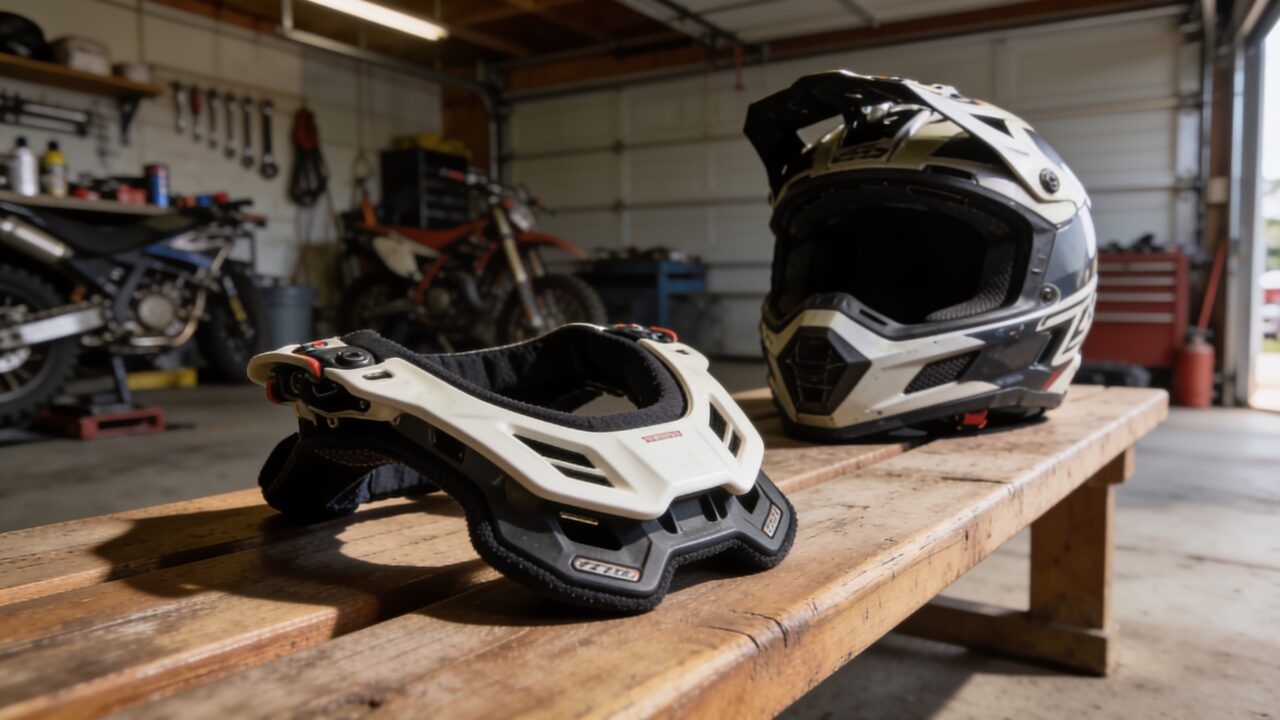
A dirt bike neck brace works as a mechanical stop. It limits extreme head movement in a violent crash — mainly forward flexion and axial compression — without blocking the rotation you need to read the track ahead. It lowers a risk. It does not remove it, and no honest rider treats it as insurance.
What a neck brace actually limits
In a crash, the body usually stops before the head does. The helmet keeps going. That lag is what puts the cervical spine in trouble: the neck travels past its normal range with nothing there to catch it.
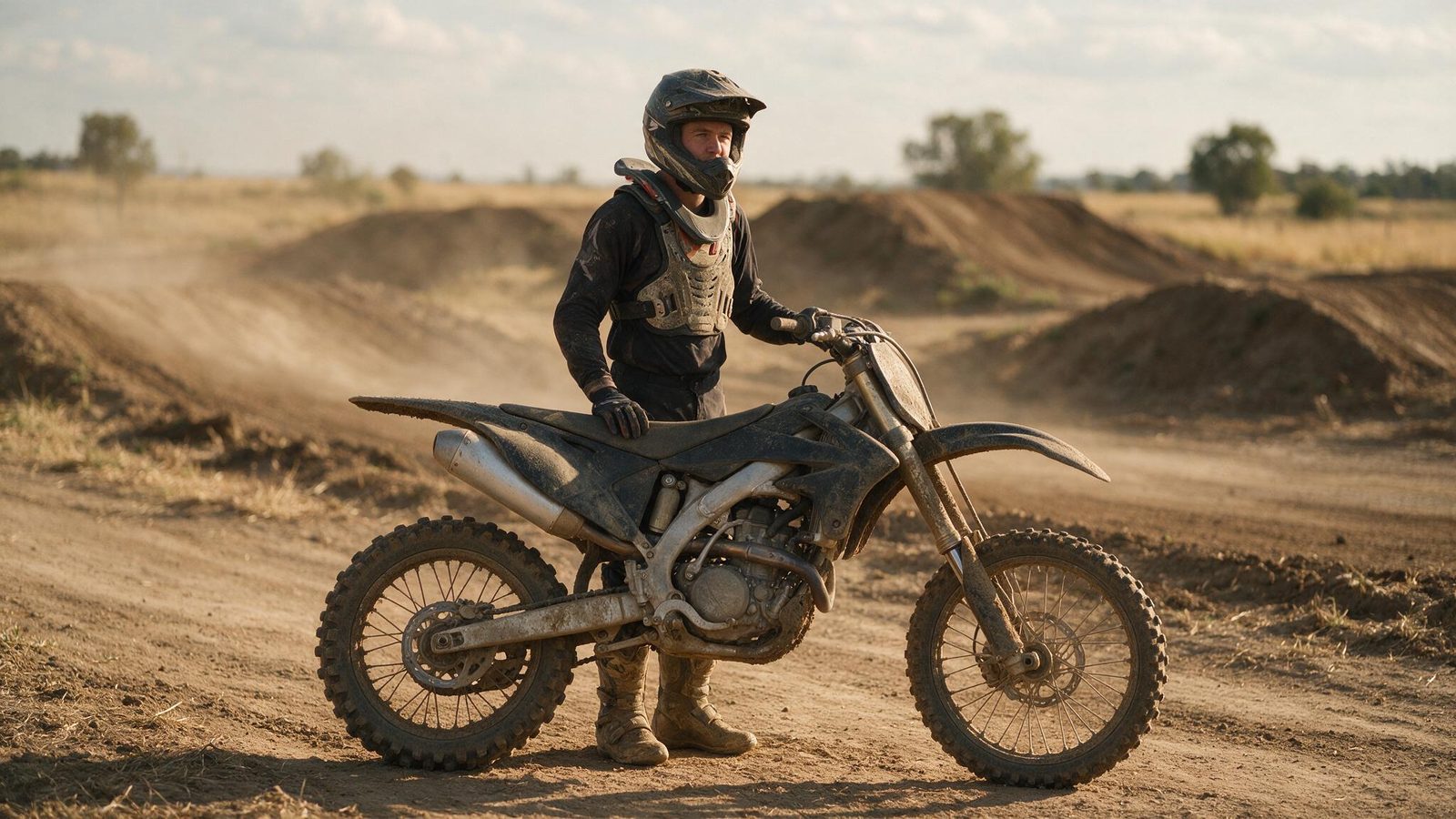
The brace steps in at that exact moment, not before. While you turn your head to spot a corner exit, it does nothing at all. It only becomes an active piece of gear in the last degrees of travel, when the head goes too far or drives down toward the shoulders.
That detail matters more than most riders assume. Looking well ahead is the foundation of riding, as covered in the guide on cornering position. A brace that stops you turning your head properly is a badly chosen brace, not a protective one.
The stop principle, in plain terms
Picture a contact point between the helmet and the shoulders, or between the helmet and the chest protector. When the head tips too far, the helmet shell meets the brace, and the movement ends there instead of in your neck.
Not every brace handles that contact the same way. Some rely on outright stiffness. Others are built to deform or separate in a controlled way under heavy load, dissipating energy rather than routing it somewhere else in the body. Neither approach makes the other pointless — they answer different priorities.
| Criterion | Rigid one-piece structure | Controlled deformation or release |
|---|---|---|
| Principle | Blocks travel through shell stiffness | Takes the load, then gives way as designed |
| Feel while riding | Firm contact once the head goes far | Firm too, but the whole assembly works more |
| After a heavy crash | Inspection required, cracks can be subtle | Usually a replacement, the part did its job |
| Watch out for | Load transferred to the collarbones | Check spare part availability before buying |
Helmet, chest protector and brace are one purchase
You never judge a brace on its own on a shop shelf. It works against your helmet shell and sits over or under your chest protector. Swap any one of the three and the whole balance shifts.
A helmet with a deep, low-cut shell leaves less room and can create permanent contact that turns unbearable after twenty minutes. A bulky chest protector does the opposite: it can lift the brace and rob it of its contact point. Before ordering anything, revisit the shell shape criteria in the guide to choosing a helmet — compatibility is usually decided there.
It is also real money. If you are building your kit piece by piece, the priority order laid out in the guide on gearing up on a budget beats putting a premium brace on top of a tired helmet.
Fitting it, step by step
A proper fitting session takes fifteen minutes and prevents the most expensive mistake there is: buying a size that only works while you sit in a chair.
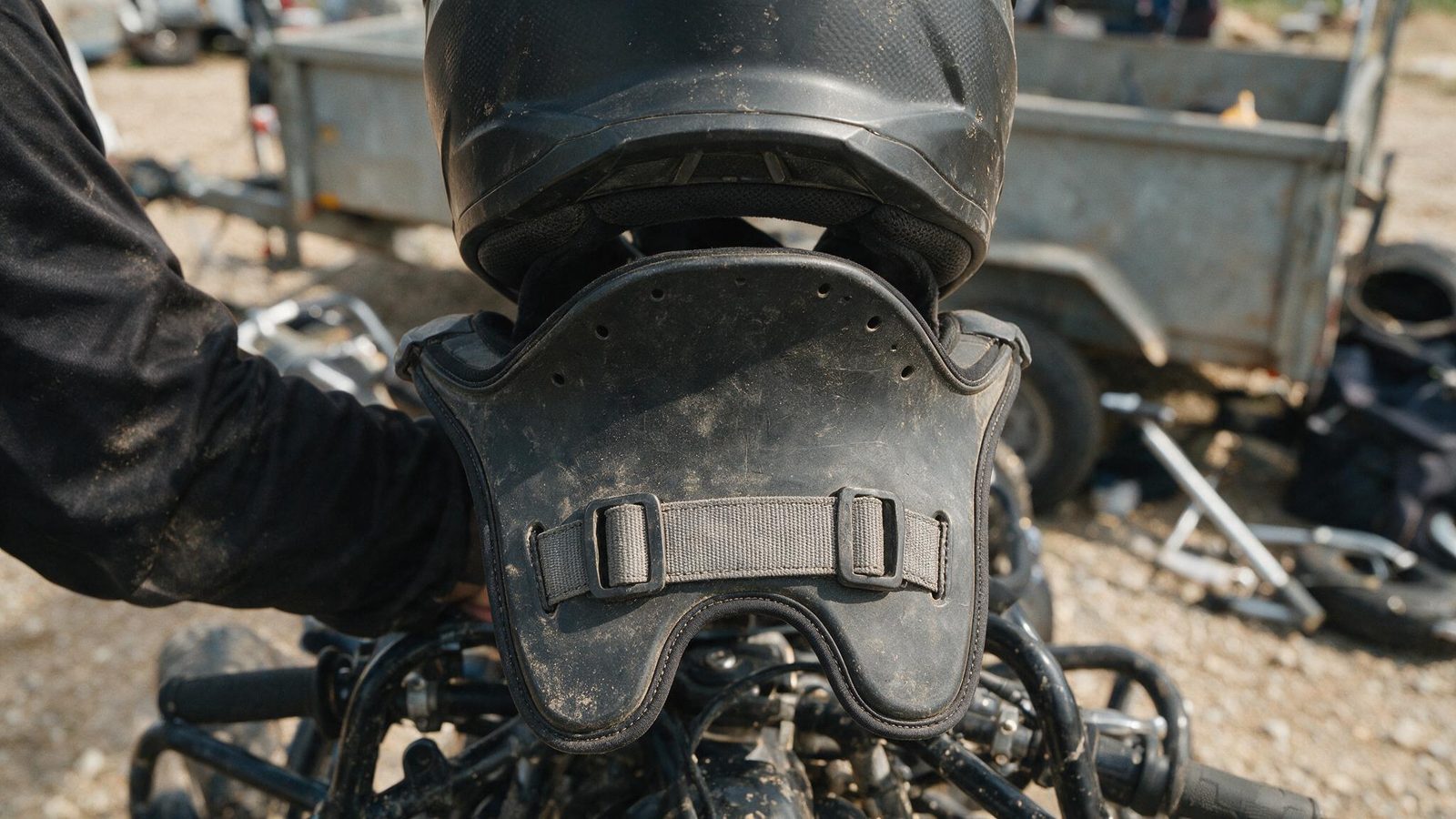
- Put on your base layer and chest protector first, exactly as you would on a ride day.
- Fit the brace, close it, then put the helmet on over it — never the other way round.
- Look straight ahead. The brace should not touch the helmet at all in that position.
- Turn your head left, then right, until you can see your own shoulder. Contact should stay light, with no hard spot.
- Lean into your riding stance, arms out toward an imaginary handlebar. Wrong sizes show up right here.
- Keep the whole setup on for ten minutes. A pressure point you feel in the shop becomes unbearable on lap two.
Stuck between two sizes? Decide in the riding position, not standing upright. Most riders end up too big because they try everything with a straight back.
What it does not promise
How well braces work in the real world is still argued over. Some research shows a clear benefit against specific injury mechanisms; other work points to limits depending on impact direction, and to load pushed onto the shoulders and collarbones instead.
None of that says skip it. It says do not lean on it. Your technique, how hard you push, track conditions and how tired you are all weigh on neck risk at least as much as the carbon shell sitting on your shoulders.
Matching the choice to how you ride
Racing and rough tracks
High speed, blown landings, traffic — the whole nature of a crash changes. In that setting the brace belongs in the kit alongside your knee braces, and plenty of race organizers actively push riders toward one.
Casual trail riding
Riding slowly protects nobody by itself. Silly low-speed crashes over a root or a rut happen too. The question is never your skill level; it is how high and how fast your head can travel.
Young riders
Kid-specific models exist in dedicated sizes, and a downsized adult brace is never a substitute. The selection logic matches what is covered in the guide on gearing up a kid: protection follows body shape, not the age printed on the label.
Whatever you ride, the brace belongs in the routine described for gear maintenance — washing the foam, checking the straps, inspecting the shell for cracks.
FAQ
Is a neck brace mandatory for racing?
It depends on the federation, the class, and sometimes the individual event. Some require one, others only recommend it. Check the supplementary regulations with the organizer before you enter rather than trusting paddock talk. Requirements for youth classes are often stricter than for adults.
Does a brace really stop you looking behind?
A well-fitted model lets you turn far enough to read the track and check a rider closing in. If you hit a hard stop before you can see your own shoulder, that is a sizing, adjustment, or helmet compatibility problem, not something you have to accept.
Do I have to replace it after a crash?
Yes, as soon as it has taken a solid hit, shows deformation, a crack, or unusual play in a joint. On models built to give way in a controlled fashion, the part has already done its job and will not do it twice. When in doubt, send photos to the manufacturer and ask.
Will it work with any chest protector?
No. Some chest protectors are designed to take a brace and others are not, and stacking the two can either lift the stop out of position or create a hard point on your collarbones. Always try the exact combination you will ride in, helmet included, before you pay.
More gear guidance in the gear section.
Editorial content. PiloteMX offers no on-site service, no parts or gear sales, no quotes and no bike repairs. Working on a bike and riding it carry risk: what you do with this guide is your own responsibility.