Clutch Lever Free Play: The Adjustment That Prevents Slipping
Contents
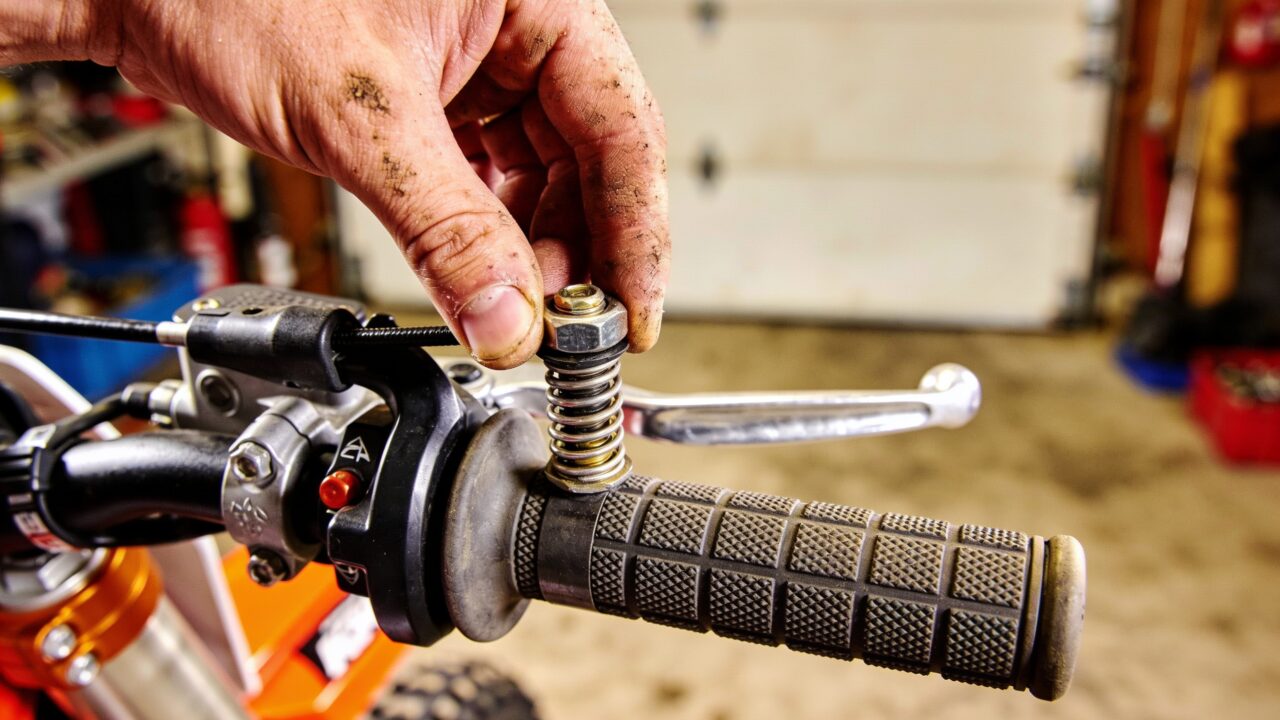
Clutch lever free play is the slack you feel before the lever actually starts pulling the plates apart. On a dirt bike it should sit between 2 and 5mm before resistance kicks in. Too little and the clutch slips constantly without you noticing. Too much and it never disengages cleanly. The setting drifts on its own as parts wear.
Why the free play has to be there
The way the clutch works comes down to springs clamping a stack of plates together. Free play is the lever travel that happens before the mechanism starts separating that stack. Put another way: as long as you are inside the free play, the clutch should be fully engaged.
Take that slack away and the plates sit marginally apart all the time. The slip that follows makes no noise and leaves no obvious sign, but it eats friction material far faster than normal. Most riders find out the day the clutch gives up halfway up a hill, not before.
The opposite mistake is less sneaky and just as annoying. Too much play delays the moment disengagement actually begins: you pull, nothing happens for a while, and the shift goes in badly. On technical terrain, where you work the lever on every drive out of a corner, you feel it straight away.
Check it before you touch anything
The check is quick and done cold, bike on the stand, bars straight. Get in the habit of measuring at the same point on the lever, otherwise you are comparing numbers that do not match.
- Take the lever with your fingertips and pull it gently towards you, no force.
- Find the exact moment resistance appears — that is the end of the free play.
- Compare that travel with the figure in your bike’s workshop manual; the usual window runs from 2 to 5mm depending on the model.
- Release and repeat several times. Play that changes from one pull to the next means the cable is snagging inside its housing.
- Turn the bars lock to lock, then measure again at the same spot.
Write down what you find. The way it drifts from one session to the next tells you more than any single reading.
Adjusting it: two systems, two jobs
Cable clutch
Adjustment runs through a barrel adjuster at the lever, or a nut at the far end of the cable near the clutch cover. On most bikes the lever adjuster handles small corrections and the engine-end nut takes over once the barrel runs out of thread.
Loosen the locknut, adjust, tighten it back, then check at the lever again. The job itself is simple; what matters is rechecking after the locknut is torqued, because tightening it often shifts the setting you just gained.
Hydraulic clutch
No barrel to wind here — the circuit takes up wear on its own. What you watch instead is fluid level in the reservoir and air in the line. A spongy lever that sinks softly and only disengages near the end of its travel almost always means air in the system, which means bleeding it.
Some hydraulic levers offer a reach adjuster on the bar. That changes the distance between lever and grip, not internal free play. Do not mix the two up: reach adjustment will never fix a slipping clutch.
Reading the lever: what each symptom means
The lever talks long before the bill arrives. These are the cases that turn up most often in the paddock.
| What you feel | Likely cause | What to do |
|---|---|---|
| Lever bites from the very start of its travel | Not enough play, plates never fully clamped | Give some play back, then watch plate wear |
| Lever pulled to the bar, bike still creeps | Too much play, or plates at the end of their life | Redo the adjustment; if nothing changes, the cover comes off |
| Heavy lever, effort climbing through the session | Dry cable, pinched or deformed housing | Lubricate or replace the cable, check its routing |
| Soft lever, spongy feel | Air in the hydraulic line | Bleed the system, check level and seals |
| Different play at every ride | Cable fraying inside its housing | Replace it before it snaps |
The cable is half the story
On a cable setup, the adjuster is only the visible part. A dry cable stiffens, lever effort climbs, and you end up pulling harder than you should — which hides free play that has quietly closed up. Regular cable maintenance buys more comfort than a perfectly measured adjustment on a dry cable.
A housing pinched between the fork clamp and a wiring loom creates a local tight spot: play goes marginal over one section of steering and stays fine everywhere else. No amount of adjusting fixes that.
Cables also wear from the inside. Strands break one at a time, play grows for no visible reason, then the thing snaps, usually mid-drive. Play that moves between rides when you have not touched anything is your replacement signal. Better done in the garage than at the edge of the track.
The mistakes you see most often
First one: setting play to the bare minimum to gain precision. The lever does respond earlier, and the clutch slips permanently. The plates pay for it, and breaking in a fresh engine goes badly when the transmission is already slipping.
Second: covering up growing play by simply pulling harder. Disengagement stays incomplete, shifts go in under load, and the gearbox takes hits it has no reason to take.
Third: treating adjustment as a once-a-year job. A new cable stretches quickly in its first hours. On a bike that gets used hard, free play deserves the same attention as chain tension.
One last thing: a clutch that still slips after a clean adjustment is not a free play problem. Worn plates, tired springs, the wrong oil — the cover has to come off, and behaviour differs noticeably between a 2-stroke and a 4-stroke. Without the tools and your bike’s manual, hand the job to a mechanic.
FAQ
How often should I check clutch free play?
A quick look before every ride is the habit to build: cables stretch naturally with use and free play closes up without warning. A full adjustment only becomes necessary once travel drifts outside the window given in your bike’s workshop manual. On a hydraulic clutch you watch fluid level and lever feel instead of measuring travel.
Why does my clutch lever feel mushier and mushier?
On a cable clutch it is progressive cable stretch: play grows, the lever feels soft, and disengagement happens later than it used to. On a hydraulic clutch that spongy feel points to air in the line, sometimes to a leaking master cylinder seal. There, bleeding comes first, before any other adjustment.
Can bad free play damage other parts?
Yes, in both directions. Too little play keeps the plates slipping: they heat up, glaze over and fail early. Too much leaves disengagement incomplete, so shifts go in under load and the gearbox carries stress it should never see. Either way, the part that breaks costs far more than the time spent adjusting.
The rest of the engine and transmission guides live in the mechanics section.
Editorial content. PiloteMX offers no on-site service, no parts or gear sales, no quotes and no bike repairs. Working on a bike and riding it carry risk: what you do with this guide is your own responsibility.