Breaking In a New Dirt Bike Engine: The First Hours Matter
Contents
Breaking in a new dirt bike engine means varying the revs constantly and never reaching for the top end during the first hours of running, usually one to five depending on the manufacturer. Internal parts need that window to seat against each other before they can take full load. The early oil change finishes the job.
What actually happens inside the engine
An engine leaves the factory with tight tolerances, not with perfect surfaces. Look closely at a cylinder wall and you find a deliberately rough finish, and new rings whose edges do not yet touch everywhere. Break-in is the controlled friction that wears those high spots down until the two parts sit flat against each other across the whole face.
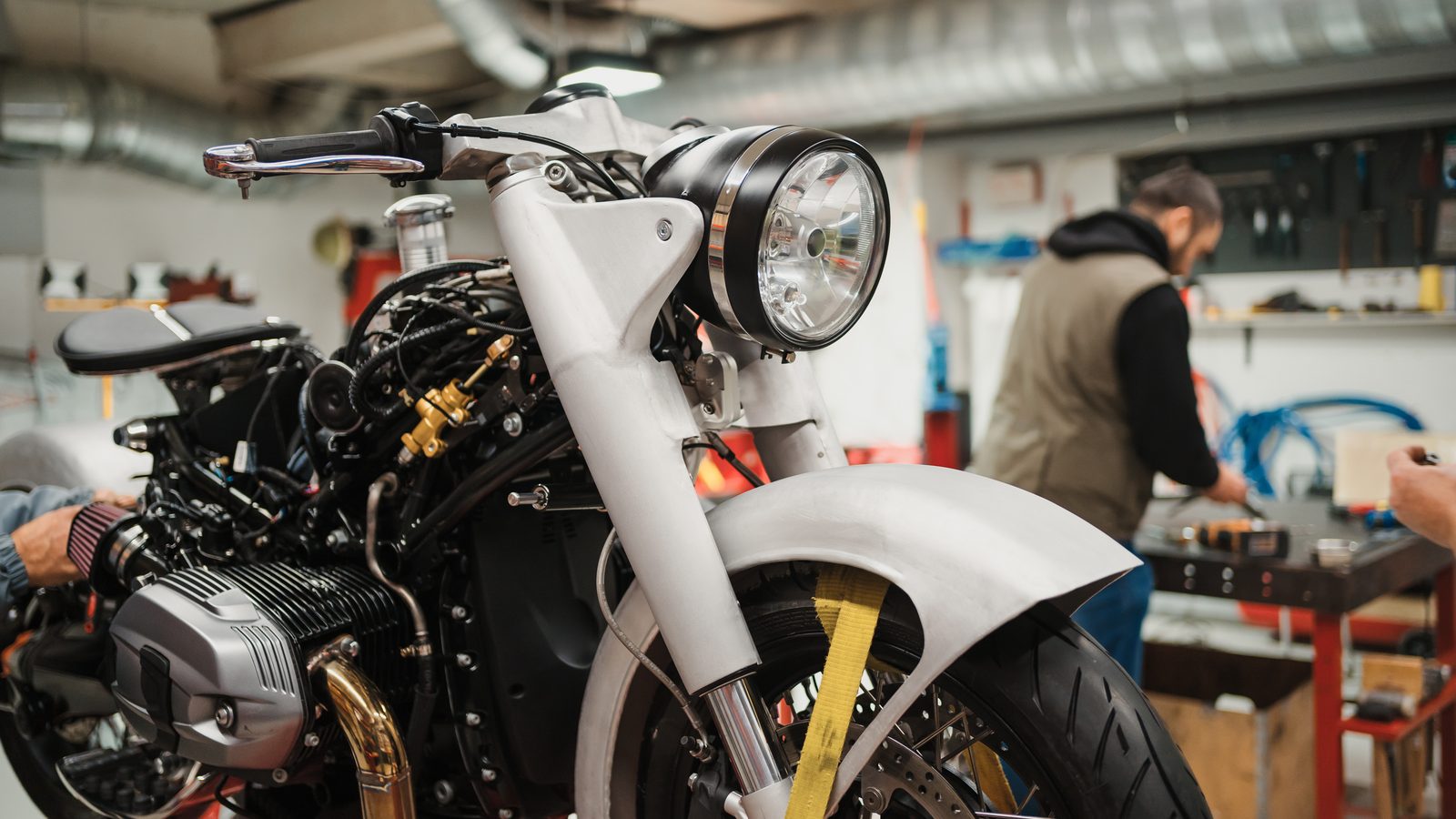
Until that contact exists, part of the combustion pressure slips past the rings. Wind the engine out at that stage and the load piles onto a few bearing points instead of spreading. That is where scoring and uneven wear on the piston and rings start.
The effect shows up hardest on a two-stroke, where the piston works straight against the cylinder and crosses the ports every revolution. A four-stroke has more parts involved, valve train and crank bearings first among them, but the logic is identical. If you want the two layouts side by side, the 2-stroke vs 4-stroke guide lays them out.
The method: vary it, don’t baby it
Most riders break an engine in too gently. Idling for an hour breaks in nothing at all: with no combustion pressure the rings never press against the wall, and the bore glazes instead. What you want is variation. Load, then engine braking, then load again.
- Start it and let it come up to temperature without touching the throttle, so the oil reaches everything.
- Ride flowing, flat ground and change gear often, never sitting at one steady rpm.
- Alternate: a few seconds of real load pulling up through the revs, then close the throttle completely and let the engine brake.
- Shut it down now and then to cool, especially on slow ground where the cooling system gets little airflow.
- Widen the rev range you use session by session, without ever holding it wide open, up to the duration your owner’s manual gives.
- Change the oil as soon as the period ends, before the next ride.
No generic protocol replaces the manual. Some manufacturers split break-in hour by hour with defined rpm steps, others just give a duration. The number that counts is the one in your service manual, not the one on a forum.
Two-stroke and four-stroke: what differs here
| Watch point | Two-stroke | Four-stroke |
|---|---|---|
| Lubrication | Through the premix: use the ratio specified for a new engine, sometimes different from normal running | Dedicated oil in the case: grade and level are what matter |
| Most sensitive part | Rings and cylinder wall | Valve train and bearings, on top of the top end |
| Warning sign | Kick starter going soft, smoke changing character | New valve train noise, oil level dropping |
| Once it’s over | Gearbox oil change and a jetting check | Engine oil, filter, valve clearance check |
On a two-stroke, jetting matters twice as much during this phase: a lean mix pushes temperature up at exactly the wrong moment. If altitude or season changed between buying the bike and its first ride, read up on carburetor jetting before you ride, not after.
The mistakes that cost real money
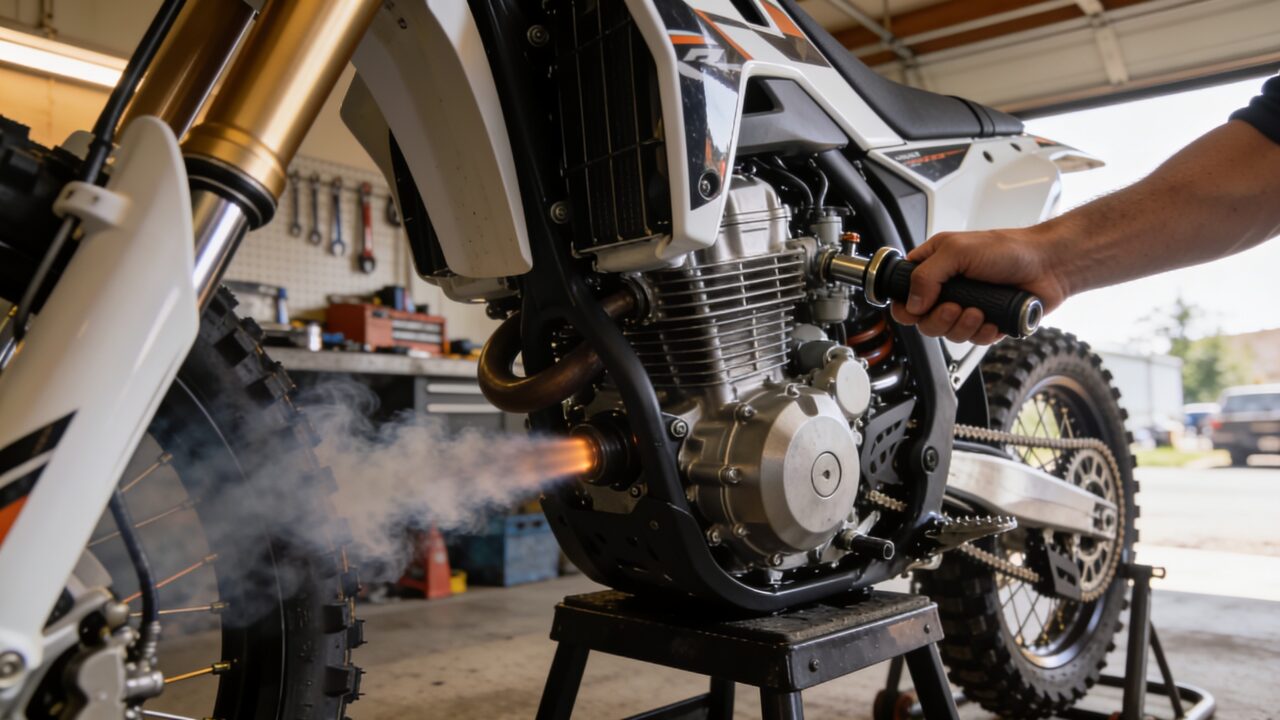
Warming it up on the stand
Ten minutes idling in the paddock has never broken in an engine. With no load, cylinder pressure stays low and the rings never press out; on a liquid-cooled motor with no air through the radiator, temperature climbs for nothing. Warm it by riding slowly instead. It works better and takes less time.

The full-throttle test lap
The temptation is real on a new bike. One hard pull to the limiter, on an engine whose rings have not found their place yet, is enough to mark the bore. It does not happen every time, but when it does you pay for it in compression much later, without ever connecting the two.
The break-in that never ends
The opposite mistake exists too: riding for months while keeping the engine down low. The rings end up glazing the wall instead of bedding into it, and the engine never gives you what it has. Break-in has an end point, and the manual states it.
The oil change that closes it out
This is the step riders skip most, and it is the most useful one. Break-in oil has collected the metal particles torn off while the parts were seating. Leaving them in circulation until the normal service interval means running lapping paste through the bearings.
Change the oil at the interval given for a new engine, not the everyday one; the two are rarely the same. Swap the filter at the same time on a four-stroke. And look at what comes out: fine bright glitter is unremarkable at this stage, chips you can see with the naked eye are not. Full procedure is in the oil change guide.
If you are unsure about the top end afterwards, a compression test gives you a measured answer in a few minutes. Do it while the bike is still new: you end up with a reference figure to compare against two seasons from now, which beats guessing.
What about a rebuilt engine?
Same rules. A fresh top end dropped into an already run-in bottom end needs the same treatment, because the new parts are precisely the ones that have to seat. Break-in follows the part, not the bike. A rebored or replated cylinder starts from zero, and so does a straight ring swap.
One honest caveat: if someone else opened the engine, you do not know what the internal clearances are. Ask the shop for its break-in protocol and the measurements it took at assembly. Nobody can hand you those figures remotely, and inventing them would be gambling with your engine.
FAQ
How long does dirt bike engine break-in take?
Usually between one and five hours of running depending on the manufacturer and model, sometimes split into rpm steps hour by hour in the manual. It is a running time, not a distance. Take the figure from your own service manual: between a small two-stroke and a big four-stroke, the recommendations have nothing in common.
Can I break the engine in on a track?
Yes, as long as you ride differently than usual: no holeshot starts, no jumps under full load, no long straight held wide open. A flowing track with linked corners varies the revs on its own, which is exactly what you want. A connecting trail or open ground does the job just as well.
The engine uses a little oil during break-in. Is that a problem?
A slight drop in level on a new four-stroke is nothing to worry about while the rings are still settling. What should worry you is consumption that does not fall off once the break-in period ends, or blue smoke when you get back on the throttle. If that happens, stop riding and have the top end checked.
More on how these engines work in the mechanics section.
Editorial content. PiloteMX offers no on-site service, no parts or gear sales, no quotes and no bike repairs. Working on a bike and riding it carry risk: what you do with this guide is your own responsibility.