How the Gearbox Works: Understanding the Gear Ratios
Contents
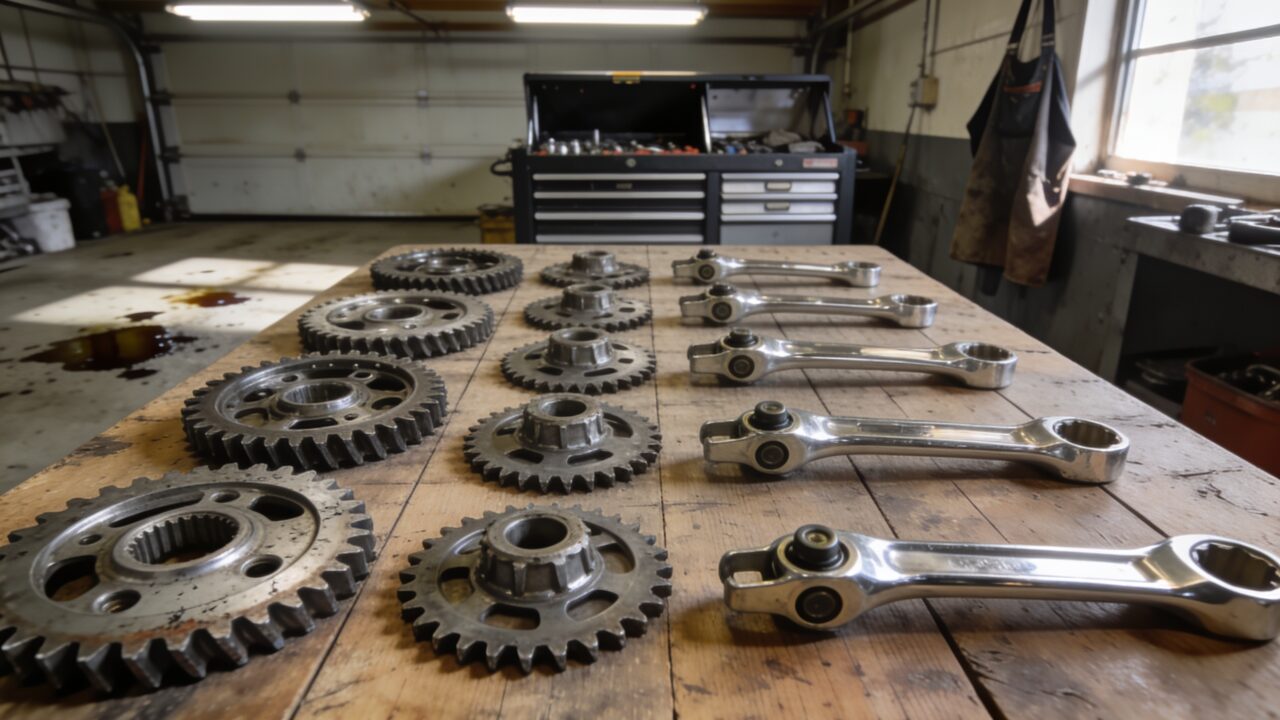
A dirt bike gearbox runs engine torque through pairs of gears of different sizes. Each pair is a tradeoff: a small driving gear against a large driven gear gives acceleration, the reverse gives speed. The foot lever turns a drum that slides shift forks, engaging one pair at a time, always in sequence.
How the reduction works
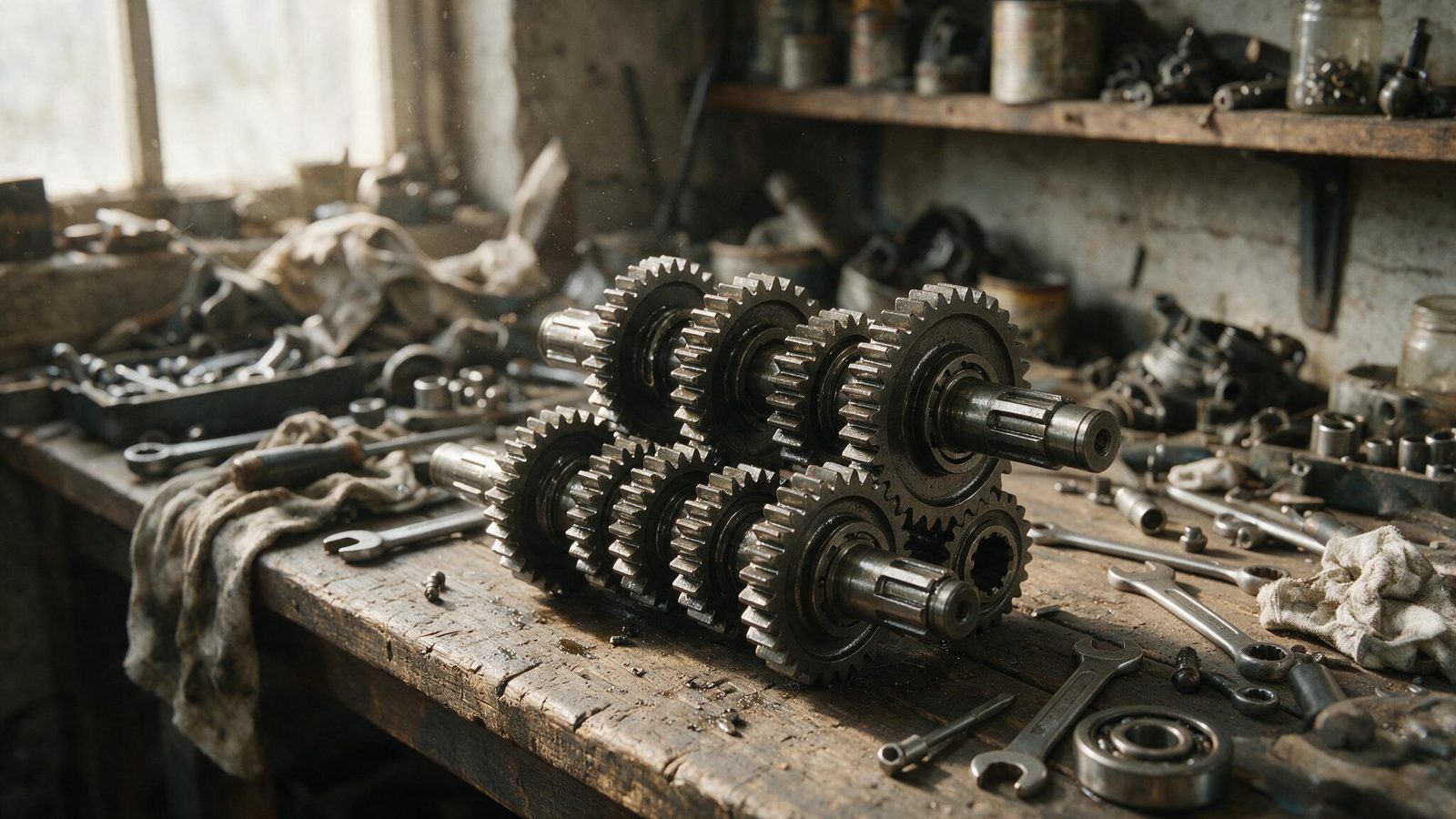
Two shafts spin constantly inside the case, the input shaft on the clutch side and the output shaft on the chain side. Each carries one gear per ratio, and the gears stay meshed in pairs at all times. What changes when you shift is not which gears mesh — it is which gear gets locked to its shaft.
The tooth count between the two gears of a pair sets the reduction. In first, the driving gear is small and the driven gear large: torque gets multiplied hard, and top speed in that gear stays low. That is what drags you out of a rut or off the gate.
In top gear the relationship flips. The driver becomes the big one, the driven the small one, and the bike covers ground where there is room to. In between, the spacing the manufacturer chose decides how big the gaps are, and therefore where the engine lands in its power band after every shift. A two-stroke and a four-stroke do not react the same way to that spacing, which the 2-stroke vs 4-stroke guide gets into.
From lever to gear: what moves under your boot
Lifting the shifter rotates a drum by one index. The drum carries cam-shaped tracks; pins attached to the shift forks ride in those tracks. Each fork pushes a sliding gear along its shaft until its dogs drop into the holes of the neighbouring gear. That is engagement.
Those dogs are square teeth with no synchromesh, unlike a car gearbox. They either go in cleanly or they do not go in at all. That is why the technique matters: they need an instant with no load on them to find their slots, and giving them that instant is exactly the job of the clutch.
The sequence is fixed by the shape of the drum. You cannot jump from first to fourth in one movement: every index advances one ratio, and neutral is an index like any other, wedged between first and second.
Shifting cleanly, step by step
- Pick the gear before the obstacle, not inside it. A panic downshift halfway through a rut always arrives too late.
- Close the throttle and pull the clutch as one movement, not one after the other.
- Push the lever through a full index without hesitating mid-stroke. A half shift leaves the dogs resting on each other.
- Let the clutch back out progressively as you reopen the throttle, so load returns only once the gear is home.
- On downshifts, blip the throttle while the clutch is in. The revs come up and the rear wheel does not lock on release.
- Come down through the gears one at a time, never several at once at high revs.
Clutchless upshifting exists, and plenty of fast riders do it under full load. It works because closing the throttle unloads the dogs for a moment. Done badly, it hammers them. Decide for yourself what you are willing to wear out.
Matching gears to the ground
| Terrain | Gear choice | What it buys you |
|---|---|---|
| Sand and loose ground | Shorter gear, engine high in its range | Continuous drive, less chance of digging in when you reopen |
| Hard pack and flowing tracks | Taller gear, engine mid-range | Smoother delivery, less rear wheel spin |
| Broken uphill | The gear taken before the climb, never during | No break in drive at the moment you cannot afford one |
| Open straight | Tall gear, early upshift | Speed without screaming the engine for nothing |
Running too tall on slow ground is the most common mistake: the engine lugs at low speed under heavy load, and it heats up with no air moving through the radiator. If it bogs hard as you reopen, check jetting before blaming the gearbox — a lean mixture feels exactly the same from the seat.
Holding a short gear without stalling or spinning up takes coordination between the throttle hand and the left lever. That is the subject of the throttle and clutch control guide, and it separates riders who put up with their gear spacing from riders who use it.
Spotting a gearbox problem
A gear popping out under load means rounded dogs or a bent fork. Growing resistance to engaging one specific gear, always the same one, points at the same area. A new metallic noise on the shift, different from the usual clunk, is worth stopping for.
Rule out the simple stuff first. Clutch free play that never fully disengages makes every shift stiff and forces the dogs each time: that is a healthy gearbox with a sick lever. Tired transmission oil also makes shifts notchy, especially when cold, and the oil change guide covers the interval to keep.
The rest happens inside. Fork clearances, the condition of the drum tracks and dog height cannot be deduced from a symptom — they get measured with a gauge and the service manual open alongside. Going to a professional here is not caution for its own sake. It is the only way to know what is still good inside that case.
FAQ
Why does my gearbox pop out of gear under acceleration?
Almost always rounded dogs, worn down by shifts taken under load, that no longer hold engagement. A slightly bent shift fork produces the same effect. No external adjustment fixes it, and riding on makes it worse every session. The case has to be opened and the parts measured.
Can I shift straight from first to third?
No. The shift drum advances one index per movement of the lever, so one ratio at a time. You can stack two quick lever movements with the clutch in, but you still pass through the middle gear. Neutral counts as an index of its own, sitting between first and second.
Do I always have to use the clutch to shift?
While you are learning, yes, every time. Pulling the clutch unloads the dogs and gives them time to engage. Experienced riders often upshift on a throttle chop alone, which works when the movement is crisp and punishes the gearbox when it is not. On downshifts under load, the clutch stays the rule.
How many gears does a dirt bike have?
Generally between four and six, depending on model and displacement. An engine with wide, flat torque gets by with fewer ratios; a peakier engine needs more of them to stay in its useful zone. Final drive, set by the countershaft sprocket and rear sprocket, then shifts how the whole spread feels.
More transmission topics in the mechanics section.
Editorial content. PiloteMX offers no on-site service, no parts or gear sales, no quotes and no bike repairs. Working on a bike and riding it carry risk: what you do with this guide is your own responsibility.