Landing a Jump on a Dirt Bike: Absorbing Without Getting Caught Out
Contents
A good landing is decided before impact: you read the slope from the top of the arc, set the bike’s attitude to match it, and let your legs absorb the hit with arms and legs slightly bent, never locked. Most bad landings come from a body that discovers the ground instead of anticipating it.
Read the slope before you get there
The read happens at the top of the arc, not when the ground is rushing up. As soon as the wheels are off, your eyes go to the landing zone: you judge the slope, you see whether it’s been dug out, and you adjust your attitude while you still have time. Waiting until you’re close is reacting instead of anticipating — and in the air, reacting always arrives late.
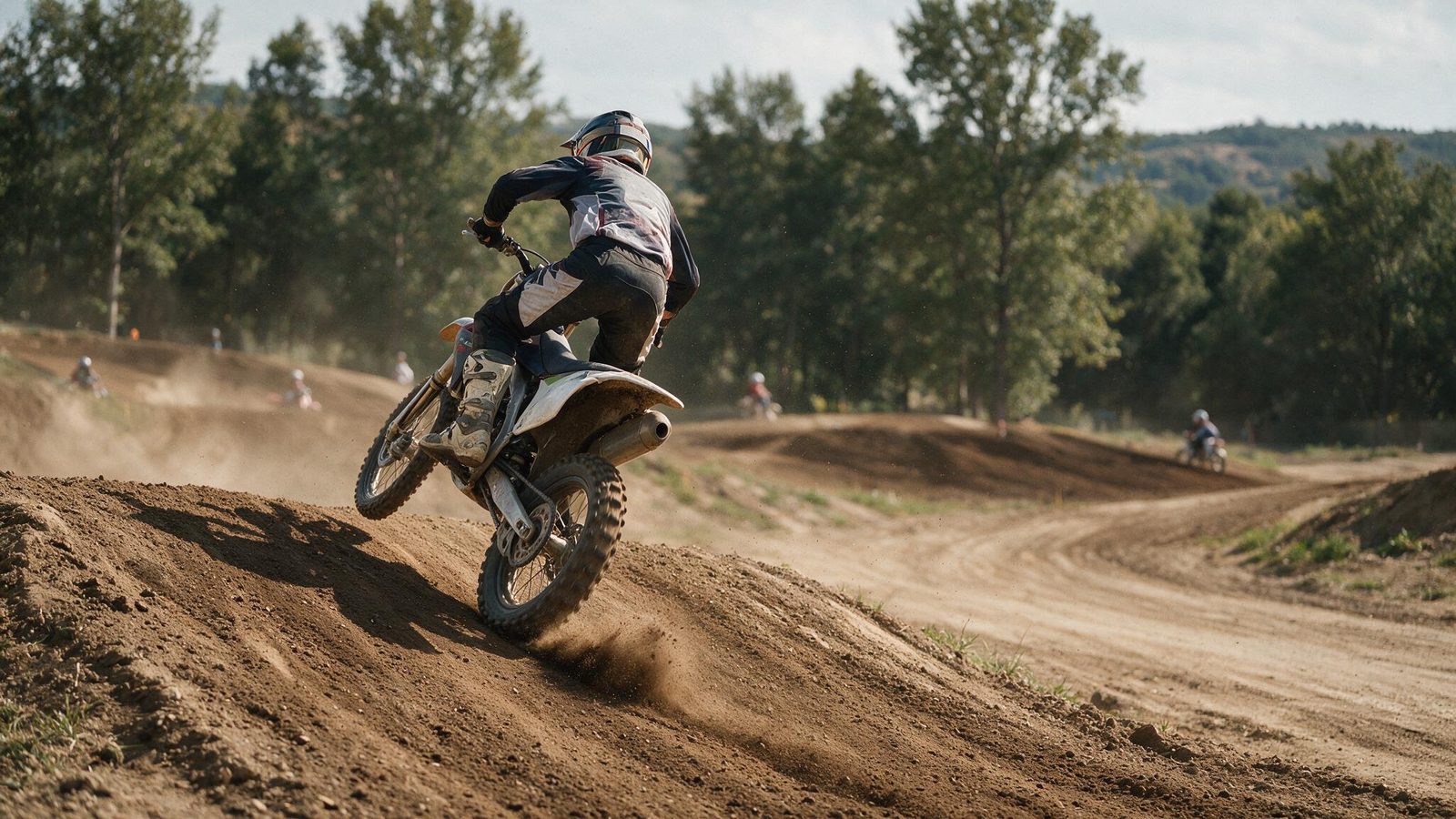
That reflex is built alongside the takeoff, as covered in the guide on how to jump. A rider who leaves the face without knowing where he’s coming down has nothing to prepare. He just takes what he gets.
Landings also change during a session. A clean downslope in the morning can be dug out by late afternoon, with a step right where you put the wheels. Look at the zone between laps, not only on your first pass.
The three families of landing
| Landing type | Attitude to aim for at impact | What saves you |
|---|---|---|
| Steep downslope | Bike angled with the slope, rear touching slightly first | The slope absorbs part of the hit for you |
| Flat landing off a small jump | Bike almost level, both wheels together | The low height leaves you a margin for error |
| Flat landing off a long jump | Level, without a single extra degree | Nothing. Your legs do the entire job |
That last row is the one that sends riders to the physio. A flat landing after a long flight forgives nothing: every extra degree of angle goes straight into the suspension, then into your back. On that kind of obstacle the real decision gets made before takeoff — either you can absorb it, or you sit this one out.
The absorption move
Your legs are the first shock absorber, ahead of the suspension. They need to be bent before impact so they can fold further at touchdown. A locked leg has no travel left: the energy has nowhere to go, so it runs up your spine.
Arms work the same way — semi-bent, neither stiff nor slack. Locked arms send the hit into your shoulders and rip the bars out of your hands if the bike arrives slightly crossed up. Your eyes stay far ahead, on the line after the landing. A rider staring at the point of impact stiffens up, which is the exact opposite of what a landing needs.
Key points
- Legs
- already bent before contact, never locked
- Arms
- semi-bent, elbows out
- Eyes
- on the line after the landing, not on the ground
- Brakes and throttle
- nothing until the suspension has finished its job
- Warning sign
- a jolt running up into your back or wrists
When the landing doesn’t go to plan
Nose high
The rear touches well before the front on terrain that didn’t call for it. Stay off the brakes. Let the front wheel drop on its own with your weight slightly back. A stab of brake right there pitches the front down hard, and you go from a manageable problem to a crash.
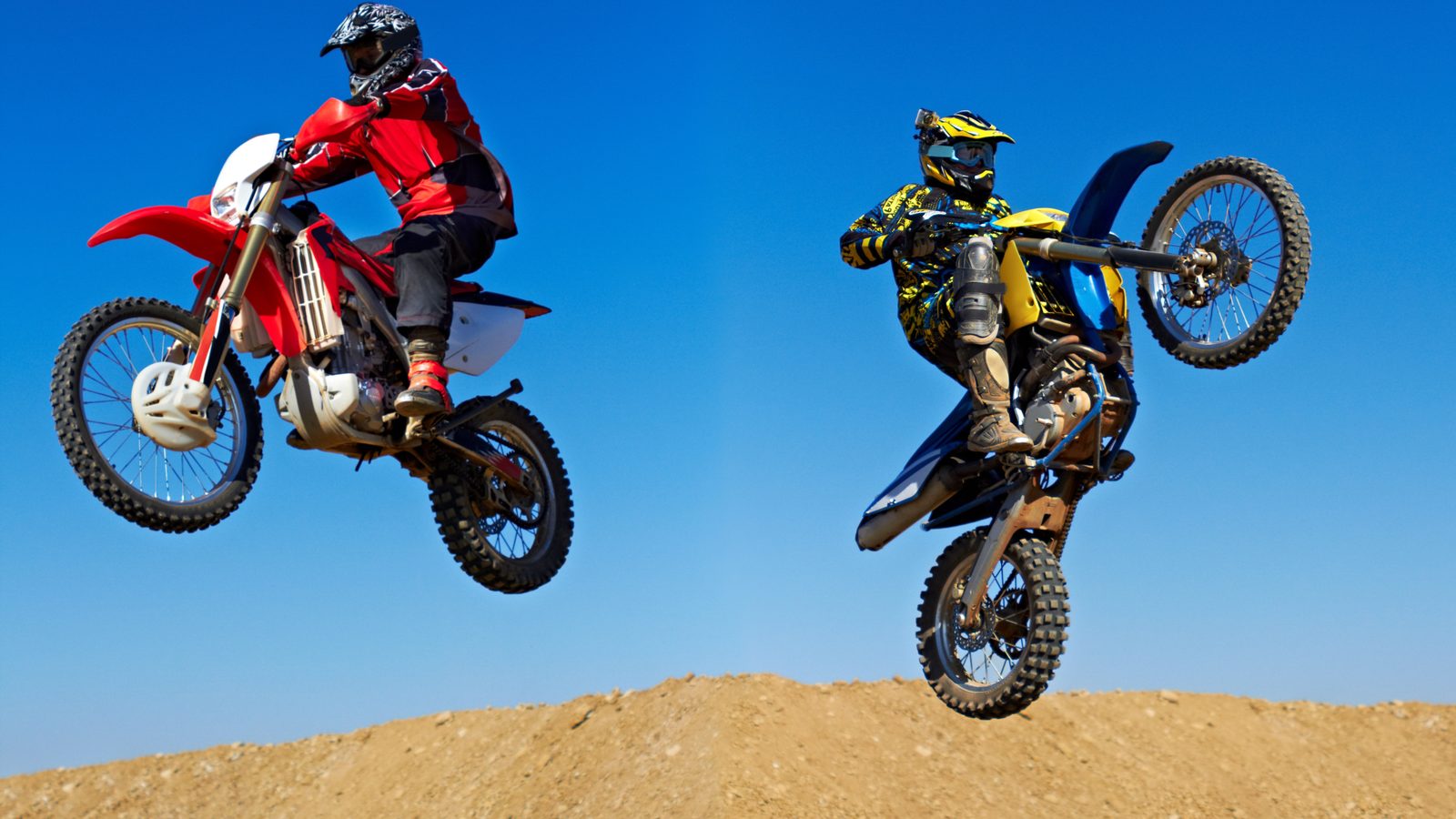
Nose low
The front touches first, and it touches hard. You need weight back at the moment of impact to stop the bike from carrying on its rotation. That’s a reflex to build on small jumps, long before you need it on something big.
Crossed up
The bike isn’t straight at contact. Bring your body back toward the centerline progressively, after the impact. No sharp input at the bars: a violent correction amplifies the wobble instead of fixing it. If the landing feeds straight into a corner, let the bike settle before you go looking for your line — the basics are in the guide on cornering position.
The mistakes that make it worse
Locked legs at impact do the most damage, and they almost always come from apprehension. The rider stiffens because he’s braced for the hit, and that bracing is exactly what makes the hit brutal. The root cause usually sits higher up: a poorly anchored riding stance won’t survive a landing.
Braking the instant the wheels touch unsettles everything at the worst moment. The suspension is working; adding a weight transfer on top of that asks the bike for two contradictory things at once. Let it finish, then brake — the dosing principles are the same as in normal braking.
Staring at the point of impact instead of what comes next kills your anticipation. On a track, a landing rarely opens onto empty flat ground: there’s a corner, a bump, another rider.
One last thing, and it isn’t a riding fix: if you’re bottoming out on every landing despite a clean move, have a professional check your suspension setup. A shock set up for the wrong weight can’t be compensated for with your legs.
Building absorption without hurting yourself
- Small jumps on repeat. On a low, rolling obstacle, work nothing but leg flex at impact. No height involved. Repeat until absorbing becomes a reflex instead of a decision.
- Slope reading. On a jump with a pronounced downslope, force yourself to look at the landing from the top of the arc and say out loud what you see. It sounds silly. It works.
- Step by step. Only add height or distance once the previous landing has become smooth. Whoops and bigger jumps rest entirely on that base, built at low risk.
- Off-bike strength. Legs that fade late in a session stop absorbing properly, and that’s when landings start going wrong. The work is laid out in the fitness training guide.
FAQ
Why does my back hurt after jumping?
Usually because your legs stay locked at impact instead of folding progressively. Check your eyes too: staring at the point of impact stiffens the whole body by reflex. If the move is clean and the pain sticks around, have a professional check the suspension setup, and see a doctor rather than continuing to absorb it session after session.
Should you brake as soon as the wheels touch down?
No. Let the suspension finish absorbing before you touch the brakes or the throttle. Braking during that phase removes stability right when the bike needs it most, and on a downslope landing it can wash the front out. A fraction of a second of patience is enough, and it costs you nothing on the clock.
How do you correct a crossed-up landing?
Bring your body back toward the centerline of the bike progressively, after the impact, with no sharp input at the bars. The bike straightens itself out once it’s rolling. What makes it worse is the violent correction: you add an oscillation on top of a wobble that was already settling down.
Should you look at the ground while landing?
No, keep your eyes on the line after the landing. Fixating on the point of impact stiffens your body at the exact moment it needs to stay loose, and it robs you of the information you need next: the corner, the bump, or the rider coming in behind you.
Find all the riding fundamentals on the riding technique page.
Editorial content. PiloteMX offers no on-site service, no parts or gear sales, no quotes and no bike repairs. Working on a bike and riding it carry risk: what you do with this guide is your own responsibility.