Whoops on a Dirt Bike: Why Speed Stabilizes You Instead of Throwing You Off
Contents
In a whoop section, speed is what settles the bike down. Fast enough, and it skims across the tops of the bumps instead of dropping into every trough, so the line smooths out. Too slow, and each bump lands as an isolated hit that unsettles you a little more than the last one. Stand up, sit back, hold the throttle, look at the exit.
Why going faster calms the bike down
A whoop section is a tight run of small bumps, usually fairly even. Below a certain speed the bike follows the ground: up, down, up again. Every trough hands energy back at the wrong moment, the suspension works against you, and the rhythm builds on its own.
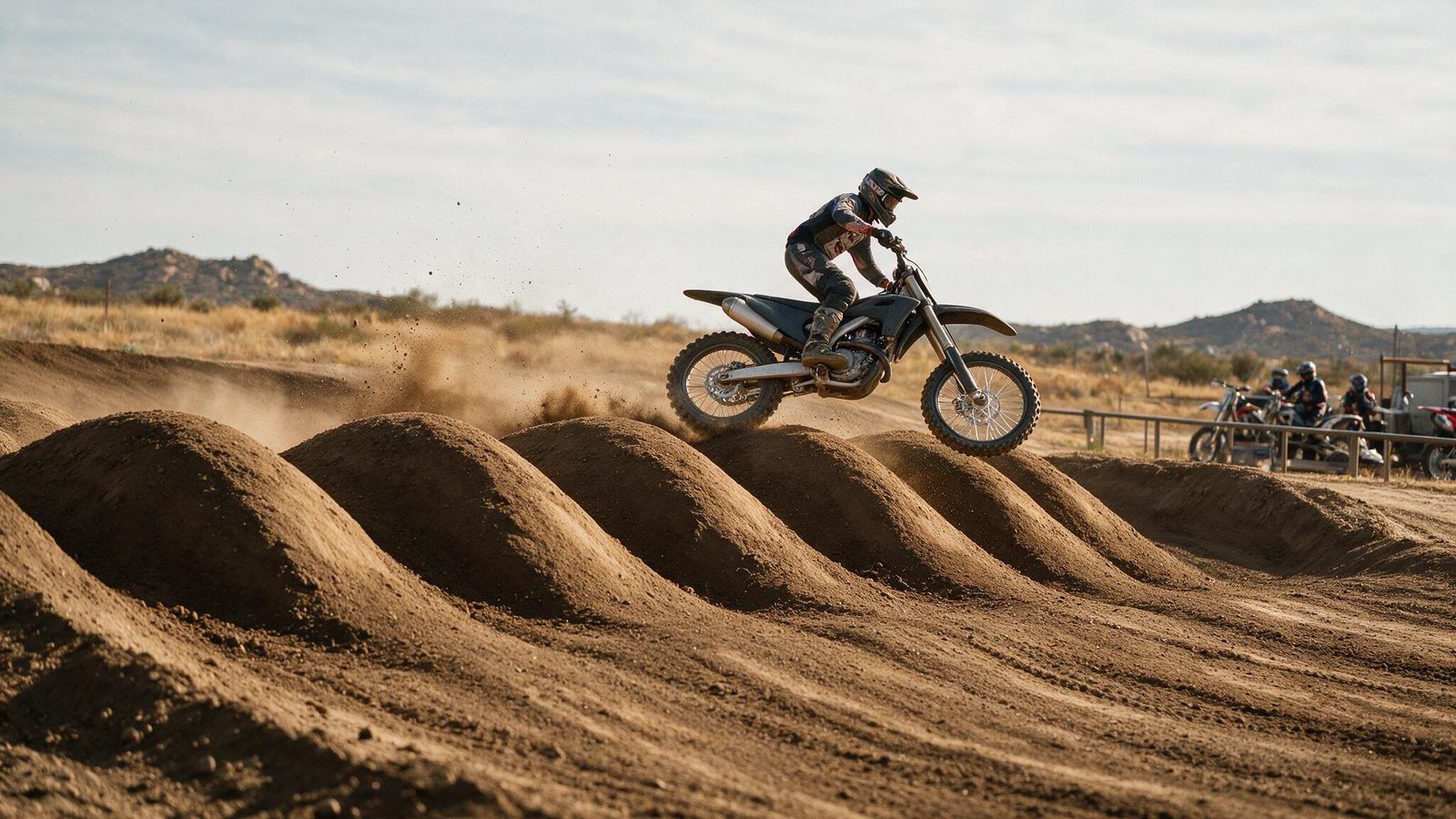
Above a threshold speed — different for every section, every bike, every state of the dirt — the bike stops dropping all the way into the troughs. It travels top to top, like a stone skipping across water. The hits come more often but they’re much smaller, and above all they’re even. That evenness is what stabilizes you, not the speed itself.
The catch is that the threshold can’t be calculated. You feel it. And the only way to feel it is to go find it on a section short enough to stay recoverable. Most riders who “can’t do whoops” are actually running just under the threshold, in the worst place to be: too fast to ride each bump cleanly, too slow to skim.
This asks for solid fundamentals. Your throttle and clutch control needs to be clean already, and so does reading the bike in the air — the skill you build learning to jump. Whoops are not where you discover either of those.
The sequence
- Pick out the exit of the section before you get there, never the first bump. Your entry speed gets decided right there.
- Stand up and slide back half a boot on the pegs, arms loose, elbows out. The front needs to stay light.
- Get on the throttle before the first bump and freeze your wrist. You enter with an rpm, you keep it.
- Let the legs do the work on their own. They rise and fall, your upper body barely moves.
- Squeeze the tank with your knees the moment the rear steps out sideways. Your arms fix nothing here — they make it worse.
- Hold the throttle through the last bump. You set up the exit afterwards, not inside the section.
None of this is a checklist you run through while riding. At that speed there’s no time to think. Work one item per pass, until it drops out of your head.
Skimming or rolling bump to bump
Both approaches are legitimate. What hurts people is mixing them.
| Rolling bump to bump | Skimming | |
|---|---|---|
| Speed | Well under the threshold | Clearly above it |
| Position | Standing, centered on the bike | Standing, back, front end light |
| Throttle | Metered bump by bump | Steady, open, frozen |
| Where it fits | Dug-out, uneven whoops, greasy dirt | Even whoops, a section you know |
| What bites you | Fatigue, rhythm running away | Headshake if you chop mid-section |
On a track you’ve never ridden, the first approach is the right one. Roll through once slowly, see where the troughs are deepest, find the exit. Only then start thinking about skimming.
Mistakes that cost you control
Far and away the most common: backing off out of nerves once you’re committed. That instinct serves you well everywhere else, and here it’s exactly backwards. Chopping mid-section drops the bike into the troughs at a rate it can no longer absorb, and the bars start to shake.
Sitting down to “take” the hits is next. Seated, the suspension is all you’ve got left and your back becomes the second shock. Standing, the legs do the job — that’s the whole point of the riding stance on rough ground.
Eyes glued to the next bump break your riding into pieces. You end up handling six obstacles instead of one, you react a beat late, and you gas out twice as fast.
Then there’s stiff arms. When the rear starts dancing, plenty of riders clamp the bars and try to hold them straight. That amplifies everything. Knees hold the bike, hands only steer it.
Learning to skim without scaring yourself
On a short section
Find two or three low, even bumps. Roll them slowly first to memorize the spacing. Then come back and add one notch of speed per lap, throttle frozen at the entry. At some point the feel changes: the bike stops falling and starts sliding across the tops. Remember the rpm where that happened — it becomes your reference.
When it gets longer
Add one bump at a time. The trap is lengthening the section while easing off the throttle to compensate — you drop back under the threshold and lose the whole benefit. Same commitment, longer section, that’s the only route. Build these passes into your sessions rather than trying them at random: a structured training plan beats ten laps with no intent.
When your head blocks
There comes a point where you know exactly what to do and your hand still won’t open. That’s normal, and riding more doesn’t fix it. Step back a level, go back to short sections, rebuild confidence on easy ground. Mental preparation does as much work here as technique does. And if you’ve had a real scare, let it settle before you go back in.
FAQ
Why speed up in whoops when it feels dangerous?
Because at sufficient speed the bike skims the tops instead of diving into every trough. The hits get small and even, and that evenness is what stabilizes you. Slow down and you keep the bike in contact with every bump, so each trough adds a bit more disorder on top of the last one.
Sit or stand through whoops?
Stand, always, and slightly further back than your usual position. Seated, you lose the leg absorption and take everything through your back. Back on the pegs, the front stays light and moves from top to top more easily. Knees squeeze the tank, arms stay loose.
What do I do if the front starts shaking mid-section?
Squeeze your knees, keep your arms loose and hold the throttle. Chopping puts the bike back into the troughs and feeds the shake. If the movement is already too violent to hold, aim for a way out to the side instead of fighting to the last bump. Leaving the line beats hitting the ground.
What level do you need before trying whoops?
Standing position, throttle control and jump landings all need to be automatic first. Whoops chain together micro-landings at a fast rate, so if any one of those still takes thought, you’ll be late everywhere. Soft terrain like sand forgives far more.
Find all the riding fundamentals on the riding technique page.
Editorial content. PiloteMX offers no on-site service, no parts or gear sales, no quotes and no bike repairs. Working on a bike and riding it carry risk: what you do with this guide is your own responsibility.