Cooling System: How the Circuit Protects the Engine
Contents
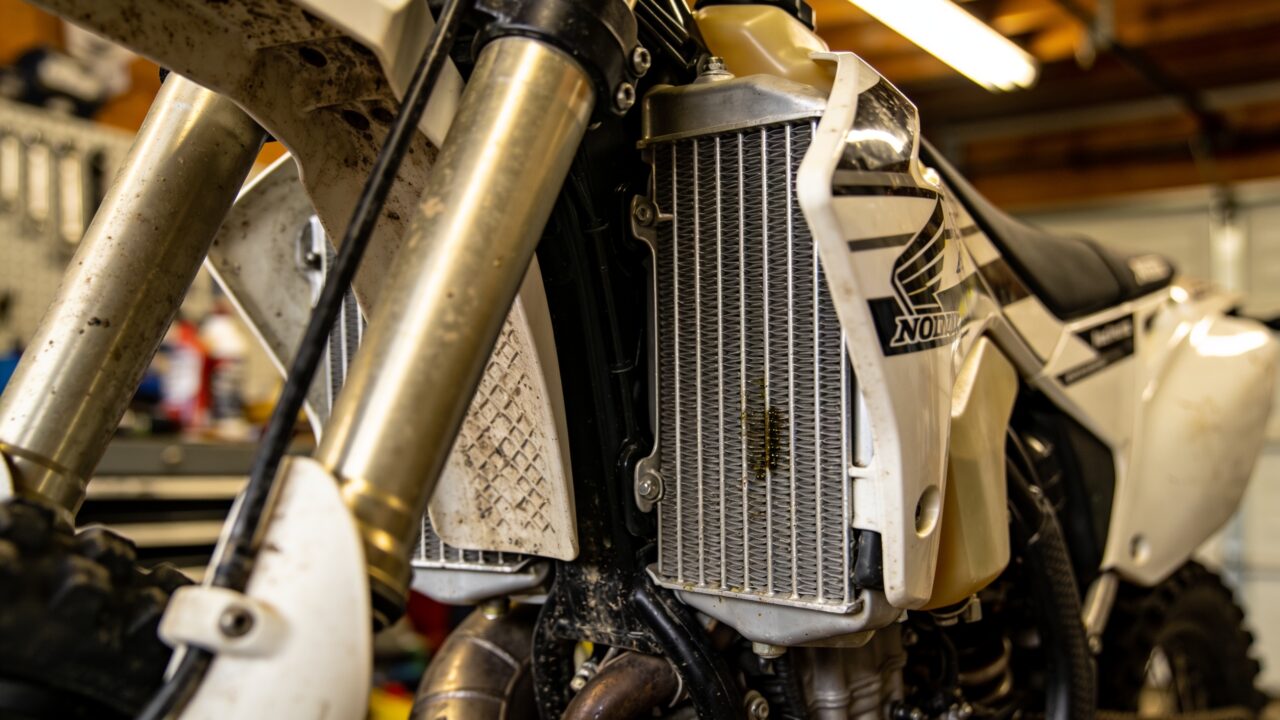
A dirt bike cooling system pumps fluid between the engine and one or two radiators sitting on either side of the tank. The pump runs off the engine itself: coolant picks up combustion heat along the cylinder and head, then dumps it into the air as it passes through the radiator fins. Without that loop, the engine seizes.
What flows, and where it goes
The water pump is driven mechanically by the engine. It turns whenever the engine turns — no relay, no sensor, no switch. It pushes coolant through passages cast straight into the cylinder and head, right up against the combustion chamber.
The fluid comes out hot and heads for the radiators, finned exchangers hung in the airflow on both sides of the tank. Air moving through the fins carries the heat away, the coolant drops in temperature and goes around again. As long as the bike is moving, the loop takes care of itself.
Some bikes add a thermostat. Cold engine, it blocks flow to the radiators so the motor warms up quickly. Once hot, it opens. Plenty of motocross machines skip it entirely and run full circulation all the time, which puts the rest on the rider.
The radiator cap is not just a lid. It holds the circuit under pressure, and that pressure raises the boiling point of the coolant. A tired cap with a hardened seal lets the system spit long before the temperature it should handle. It is a wear part most riders never think about.
Why motocross is harder on the circuit
A street bike runs fast and steady, so airflow is constant and the radiators do their job unattended. Off-road is nothing like that. You swap between full throttle and crawling sections, and in a deep rut the engine works hard while almost no air moves through the fins.
Hill climbs concentrate the whole problem: high revs, low ground speed, maximum load. That is where temperature climbs fastest, and where a marginal circuit usually gives up.
The coolant ages too. Its corrosion inhibitors get used up and its ability to move heat falls off, so it protects less than fresh fluid while still looking perfectly fine in the tank.
A lean mixture also runs hot, whatever the cooling system does. If the bike started heating up after you touched the jets, read the guide on carburetor jetting before you blame the radiators.
What overheating does to the engine
A hot engine loses power before it breaks. Parts expand, working clearances close up, and the piston drags harder in the bore. You feel it at the throttle: soft, rough, unwilling to rev the way it did an hour earlier.
On a 2-stroke, piston-to-cylinder tolerances are tight and the thermal margin is thin. Repeated overheating wears the piston kit faster than the hours on the bike would suggest.
An abnormally low compression test sometimes traces back to exactly that: heat episodes that marked internal parts without ever causing an outright failure. The link is indirect, but it is real.
A fresh engine is more sensitive still. During break-in, surfaces are bedding into each other and take heat badly. It is the worst possible moment to pull a long climb on a questionable circuit.
The circuit check before you ride
- With the engine cold, open the radiator cap and confirm the coolant sits where it should.
- Look at colour and clarity: cloudy, rusty or oily fluid does not go back in service as is.
- Run a finger across the fins on both radiators and break out the dried dirt packed between them.
- Hunt for flattened fins, dry residue, and the white or coloured staining that gives away a weep.
- Squeeze every hose along its length — it should stay supple, with no cracking and no hard spots.
- Check the clamps and the radiator mounting bushings, especially after a crash.
- Refit the cap, turn it to the stop, then confirm it no longer spins freely.
Reading the symptoms
| What you see | Common cause | What to do |
|---|---|---|
| Steam at the cap at the end of a session | Circuit overheating, tired cap or clogged radiators | Shut it down, let it cool, clean the fins before going back out |
| Level dropping with nothing on the ground | Possible internal leak, head gasket suspect | Get it checked by a professional instead of topping up again |
| Fluid gone brown or foaming | Coolant at the end of its life, or contaminated | Full drain and flush of the circuit |
| Engine going soft on climbs only | Not enough heat dissipation at low speed | Clean the radiators, check the level, straighten bent fins |
The mistakes that end in overheating
Topping up without chasing the cause. A level that drops every ride is telling you something. Adding fluid pushes the problem back until it lands halfway up a hill, a long way from the truck.
Washing the bike and forgetting the radiators. Dried mud between the fins builds a mat that blocks air. From above everything looks clean; from the front, half the exchange surface has stopped working.
Riding on a bent radiator. After a crash the chassis takes the hit and the radiators often take it with them. A wide patch of flattened fins is that much airflow gone, with no leak to warn you.
Above all: pressing on because the moto is nearly over. An engine steaming at the cap does not fix itself under load. Two minutes stopped is cheaper than a top end.
FAQ
Why does my bike run hotter in technical terrain than on a fast straight?
Because airflow through the radiators depends on ground speed, not engine speed. In a slow section the motor works hard and almost no air passes through the fins. The imbalance shows up on the temperature straight away. Up to a point that is normal; if it boils over, look at clogged fins or a low level.
Does a dented radiator still work?
Partly. As long as it is not leaking it still cools, but every crushed patch of fins is exchange surface you no longer have. On a bike being pushed hard, that shows up on climbs and in hot weather. Combing the fins straight recovers a good share of it. A pierced or deformed core gets replaced.
Can I use tap water to get home?
To get home, yes — better than running dry. But tap water brings no corrosion protection and no freeze protection, and its minerals settle in the engine passages. Treat it as a patch: drain it and refill with the coolant your manufacturer specifies as soon as the bike is back in the workshop.
More systems covered in the mechanics section.
Editorial content. PiloteMX offers no on-site service, no parts or gear sales, no quotes and no bike repairs. Working on a bike and riding it carry risk: what you do with this guide is your own responsibility.