Exhaust and Silencer: Their Real Effect on Power
Contents
On a dirt bike the exhaust does more than vent burned gas: its internal geometry shapes the power curve, especially on a 2-stroke. The silencer kills noise by pushing gas through absorbent packing without choking the flow. Both age, and the engine notices before you do.
Why the exhaust counts as part of the engine
Most riders look at a pipe as an outlet. It is not, and the difference shows up on the first lap when the geometry does not suit the engine.
On a 2-stroke
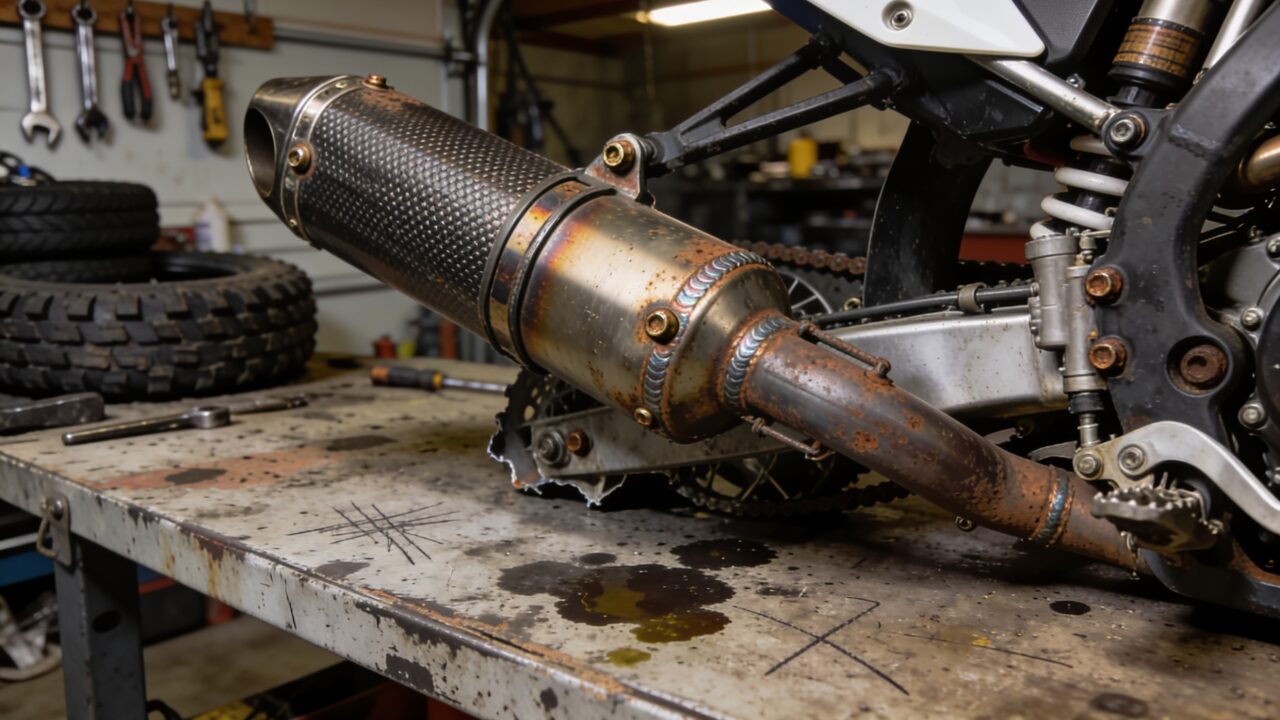
The expansion chamber does real work. It creates a pressure wave that shoves fresh mixture — the part that escaped early toward the exhaust — back into the combustion chamber, and it does it right as the port closes. Better cylinder filling, more power, but only across the rev range the chamber was drawn for.
That is why a 2-stroke reacts so strongly to its pipe. A chamber dented in a crash loses volume in one spot, the wave comes back out of phase, and the engine drops power at the bottom or the top depending on where the dent sits. A deep dent is not cosmetic.
On a 4-stroke
Wave tuning exists here too, but the main job is scavenging. Too much restriction leaves burned gas in the cylinder at the end of the cycle, and that volume will not be filled with fresh charge next time round. The engine breathes badly without necessarily sounding wrong.
The silencer: what it absorbs and what it loses
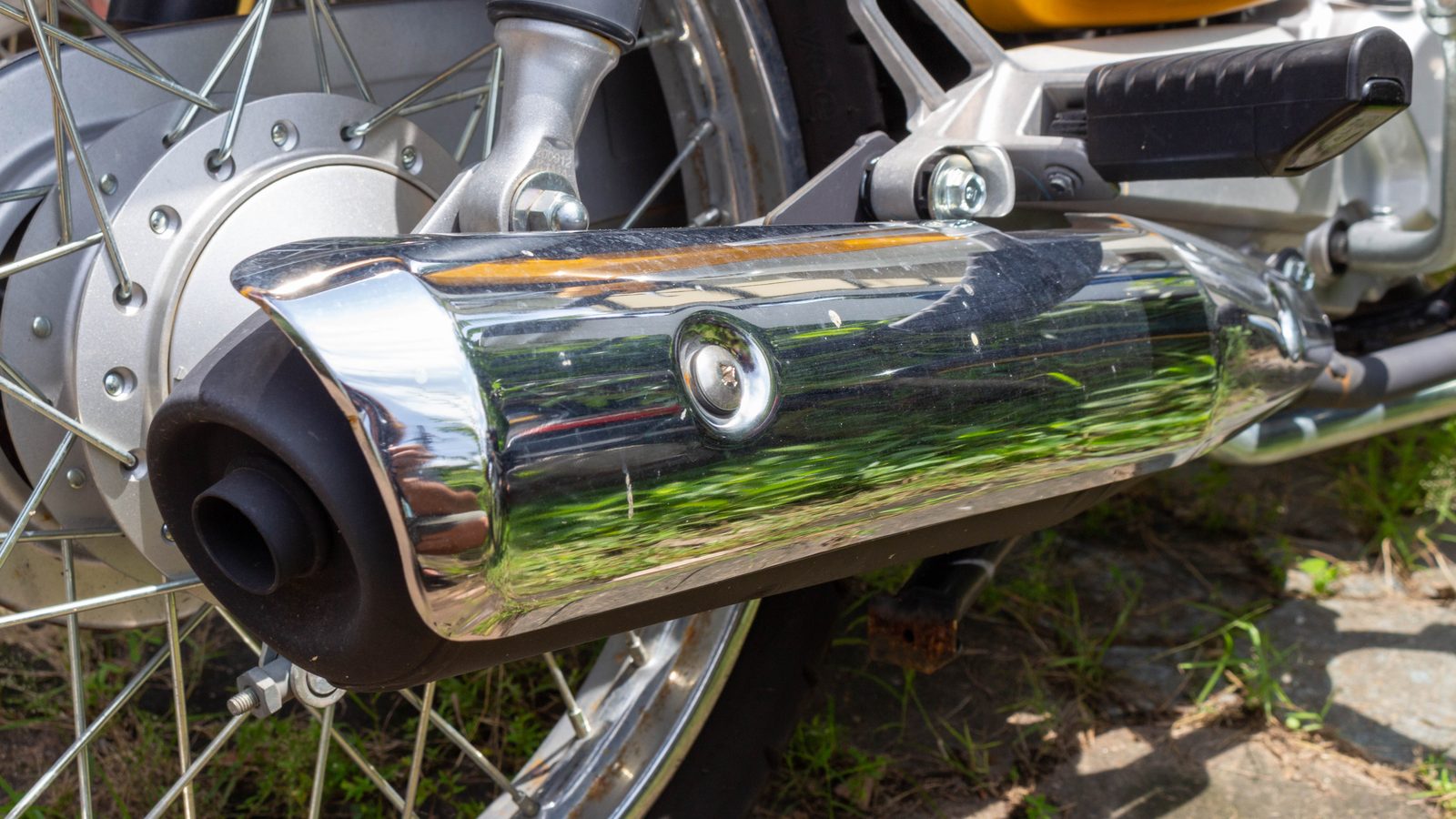
Inside the can, gas passes through baffles or absorbent packing — rock wool, purpose-made fibre — that soaks up sound energy without blocking the path. It is a permanent trade between noise and flow.
That packing breaks down with heat and hours. Nothing shows from outside: the can stays clean and the bike simply gets louder ride after ride. Once the packing has compressed or blown out, internal restriction changes too, and engine behaviour drifts away from how it felt new.
Plenty of tracks enforce a sound limit. Check that before a modification, not after: a bike over the limit gets turned away at the gate, and no technical argument beats a sound meter.
Key points
- What wears silently
- the absorbent packing inside the silencer
- Warning sign
- rising noise with no visible damage to the can
- Visual checks
- head gasket at the exhaust port, dents, cracks, corrosion
- Usual tools
- open-end wrench, fresh gasket, gloves
- Leave to a professional
- reshaping an expansion chamber, welding a cracked pipe
- Service interval
- see your bike’s workshop manual
What you can check without stripping anything
The gasket between head and header is suspect number one. A leak there drops the back-pressure the pipe needs to work, and you feel it as much as you hear it: a hard, flat note, an engine with no punch, black soot around the joint. A new gasket costs little and goes in without pulling the bike apart.
Next, run your hand along the pipe with the engine cold. You are looking for dents, hairline cracks near the mounting points, corrosion under the clamps. On a bike that has crashed, start with the side that took the hit — that is usually where the chamber lost its volume.
Finally, shake the silencer gently. Material moving around inside means packing that has come loose. Nothing breaks immediately, but the noise level will keep climbing.
Fitting a different pipe: what actually happens
An aftermarket system can deliver a real gain. It can also move power to a place you never use. It all comes down to how the new geometry agrees with the rest of the engine setup.
| Criterion | Stock system | Aftermarket system |
|---|---|---|
| Power band | Calculated for general use of the model | Often shifted up or down the rev range |
| Fuelling | Matched to the pipe at the factory | Almost always needs redoing |
| Sound level | Track-legal out of the crate | Verify before racing on it |
| Wear parts | Packing available from the manufacturer | Brand-specific repack kit |
| Going back | Not applicable | Keep the stock pipe, you will want it |
On a carburetted bike, jetting becomes the real job: the mixture that suited the old geometry no longer does. On a bike with fuel injection, the map has to follow, and not every pipe ships with one.
The mistakes that cost power
Ignoring the silencer because it seems purely acoustic. On a 2-stroke, back-pressure is part of the engine tune: dead packing changes how the bike runs, not just how loud it is.
Fitting a fresh pipe and leaving the fuelling alone. The mixture no longer matches, the advertised gain evaporates, and the engine may run lean — which the piston pays for faster than most people expect. If you doubt what is going on inside, a compression test tells you the state of the top end before you blame the exhaust.
Riding with a holed pipe and telling yourself it makes no difference. Back-pressure collapses, the curve deforms, and the odd noise eventually causes trouble wherever you ride.
Last one: skipping the exhaust port during decarbonizing. Carbon builds up on that side too. Cleaning the combustion chamber and leaving the port alone means half the job is undone, and a top-end rebuild deserves the same care all the way out of the engine.
FAQ
Does an aftermarket exhaust always add power?
No. The gain depends on how the new geometry agrees with the rest of the engine, and it usually moves power around the rev range rather than adding it everywhere. Without redoing the jetting or the map, the result is often disappointing and sometimes worse than stock. Judge a pipe on the range you actually use on track, not on a headline figure.
Why does my silencer get louder over time?
The absorbent packing inside degrades under heat and running hours. It compresses, chars, and sometimes leaves in pieces with the exhaust gas. The outside shows nothing, which is why the noise seems to rise for no reason. The fix is a repack with the kit made for your silencer.
Does an exhaust gasket leak really hurt power?
Yes, and clearly so on a 2-stroke. The expansion chamber needs consistent back-pressure to return its wave at the right instant; a leak at the head drops it and the wave arrives out of phase. You lose torque, the note turns hard, and black soot shows around the joint. Replace the gasket before hunting anywhere else.
The rest of the engine and transmission guides live in the mechanics section.
Editorial content. PiloteMX offers no on-site service, no parts or gear sales, no quotes and no bike repairs. Working on a bike and riding it carry risk: what you do with this guide is your own responsibility.