Replacing a Dirt Bike Crankshaft Bearing
Contents
A worn crankshaft bearing announces itself with a dull, regular metallic knock from the bottom end, clearest at idle, usually alongside vibration that builds over the hours. There’s no shortcut around it: the crankcases get split and the crankshaft comes out complete with its bearings. This is bottom-end work, not a trackside fix.
The noise that gives a crank bearing away
The sound comes from low down, under the cases, and it’s regular — a dull metallic tick that tracks engine speed, not road speed. At idle it stands out. On the throttle it drowns in everything else. Pull the clutch in with the engine running: if the noise doesn’t move, the clutch and gearbox get less likely.
The second sign is play. With the engine cold, grab the gearbox output shaft and try to move it side to side, then up and down. A worn crank bearing lets through play you can feel in your hand. On a two-stroke the neighbouring seal often goes at the same time, and the engine starts hanging revs, stalling when hot, answering the throttle oddly. Plenty of riders burn evenings on jetting before working out the air leak is mechanical.
Rule out the cheap suspects first
A noisy bottom end doesn’t mean crankshaft. Sort it out by ear and by hand before committing to a full split — a good share of suspicious noises come from parts you can reach in half an hour.
| What you hear | When | Where to look first |
|---|---|---|
| Dull regular tick, locked to engine speed | At idle, cold or hot | Crankshaft bearings |
| Sharper clatter from up top | At idle, fades as revs rise | Piston, wrist pin, valve clearance on a four-stroke |
| Rumble that changes with road speed, not revs | Riding, gone with the clutch pulled in | Gearbox bearings, chain, sprockets |
| Rattle on hard acceleration | Under load only | Clutch basket, cush drive |
Check the engine mounts and the chain slider while you’re there: one loose frame bolt makes a very convincing noise. And if the bike has taken a hit, look at the case before blaming what’s inside it.
Why the engine has to come apart
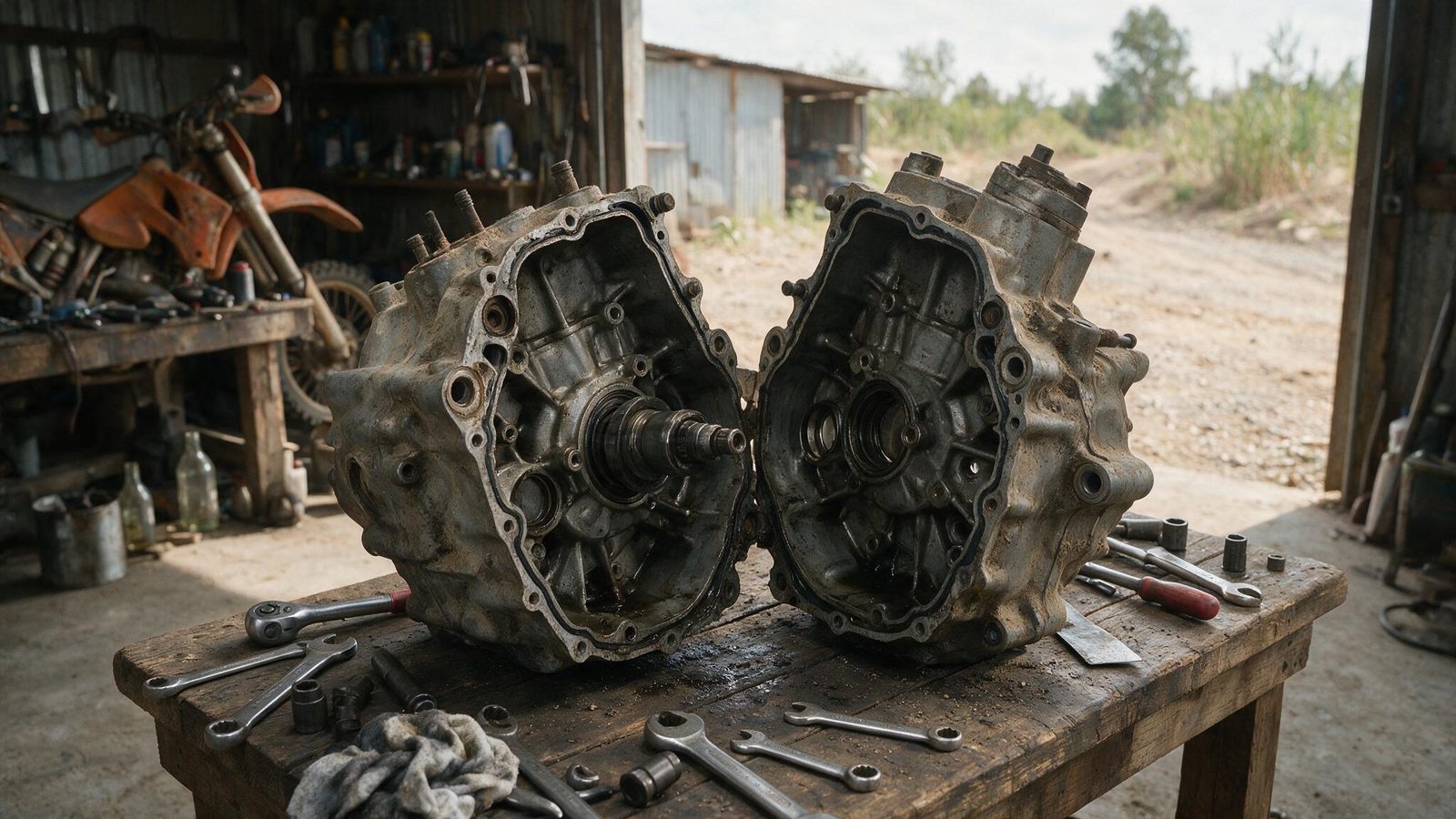
A wheel bearing changes with the wheel out. A steering head bearing changes with the stem dropped. The crankshaft sits trapped between the two case halves, pressed and aligned to a tight tolerance, and nothing reaches it from the side. Opening it up means pulling the engine, emptying it — clutch, ignition, gearbox, shafts, shift drum — then splitting the cases.
Which is to say you won’t do this job in an evening, and you don’t want to do it twice. While the engine is open, everything that wears gets replaced: crank seals, case gaskets, any gearbox bearing that feels notchy. If the shift forks show any wear, now is the moment — a year from now costs the same teardown all over again.
How the job actually runs
Here’s what happens, whether you do it yourself or follow the work at a shop. Every step has its trap.
- Drain, pull the engine, strip the external parts: exhaust, intake, ignition, clutch cover.
- Remove the clutch, flywheel and shift mechanism. Pullers are model-specific. Hitting things deforms exactly what you’re trying to save.
- Split the cases with the proper puller, pulling straight and evenly. Never a screwdriver in the gasket face — one gouge there and the case won’t seal again.
- Press the crankshaft out with its bearings, on a press or the correct tool. Load goes through the right surface, never through the flywheels.
- Check the crankshaft: runout, big-end side play, condition of the rod and pin. This is where you decide to rebuild it or replace it.
- Fit new bearings with the case warmed by the method in the service manual so they drop in without force. Push on the outer race, never through the balls.
- Reassemble with new seals and clean gasket faces, then torque the cases in the sequence and to the figures the manual gives.
- Start it gently and keep the revs down at first while the new bearings settle in.
Doing it yourself or handing it over
A well-equipped home mechanic can pull this off. It takes a press, the model’s pullers, a way to check crank runout between centres or on V-blocks, and the bench space to lay out a full table of parts. Without that alignment check you’re reassembling blind: a crank that runs out eats its new bearings and the noise comes back well before the season ends.
The other factor is what the bike is worth and what it already has behind it. On a high-hours machine, the repair or replace question belongs to the whole engine rather than one bearing. A checked used bottom end sometimes costs less than a rebuild, especially if the top end is also asking for a rebuild.
If you hand the job over, ask for the crankshaft inspection to be written on the invoice and keep the old parts. They tell you what really happened in there.
FAQ
Should I replace the crank seals at the same time?
Yes, every time. They work in the same conditions as the bearings and age at the same rate. Replacing them later would mean opening the engine again, so you’d pay the entire teardown twice for two seals that cost a fraction of the job. Same logic for case gaskets and the wrist pin circlips if you’re going that deep.
How do I tell crankshaft noise from gearbox noise?
Listen to what it obeys. Crank noise follows engine speed and is audible with the bike standing still and the engine running. Gearbox or drivetrain noise follows wheel speed, changes when you shift, and often disappears with the clutch pulled in. Do the standing test first, the riding test after.
Can I keep riding a bit with a bearing that’s making noise?
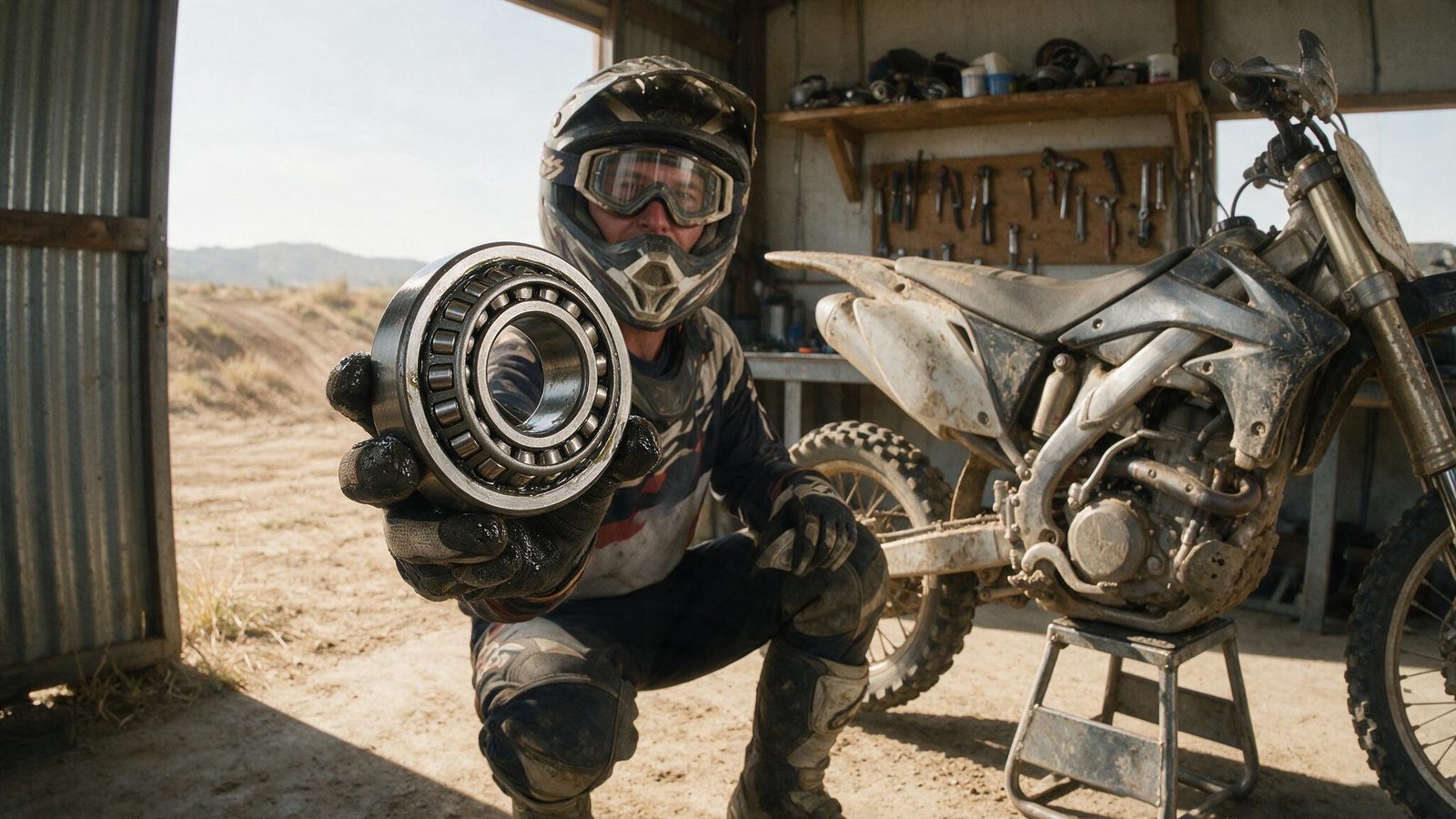
No, and that isn’t being overly careful. A failing bearing goes all at once, without the symptom building first. The cage releases the balls into the bottom end, the crank and cases take the damage, and the engine can seize with the rear wheel down. The bill at least doubles between the first noise and the failure.
How long is the bike off the road?
Count on several days at a specialist shop: removal and teardown, crankshaft inspection, waiting on bearings and seals, reassembly, then running it in. Mid-season, parts availability usually stretches the stay. If you ride every weekend, book the job for winter rather than the middle of the race calendar.
More repair guidance in the repairs section.
Editorial content. PiloteMX offers no on-site service, no parts or gear sales, no quotes and no bike repairs. Working on a bike and riding it carry risk: what you do with this guide is your own responsibility.