Bent Frame After a Dirt Bike Crash: What to Do
Contents
After a heavy crash, a slightly warped frame can sometimes be straightened on an alignment table by a professional. A visibly bent frame, or one cracked at a structural weld, gets replaced: no straightening gives a tube deformed past its elastic limit back the stress distribution it left the factory with. That call comes from a proper check, not from a glance.
The signs that reach you through the bars
A bent frame is usually felt before it is seen. The bike drifts to one side on a straight while you hold the bars level. It turns better left than right, or the other way round. The steering stops returning to center on its own when you loosen your grip.
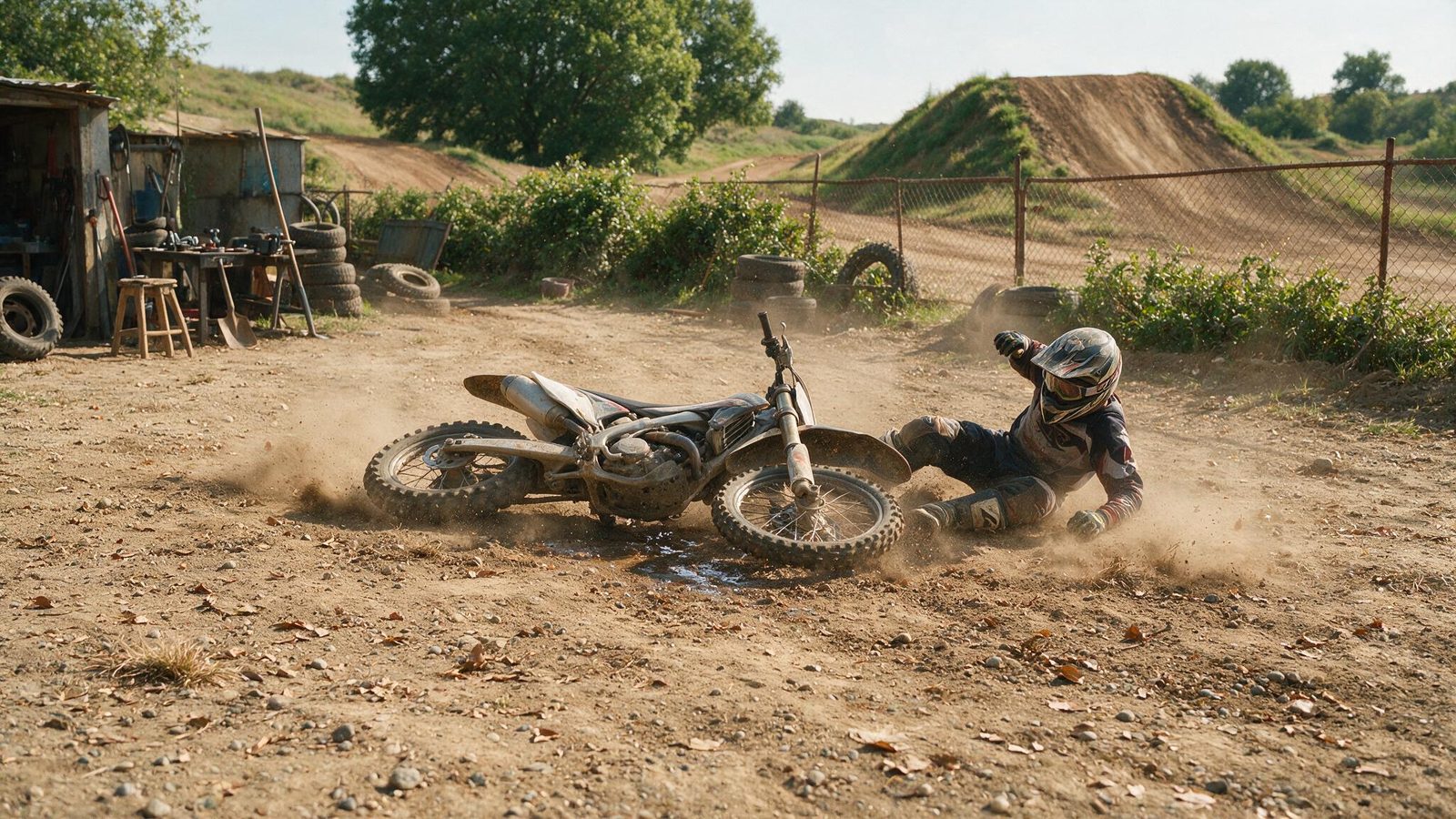
The tires tell the same story: wear that sits off to one side, knobs shaved down on one edge only. Plenty of riders spend weeks redoing suspension settings before working out that the fault lives in the chassis itself. If the bike handled fine last ride and badly right after a crash, stop turning clickers and go look at the frame. The same crash often catches the exhaust too, so check for a dented silencer while the bike is on the stand.
The check you can run in your own garage
- Put the bike on the stand, on genuinely flat ground, wheels in line and bars straight.
- Step back a few meters, crouch behind the rear wheel and see whether it tracks exactly with the front.
- Run a string down both sides at axle height to confirm both wheels sit in the same plane.
- Tape-measure from the rear axle to a fixed point on the frame, left side then right side. The two readings should match.
- Turn the bars to full lock each way: the travel should feel symmetrical and both stops should meet solidly.
- Degrease the steering head, the swingarm mounts, the engine mounts and the footpeg brackets, then inspect every weld under raking light.
- Hunt for cracked paint. It almost always marks where the metal worked, well before a crack becomes visible.
- Write down everything you find and photograph it. That is what you hand the shop.
This check does not replace an alignment table. It tells you whether you need one. A clear discrepancy at any of those steps is enough to stop riding.
Steel or aluminum: two different behaviors
| Criterion | Steel frame | Aluminum frame |
|---|---|---|
| Reaction to an impact | It bends and stays bent | It absorbs, then cracks without warning |
| Cold straightening | Conceivable on a light warp, in a proper shop | Very risky, often refused outright |
| Weld repair | Possible for a qualified welder | Specific TIG plus post-treatment, specialist shop |
| Warning sign to look for | Cracked paint, a rust weep at the same spot | A whitish line or powder around a weld |
That difference is why an answer picked up on a forum is worthless until you know which frame is being discussed. On welding itself, the plastic and aluminum welding guide covers what stays within reach of a home mechanic — and a frame is not on that list.
What straightens and what doesn’t
A light warp on a steel tube, with no crack and no stress marks around the welds, gets corrected by a professional with a jig built for motorcycles. Measure, correct, measure again: those three steps belong together.
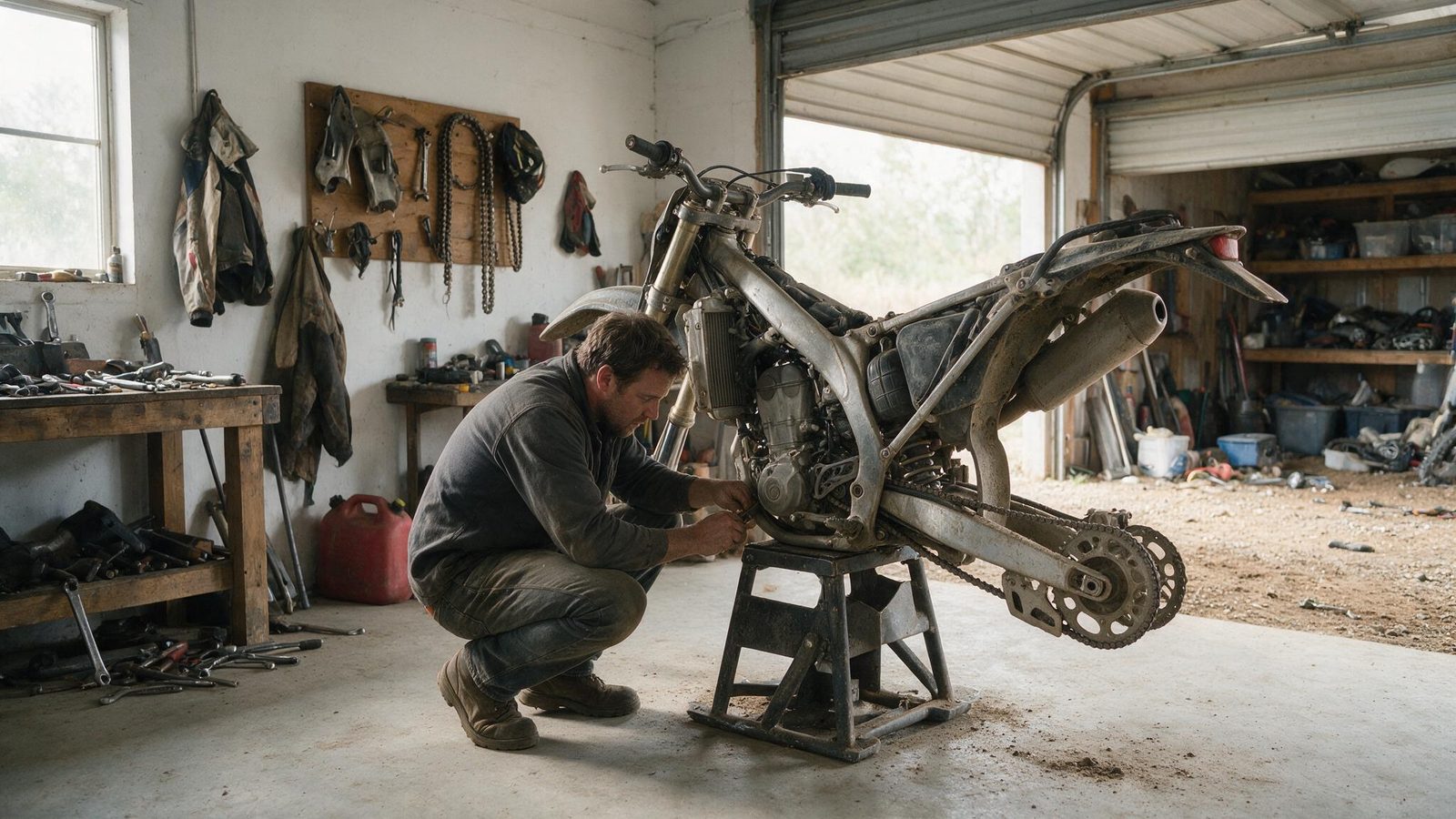
What does not straighten: a visible crack, a marked deformation — more than a few millimeters of offset — and above all any damage reaching the steering head or the swingarm mounts. Those areas concentrate the loads. A correction that restores the look without restoring the geometry leaves you with a bike that appears straight and isn’t.
While the bike is apart, check whatever took the hit alongside the frame. A steering head that absorbed a frontal impact deserves a look at the steering head bearings: a brinelled ball in its race gives a notchy spot dead ahead that people readily mistake for a bent frame.
Why a pry bar fixes nothing
A frame straightened with a bottle jack in the corner of a garage can absolutely end up looking straight. The trouble is torsion: the bike stays twisted in a plane your eye cannot read. On track that means a machine that drops into one corner and fights the other, chewing through bearings and chain adjustment for no reason anyone can name.
Then there is what straightening does to the metal. Cold-working a zone already hardened by the impact, with no measurement and no treatment afterward, creates a spot harder and more brittle than the rest of the tube. The next crash will find exactly that spot.
When replacement stops being a question
Three cases end the debate. A crack at a structural weld, first. A frame already straightened once that deforms again in the same place, second: the metal has reached its limit and is saying so. Finally a violent impact after which alignment can no longer be guaranteed, or where the serial number area itself suffered — with that number unreadable the bike becomes unsellable and sometimes impossible to insure.
From there the maths look like any other big-ticket part: the price of a bare frame, the hours to move everything onto it, the value of the bike underneath. The repair or replace guide lays out the method. On a bike several seasons in, a checked used frame often solves the equation better than an uncertain straightening job.
FAQ
Can I ride with a slightly warped frame?
No. Even a light warp already degrades handling and puts bearings, chain and suspension to work at an angle. More to the point, you have no idea whether that warp comes with the start of a crack hidden under the paint. Get it checked before you ride again, not after one more session.
How do I tell a crack from a bit of dirt?
Clean the area with degreaser and dry it. A crack shows as a fine continuous line that a rag will not wipe away, usually following the edge of a weld. On steel, a rust weep reappearing at the same spot gives it away. On aluminum, look for a whitish line or paint blistering along a straight path.
Does an aluminum frame repair like a steel one?
No. Aluminum tolerates cold straightening far worse and needs specific TIG welding, with a treatment afterward to give the area its properties back. Plenty of shops simply refuse to touch an aluminum motocross frame, and that refusal is a good sign rather than a bad one.
My bike pulls to one side, is the frame always to blame?
Not always. A bent swingarm, forks twisted in the clamps, a warped wheel or brinelled steering bearings all produce the same feeling. Start with the simple checks: wheel alignment, symmetrical measurements, steering travel. The frame joins the list once everything else has come back clean.
More repair guidance in the repairs section.
Editorial content. PiloteMX offers no on-site service, no parts or gear sales, no quotes and no bike repairs. Working on a bike and riding it carry risk: what you do with this guide is your own responsibility.