Failed Stator or CDI on a Dirt Bike: Diagnosis and Replacement
Contents
A stator is diagnosed with a multimeter: measure coil resistance and compare it to the figures in your bike’s service manual. Out of tolerance or open-circuit, it gets replaced. A CDI box can’t really be measured. It’s tested by elimination, by fitting a box you know is good. And before either of them, always test the spark plug.
Who does what in the ignition
The stator sits still, bolted against the case behind the flywheel. As the flywheel spins, its magnets sweep past the stator windings and generate current: some of it feeds the ignition, some feeds charging and lighting on bikes that have them. The CDI takes that current, stores it, and dumps it into the high-tension coil at the right instant. The full picture is laid out in the ignition system, and on fuel-injected bikes the ECU takes over that timing job.
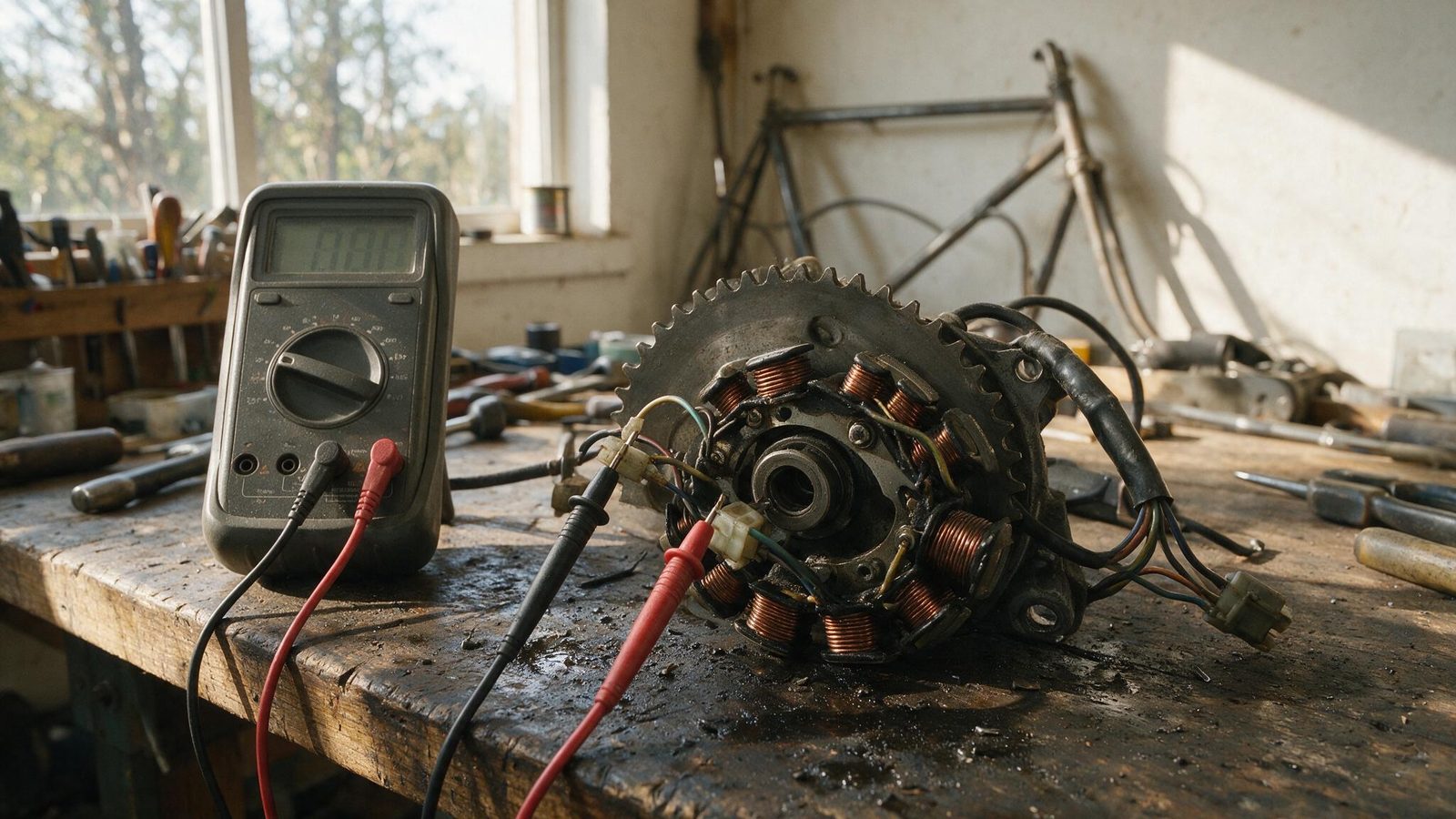
Hence the problem: both failures open with the same symptom, an engine spinning over with no spark. Except one of them can be measured and the other can’t. That’s why the order you test in matters more than the tools you own.
Read the symptoms before you take anything apart
| What the bike does | What it points to | First test |
|---|---|---|
| No spark at all, cold or hot | Plug, cap, kill switch, then stator or CDI | New plug, then continuity through the kill switch and stop button |
| Starts fine, then dies once the engine heats up | A winding or electronics dropping out with heat | Repeat the resistance readings hot, right after it cuts |
| Runs, but the lights fade or the battery stops charging | The stator’s charging winding | Measure the charging output separately from the ignition side |
| Spark is there, but it misfires and dies high in the revs | Timing control, so the CDI or the trigger pickup | Swap test with a known-good box |
The fault that shows up hot and vanishes cold is the sneakiest one. A winding with tired insulation conducts perfectly while the engine is warm, then shorts to ground once the temperature climbs. Measure it cold, after pushing the bike back to the van, and everything reads normal. You have to measure straight away, the moment it stops.
Testing the stator with a multimeter
- Ignition off, battery disconnected if the bike has one. Put the key somewhere else so nobody switches it on mid-test.
- Follow the loom out of the ignition cover and unplug the stator connector on the bike side. Every reading is taken on the stator side, with the loom disconnected.
- Look before you measure. A blackened wire, melted insulation, a green terminal or a burnt smell at the connector often gives the verdict without a meter.
- Ohmmeter across the output wires, pair by pair, and compare to the figures in your bike’s service manual. A reading that runs off to infinity means a broken winding; one well below the reference means shorted turns.
- Now measure between each wire and the engine case, on clean bare metal. There should be no continuity at all. A reading that collapses toward zero means a winding is touching ground.
- If the fault is heat-related, run the whole set of readings again hot, without waiting for it to cool.
- Finish on the connector itself: wiggle the loom by hand while the meter is connected. A reading that jumps is a broken wire inside the sleeve, not a dead stator.
One precaution before cranking the engine to look for a spark: never hold the plug lead or the plug in bare hands while someone kicks it over. Ignition high tension gives a serious jolt, and the flinch that follows usually sends your hand into the engine. Grip the plug in insulated pliers, body earthed against the case, and watch from a distance.
Testing a CDI you can’t measure
A CDI box won’t be read with an ohmmeter: its internal components give no simple value to interpret, and two healthy boxes of the same model can show different readings. Swap testing stays the only reliable method. Fit a compatible box you know works, try it, and the diagnosis makes itself.
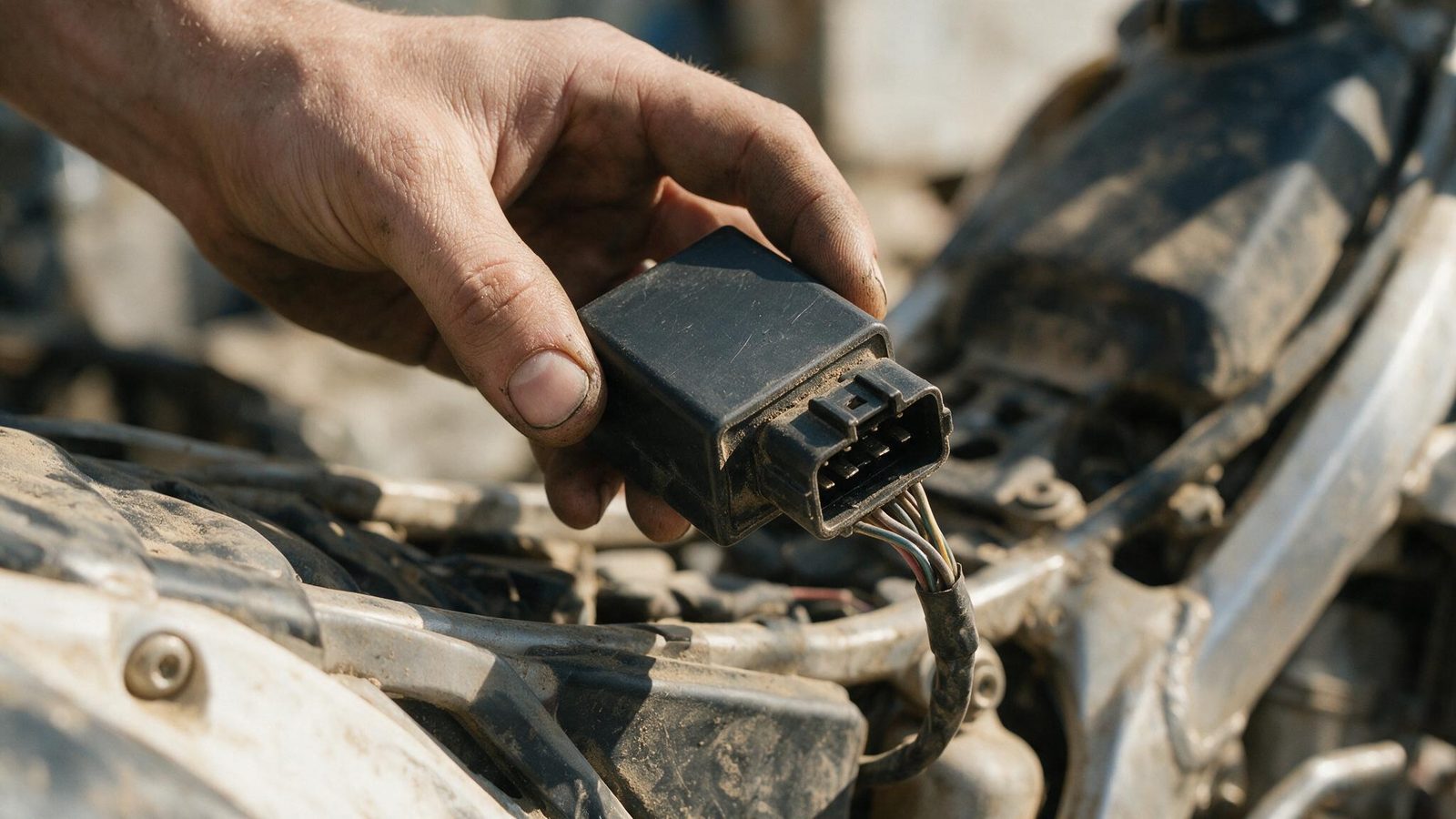
The overall logic comes down to one rule: you only condemn a CDI once everything measurable has passed. Plug, cap, kill switch, sidestand switch, engine grounds, loom continuity, then stator. If all of that checks out and the spark is still missing, the box becomes the prime suspect.
Replacing the guilty part
The CDI is the easy one. Unplug, plug in, and nothing mechanical comes apart. Just check the rubber mounts on its bracket: a box vibrating directly against the frame eventually shakes a solder joint loose inside.
The stator asks for more. You drain whatever needs draining on that side, pull the ignition cover, then usually the flywheel with the correct puller — never with a lever or a hammer, which distorts the crankshaft. The new stator goes back in its original orientation, and its wire grommet has to follow exactly the same route without getting pinched by the cover. That step is what kills brand-new stators.
While the cover is off, look at what sits behind: a weeping seal, play at the crank. If you feel play, the job changes scale and turns into replacing a crankshaft bearing, a project far beyond swapping a stator. Choosing between a used stator and a new part is the same call laid out in repair or replace a part.
Keeping it from happening again
Most of these failures come from water and vibration, not wear. A wiring harness rubbing on a frame tube eventually grounds a wire, and that short can take the box with it. Check the rub points every time you wash the bike, put the clamps back where they were, and keep the pressure washer away from connectors.
A smear of dielectric grease in each terminal on reassembly genuinely changes things on a bike that lives in mud. And keep a spare plug and cap in your trailside repair kit: it’s the most common ignition failure of all, and the only one you can actually fix at the track.
FAQ
Can I test a CDI without buying a new one?
Yes, two ways. Borrowing an identical box from another rider is the fastest and cheapest route by far. Otherwise some shops run a dedicated test bench that loads the box the way the engine would. Either beats ordering blind, because a CDI is almost never taken back once it has been plugged in.
Can a failing stator kill the CDI?
It can. A partially shorted winding sends irregular voltage downstream, and the electronics don’t tolerate that well. It’s exactly why the stator gets tested first, before the box is even suspected: fitting a new CDI to a sick stator risks destroying the new part within a ride or two.
How do I know it’s the plug rather than the ignition?
Always start there. Fit a fresh spark plug of the correct type, check the cap is fully seated and that the lead isn’t corroded inside it. The plug and its cap are the most common cause of a missing spark, the cheapest to rule out, and the only one you can replace without taking anything apart.
More repair guidance in the repairs section.
Editorial content. PiloteMX offers no on-site service, no parts or gear sales, no quotes and no bike repairs. Working on a bike and riding it carry risk: what you do with this guide is your own responsibility.