Riding Sand on a Dirt Bike: Keep the Momentum, Don’t Fight It
Contents
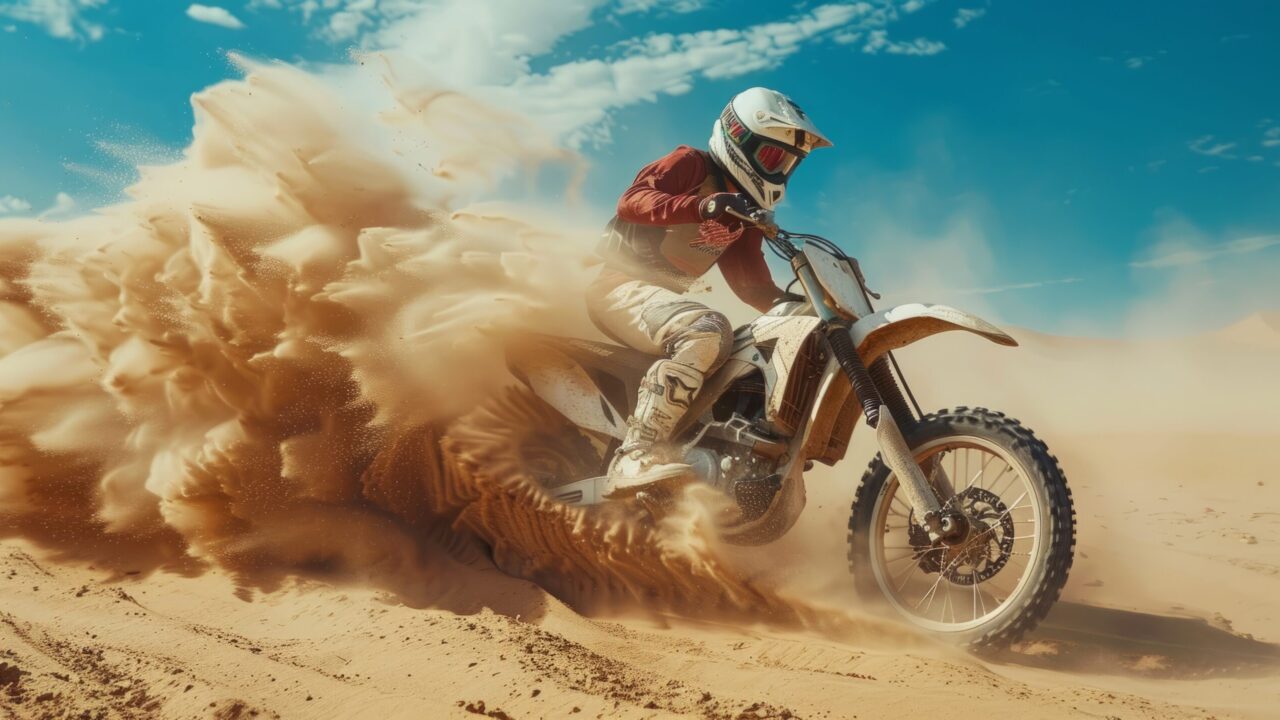
Sand rides like deep water: you never stop in it. Constant momentum, standing and shifted back, steady throttle instead of on-off bursts. Almost every sand problem follows the same chain — the rider eases off out of caution, the front wheel digs in, and then he muscles through a section that would have been easy at speed.
Why sand punishes hard-pack reflexes
On hard-packed dirt the bike pushes against a surface. In sand it pushes against something that gives way. The front wheel digs and loses steering accuracy; the rear finds traction by moving material rather than driving off it. Everything that works on hard ground — braking late and hard, turning sharply, correcting with the bars — turns against you here.
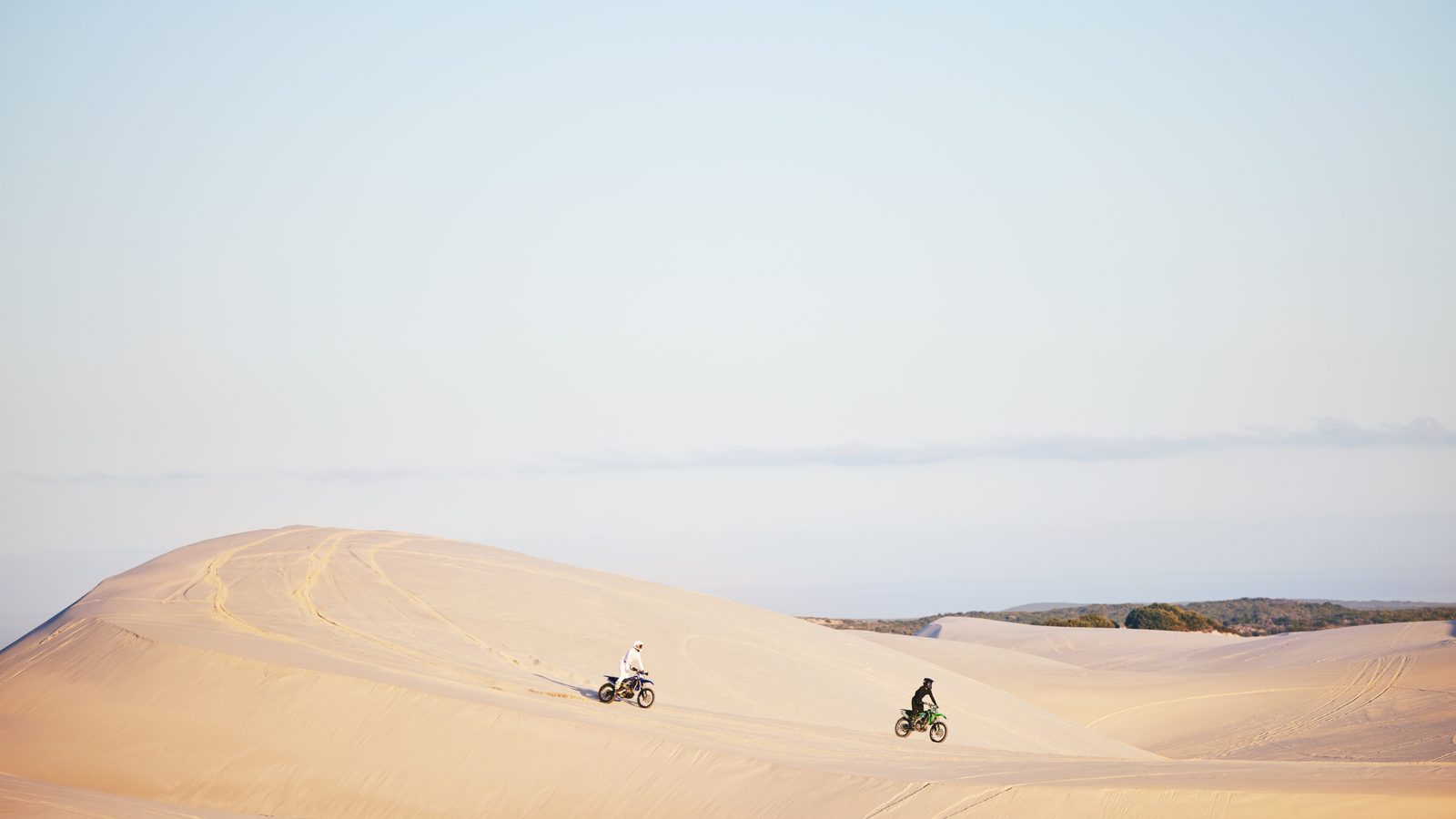
Speed does the same stabilizing job it does in the whoops, for a different reason. Enough momentum and the front stays near the surface, which hands your steering back. Ease off and it ploughs, and every metre after that is harder than the one before. It’s a loop, and it spins fast in the wrong direction.
Sand also lies to your eyes. A stretch that looks flat hides swells, holes carved by the rider ahead, sometimes a damper patch that grips like concrete. You won’t see them. You’ll feel them in your legs, which is exactly why the stance matters.
Stance: standing, back, light hands
Take your usual riding stance and move your hips back one notch further than normal. Knees loose, elbows up, weight through the pegs. That rearward shift is more pronounced here than on any other surface, because it’s the single thing keeping the front from burying itself.
Sand checkpoints
- Stance
- standing, hips behind the footpegs
- Eyes
- far ahead, never on the front wheel
- Hands
- loose fingers, no sharp bar inputs
- Throttle
- open and steady, never chopped
- Line
- one that already exists, not one you cut
- Warning sign
- the front goes heavy and vague: you’re too slow
Your hands hold on, they don’t steer. A sharp bar input in soft ground unsettles the bike more than it turns it. The bike changes direction through body weight and throttle, over a much longer distance than on hard pack, so start every direction change well before you’d normally think about it. Otherwise you arrive at the corner without having begun to turn.
Sit down and you lose all of it. You can’t move your weight back, you take the holes through your spine, and the first hidden dip throws you onto the tank. Standing is the rule here, near enough without exception.
Throttle: steady, never on-off
Sand wants consistency. A steady trickle of throttle keeps the rear loaded and the front floating; a jerky one spins, digs, hooks up, and you shed momentum on every cycle. It’s the direct extension of what throttle and clutch control covers: the right hand works in small variations, not in all-or-nothing.
Braking follows the same inverted logic. In deep sand the front brake mostly buries you. Scrub speed with the rear and with engine braking while keeping the bike rolling, rather than chasing the hard stop you’d get on hard pack. Good brake modulation counts for more here than almost anywhere else on the track.
Pick a line instead of cutting one
After an hour of riding, a sand track is a web of lines. They’re packed harder than the loose stuff beside them, which makes them faster and steadier. The same logic as rut cornering applies: choose your line early, commit, don’t change your mind halfway through.
Cutting across untouched sand to pass costs energy and momentum. It’s worth trying down a straight when you have the power for it, rarely on a corner entry. On a wet track the thinking moves closer to riding mud — you hunt for the ground that holds, not the shortest line.
When it starts to go sideways
Bike wandering underneath you? Look far ahead, let your arms follow, keep the throttle where it is. The bars will move in your hands, and that’s normal. Gripping tight and correcting turns a harmless wobble into a crash. That reflex takes confidence, and confidence gets built over longer and longer stretches, not in one session.
Stopped dead in the deep stuff? Get going again standing, never seated. Slip the clutch progressively, moderate throttle, and let the rear tyre find something to push against before you feed in power. Dumping the clutch just digs a deeper hole, and then you’re pushing.
Three drills to get comfortable
- Straight line, moderate sand. Constant speed, weight back, no turning at all. One goal: feel the moment the front goes light and settles. Do ten passes and chase nothing else.
- Early direction changes. Same stretch, same throttle, but add wide arcs triggered far earlier than feels natural, steering through the pegs. Ban yourself from using the bars for the whole drill.
- Deliberate loss of momentum. Slow right down on purpose in a shallow section, then drive back out on the clutch without a jolt. You rehearse the situation that scares you while it isn’t yet an emergency, which is how the panic reflex gets defused.
FAQ
Why do I bog down when I slow down to be careful?
Because slowing removes the one thing holding you up: the momentum that keeps the front wheel near the surface. The caution reflex you learned on hard pack works backwards in soft ground. Coming up to a sand section, crack the throttle open slightly instead of easing off, and hold that opening all the way through.
Sit or stand in sand?
Standing with your hips back, in almost every case. It lightens the front and lets your legs absorb whatever the sand is hiding. Seated, you load the front wheel at the worst possible place, you lose the ability to correct with your body, and the first hidden dip fires you toward the tank.
How do you turn properly in soft ground?
Very early, and with your body. Start the direction change well before the point you want to reach, weight the outside peg, and let steady throttle bring the rear around. A sharp bar input does the opposite: it unsettles the bike without turning it, and it puts more riders on the ground than anything else in sand.
The bike stopped in deep sand. How do I get moving?
Stand on the pegs, slip the clutch progressively, moderate and steady throttle. Let the rear tyre build something to push against before you give it everything. Dumping the clutch digs a hole and sinks you further. If the frame is resting on the sand, dig it clear by hand before you try again.
Find all the riding fundamentals on the riding technique page.
Editorial content. PiloteMX offers no on-site service, no parts or gear sales, no quotes and no bike repairs. Working on a bike and riding it carry risk: what you do with this guide is your own responsibility.