Hill Climbs and Descents on a Dirt Bike: Two Opposite Skills
Contents
Going up, you move your chest forward to keep the front wheel down and put the power through without looping out. Going down, you move back and let engine braking slow you; the brakes only fine-tune. The two moves are nearly inverted, which is why so many riders bring one set of reflexes to the wrong slope and get caught out.
Why the two moves are opposites
A slope moves your weight for you. Uphill, gravity pulls you back and unloads the front wheel. Downhill, it shoves you forward and crushes the front. Your job is to cancel that transfer, not go along with it.
Hence the inversion: you move forward when the bike throws you back, and back when it throws you forward. Everything else follows from that.
| Climb | Descent | |
|---|---|---|
| Body position | Chest forward, sometimes almost over the bars | Hips back, arms bent |
| What controls speed | Throttle, applied progressively | Engine braking, brakes as backup |
| Gear | One that pulls without straining, picked before the hill | Short enough for the engine to hold you |
| Expensive mistake | Adding throttle instead of moving forward | Dragging the front brake the whole way |
| Eyes | The crest, never the wheel | The runout at the bottom |
The climb, step by step
Before you commit
Pick the gear at the bottom, not halfway up. Downshifting mid-climb kills your momentum and forces you to make it up with throttle, which unloads the front even more. On a modern motocross bike a mid-range gear covers most practice-track climbs, but it depends on how much torque your bike makes and how long the hill is. Walk an unfamiliar hill before you commit to it.
Look at the crest, not at the bottom of the hill. You ride a climb by aiming at its exit.
On the way up
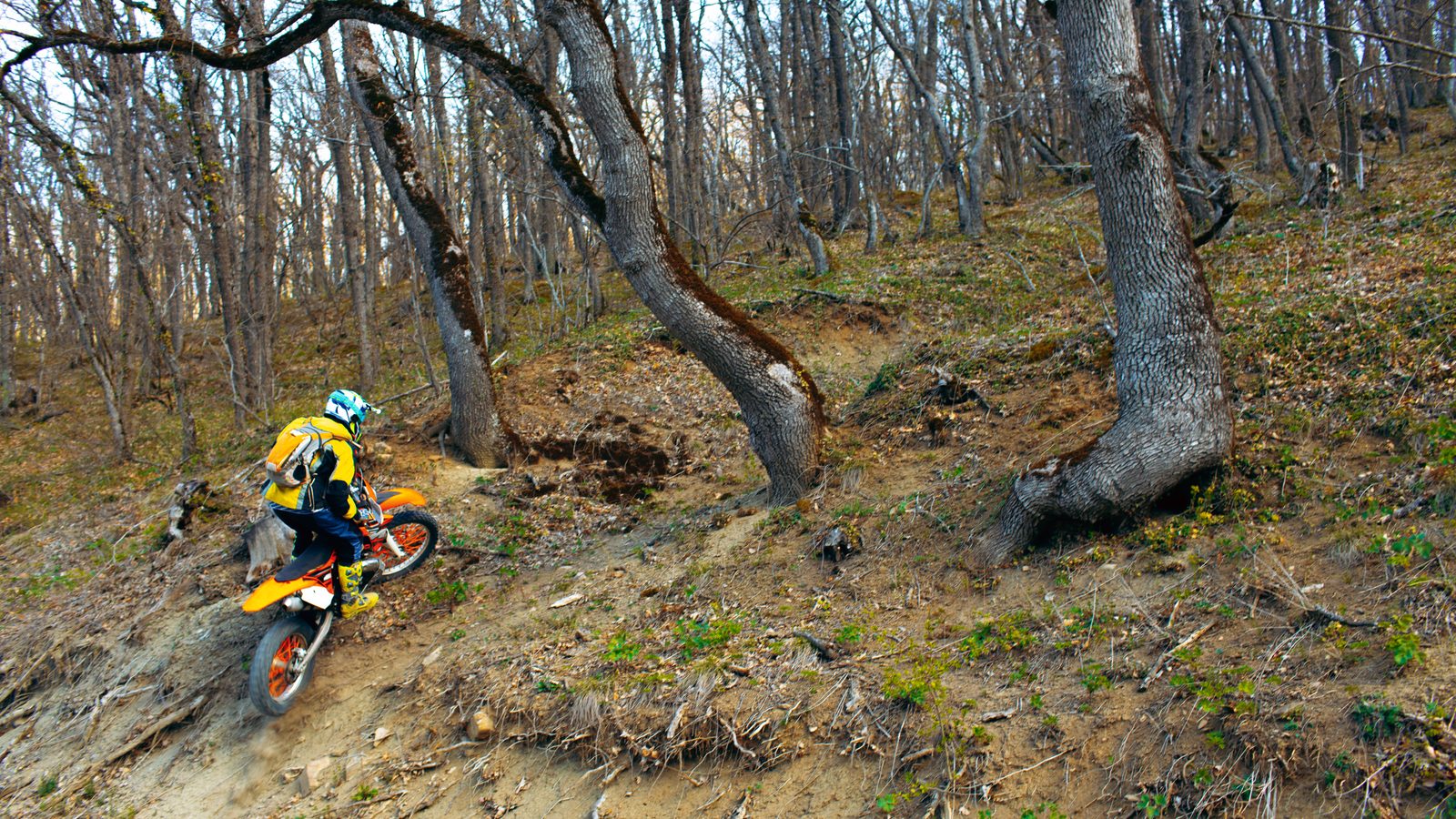
The chest comes forward, sometimes a long way. On something steep you end up with your helmet nearly over the top triple clamp, elbows high, backside off the seat. It feels wrong the first few times. It’s also what keeps the steering useful.
Throttle stays progressive. On a soft climb, a sharp handful digs the rear wheel in without gaining a meter, exactly as covered in the riding sand article. On hard, dry ground you can use more power, as long as the chest stays committed.
If it spins or the front lifts
Two opposite reflexes, and you need to know which one applies. Rear spinning: back off slightly and move further forward, don’t chop it. Front lifting: move forward first, then ease the throttle. Chopping it drops the front hard and unsettles you as badly as the wheelie did.
The descent, step by step
Position
Hips move well back from the standard riding stance, arms bent, weight on the pegs. The classic trap is hanging off the bars with straight arms: you load the front at the exact moment the slope is already loading it, and the front tire lets go at the first touch of brake.
Slowing down
Clutch out, in a short enough gear, the engine holds you on its own. That drag is steady, it doesn’t surprise you, and it never locks a wheel. Brakes go on top of it to adjust, not to slow you continuously. The modulation follows what’s covered in the braking article, with one extra caution: on a downslope, the same lever pressure dives the fork far more than it would on flat ground.
On a long descent, deliberately alternate between engine braking alone and short applications of the brakes. A trailed brake held for a minute heats the discs, and the bite fades right when you need it.
When the climb doesn’t work out
It happens to everyone: momentum gone, the bike stops halfway up. It’s the most dangerous situation in this guide, because a bike sliding back down sideways takes the rider with it.
The principle is to decide early. While you’re still moving, you can dab a foot and hold. Once you’re stopped on the slope, close the throttle, hold both brakes, and put your foot down on the uphill side. If you can’t hold it, let the bike go down the hill and step away on the opposite side. Bikes get repaired; ankles take longer.
The mistakes that show up most
Adding throttle instead of moving the chest forward. It’s the instinctive response when the climb starts stalling, and it’s the one that loops you.
Holding the climb position through the flat at the top: the front ends up overloaded, and the bike pushes straight on into the corner.
Dragging the front brake all the way down, imported straight from street riding. The brakes heat up, the fork stays compressed, and you have nothing left when a rut appears.
Coasting down with the clutch in or in neutral to “let it roll.” You throw away engine braking, the one form of drag that never locks a wheel.
Running too tall a gear both up and down. It’s the same error producing two opposite results: bogging at the top, running away at the bottom.
Three drills that build it
- Find a short, moderate hill. Climb it five times at the same speed, changing only how far forward your chest goes: neutral, slightly forward, fully committed. You’ll feel the front lighten or plant without altering anything else.
- Come back down the same hill without touching the brakes, clutch out, in a short gear. Speed isn’t the point; the point is to measure what the engine holds on its own. Then repeat it one gear taller to feel the difference.
- Link a climb, a flat, and a descent if the terrain allows. Say out loud when you change position: you should move before the crest, not after it. The day you no longer need to say it, it’s yours.
Right-hand modulation gets built alongside this, in the throttle and clutch control guide. On greasy slopes, add what’s covered in riding mud, where gear choice works differently again.
FAQ
Why does my bike loop out on hill climbs?
Because your chest stayed neutral or back while the slope shifted your weight rearward. The front wheel ends up with no load on it, and the smallest throttle input lifts it. Move forward before you open the throttle, not after. On something really steep that means helmet over the bars and backside completely off the seat.
Should you use the brakes on a descent?
Yes, but as backup. Engine braking does the baseline slowing, steadily and without locking anything. The brakes handle occasional adjustments, weighted more toward the rear on loose ground. What to avoid is constant pressure on the front lever the whole way down: the discs heat up and the fork stays pinned in its travel.
What gear should I use on a hill?
One that pulls without straining going up, and short enough for the engine to hold you coming down. Choose it at the bottom, never halfway. Too tall going up forces a sudden handful of throttle; too tall coming down removes your engine braking. The right answer depends on your bike’s torque and the length of the hill.
What do I do if I don’t make it to the top?
Decide before you come to a full stop. While you’re still rolling you can dab and stabilize. Stopped, close the throttle, hold both brakes, and put your uphill foot down. If the bike starts going, let it go down the hill and step clear on the other side. Never try to turn around across a steep slope.
Do I really need to change position between up and down?
Every time, and ahead of the change rather than after it. On rolling terrain the most common mistake is holding the climb position into the descent that follows. Get in the habit of moving as the crest comes into view, not as the ground tips away. One second of anticipation changes the whole thing.
Find all the riding fundamentals on the riding technique page.
Editorial content. PiloteMX offers no on-site service, no parts or gear sales, no quotes and no bike repairs. Working on a bike and riding it carry risk: what you do with this guide is your own responsibility.