Rut Cornering on a Dirt Bike: Following the Line Instead of Fighting It
Contents
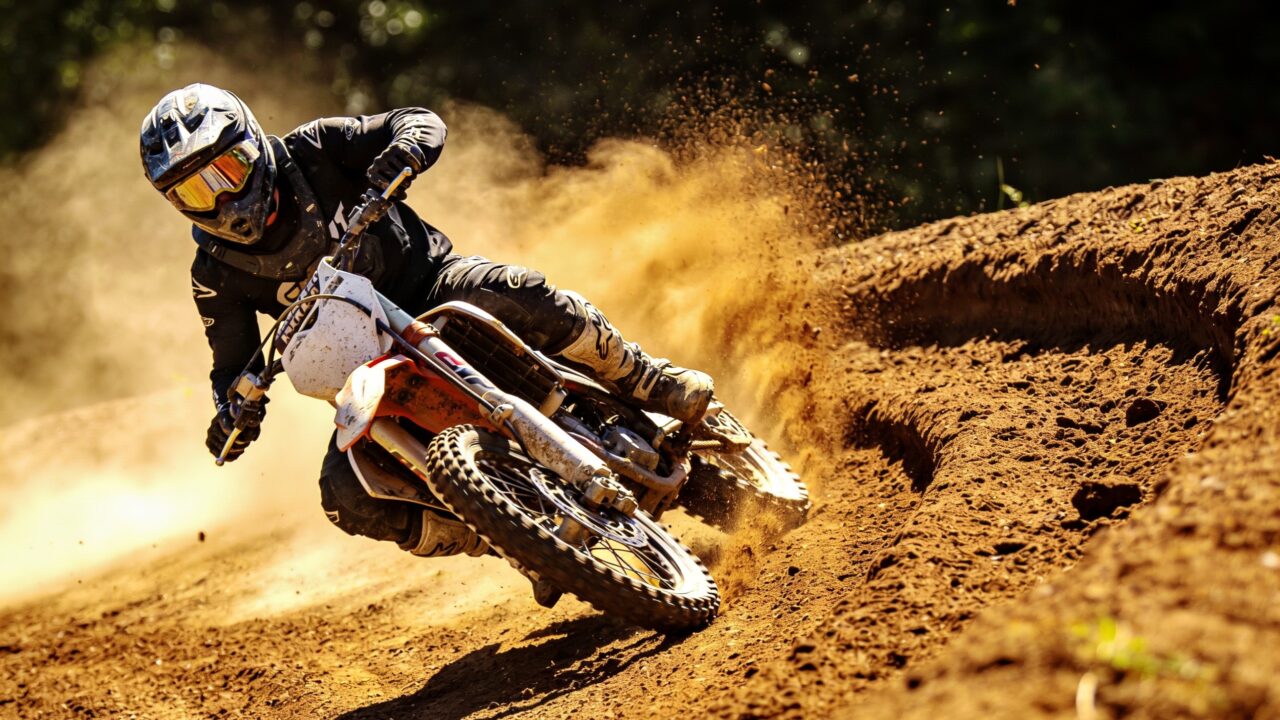
In a rut, the walls steer the front wheel for you. Your job changes: you stop steering with the bars, you hold balance with your body, and you stabilize the bike with the throttle. Pick a groove, commit, let the bike follow it. Most rut crashes come from a rider who tried to correct with the bars.
Picking your groove before you get there
A corner ridden all day ends up with three or four parallel grooves, some deeper, some cleaner. The choice happens under braking, not at the entry. Once the front wheel drops in, you’re committed.
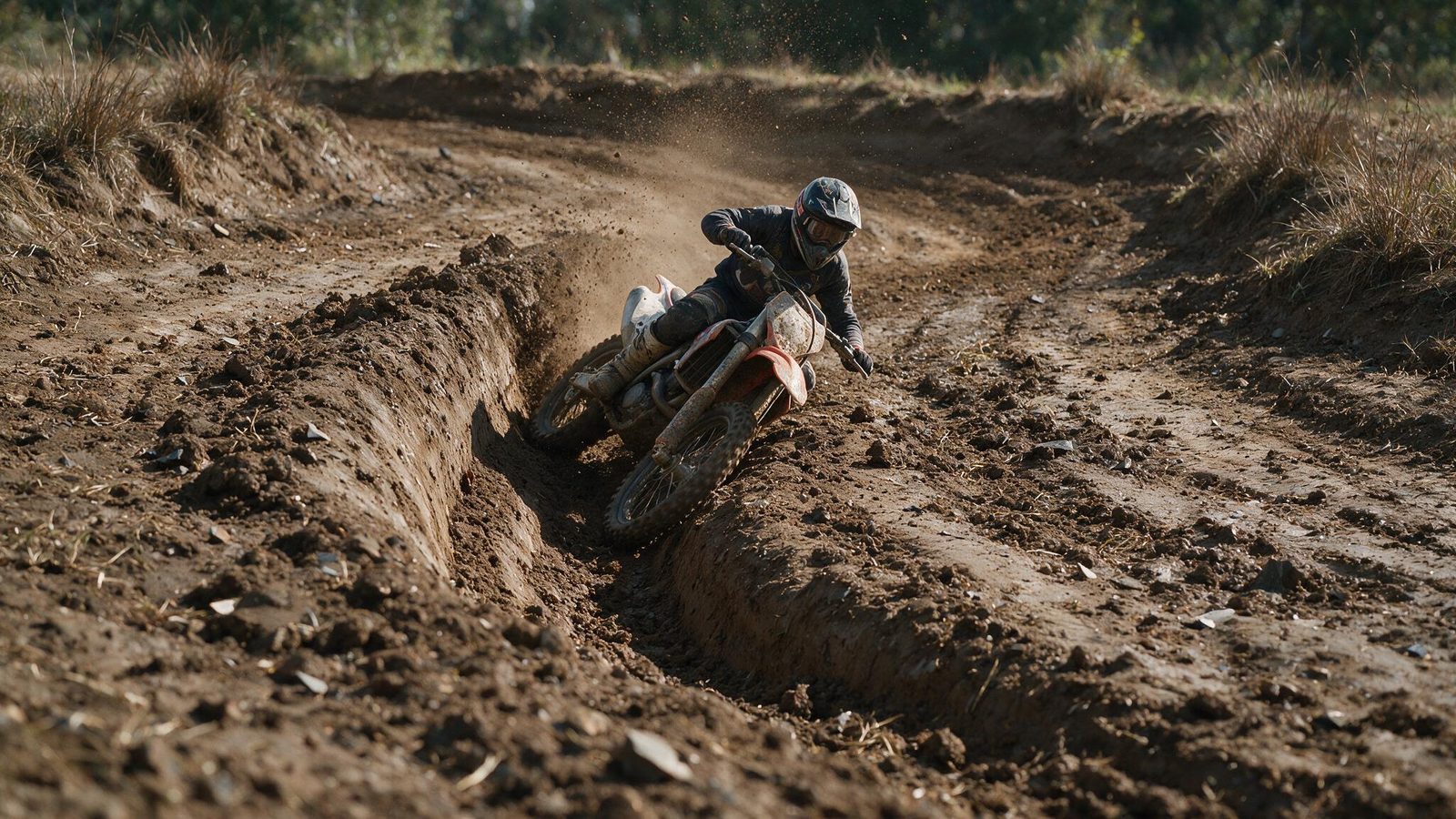
Look at what matters: the floor of the rut, not its edges. A groove with a smooth bottom holds better than a wider one with bumps in it. Be wary of ruts whose inside wall has collapsed, because they’ll spit you outward on the exit.
And look at the exit. A groove that finishes well beats a groove that starts well. Same logic as setting up a pass: the decision happens a second early, never during.
What you do once you’re in
The bars
You hold them, you don’t use them. The walls do the steering, and every micro-correction you add climbs the front wheel up the dirt. It’s the exact opposite of what works on flat ground, which is why a rut feels so wrong the first time. Keep your arms loose, elbows up, hands firm but not clenched.
Your body
Forget the outside-leg lock described in the cornering position article. A rut stops you leaning the bike as far as a berm would, so you stay more centered with a slight bias to the inside. Stand as soon as the floor gets uneven, as in the standard riding stance: your legs take the hits from the bottom of the groove.
The inside foot stays on the peg. This is one of the few corners where dabbing buys you nothing.
The throttle
A steady trickle of throttle from entry to exit. The bike settles into the groove like it’s on a rail, the rear drives, the front stays guided. Chop it and you get the reverse: the front loads up, climbs the outer wall, and leaves. It all lives in the right hand, and the throttle and clutch control article covers the modulation.
In and out, step by step
- Brake in a straight line before the entry, and finish braking before the front wheel drops into the groove.
- Line the bike up with the groove you picked and let the front wheel settle in without forcing it.
- Get back on a trickle of throttle as soon as the wheel is in, and don’t let go of it.
- Ease the pressure on the bars. Loose arms, elbows up, you’re along for the ride.
- Put your eyes on the exit, never on the floor of the rut.
- On the way out, roll it on progressively to climb the front wheel out over the side, with no bar input.
Rut checklist
- Position
- Standing as soon as the floor is uneven
- Eyes
- The exit, never the bottom of the groove
- Throttle
- Steady, never chopped
- Gear
- Often one taller than for a flat turn, to smooth out the hits
- Feet
- On the pegs, not in the groove
- Most common error
- Steering with the bars
Mistakes that push you out of the groove
Steering with the bars. Always top of the list, always for the same reason: the reflex comes from flat corners, where it works.
Hesitating between two grooves. Worst case, you enter straddling a wall, the front drops one side and the rear the other. A mediocre rut ridden with commitment beats a good one taken half-heartedly.
Switching ruts mid-corner. Crossing a wall at an angle, halfway around, almost always ends with the front washing out. Finish the one you took, even if it’s the wrong one.
Chopping the throttle out of nerves. It’s the survival reflex, and it’s the one that puts you down. Steady throttle holds the bike up; zero throttle leaves it to find its own balance, and it doesn’t have one.
Sitting in a deep rut. Every bump in the floor goes into your back, you tense up, and your precision is gone in two laps.
Dry ruts and greasy ruts
A dry, hard rut guides well but forgives little: the wall doesn’t crumble, it deflects. Ride a little more centered and be decisive with the throttle.
A greasy rut behaves differently. The walls collapse under the tire, the groove deforms while you’re in it, and the traction disappears wherever the dirt has been churned. That’s the case covered in the riding mud article: more throttle, more entry speed, and a taller gear to keep the rear from spinning. In sand, the rut deepens every lap and you have to read it again on every pass.
Three drills that build it
- One groove, ten laps. Take the same shallow rut every time and ban yourself from any bar correction. Put all your attention on your upper body balance. It’ll feel wrong for three laps, then obvious.
- Same corner, working the throttle. One lap on steady throttle, one lap with a deliberate chop in the middle. The difference in how the front wheel behaves is obvious, and that’s what you want to remember.
- Deep rut, standing. Ride the same rut seated, then standing, at the same speed. Count how many times your upper body gets moved around. That’s your measure.
Once ruts stop scaring you, flat turns and berms use the same steady-throttle logic with completely different body work. And braking always happens before the rut, never in it.
FAQ
Why do I keep crashing in rutted corners?
Because you’re correcting with the bars. Every correction climbs the front wheel up the wall, and when it drops back down it comes in crooked. Let the rut steer. Your only two tools are upper-body balance and steady throttle. Try a full lap forcing yourself to correct nothing: the bike tracks on its own.
Should you sit or stand in a rut?
Standing most of the time, especially when the rut is deep or the floor is choppy, because your legs absorb what your back would otherwise take. Sitting has a case in a shallow, even rut on a tight exit where you want to load the rear and drive out. Let the floor of the groove decide, not habit.
What do I do where two ruts merge?
Decide which one you want to finish in before you get there, and put your eyes on it. At the junction one wall disappears under the wheel: if you haven’t chosen, the bike chooses for you and rarely well. On an unfamiliar corner, take a slow first lap just to see where the grooves cross.
Can you deliberately ride out of a rut mid-corner?
Yes, by accelerating hard enough that the front wheel has the speed to climb the wall. It takes commitment: a half-hearted attempt or a sharp bar input puts the front across the wall, and that ends on the ground. If you’re unsure, stay in the groove until the exit.
What gear should I use in a rut?
Usually one taller than you’d run in a flat turn. A short gear makes the throttle snappy, and the smallest hit bounces the rear wheel out of the groove. A taller gear smooths the drive and lets you work the clutch. The right answer depends on your bike’s torque and the length of the corner, so try both on the same turn.
Find all the riding fundamentals on the riding technique page.
Editorial content. PiloteMX offers no on-site service, no parts or gear sales, no quotes and no bike repairs. Working on a bike and riding it carry risk: what you do with this guide is your own responsibility.