Washing a Dirt Bike: The Routine That Protects the Mechanics
Contents
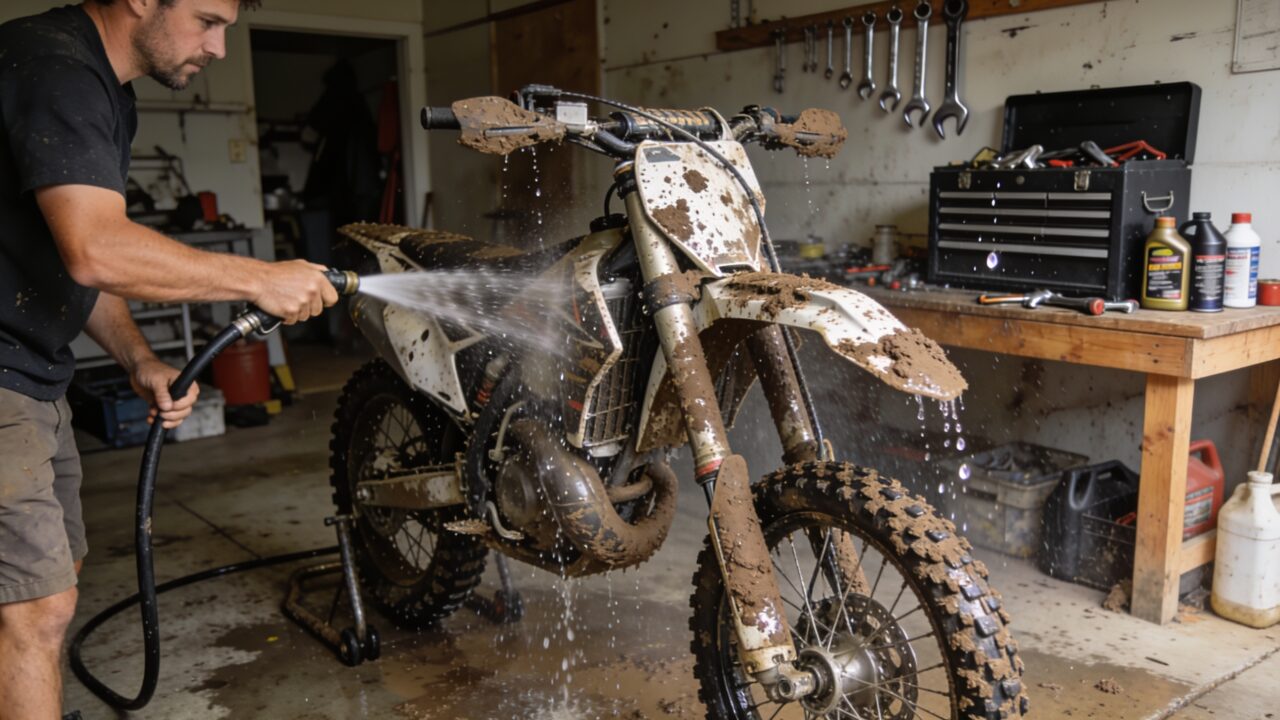
Wash a dirt bike top to bottom with warm or cool water, and keep a high-pressure jet away from bearings and seals. Dry it properly, then re-lube the chain before the mud has time to harden into an abrasive crust. Done after every ride, this removes most of the wear that mud and dust cause.
Rinse it now, not tomorrow
Wet mud rinses off with a garden hose. Dry mud has to be scrubbed, and scrubbing means scratching. The only thing separating those two jobs is how long you wait between loading the bike and picking up the hose.
Clay is the worst offender. It shrinks as it dries, packs into radiator fins, sets between chain links, bakes onto fork tubes. Once hard, it stops behaving like dirt and starts behaving like sandpaper riding against your seals every time the suspension moves.
Got home late and can’t face a full wash? Do a rough rinse anyway. Five minutes with a hose beats a perfect wash three days later. The detail work can wait until tomorrow. The crust can’t.
One thing first: a hot engine doesn’t want cold water on the cylinder or the radiator. Let it cool while you unload the van.
The wash, in order
The order isn’t about looks. It stops dirt from the top of the bike running down over parts you already cleaned, which means you only do each area once.
- Plug the exhaust and protect the intake: an exhaust bung, the airbox cover, or a rag wedged in firmly.
- Rinse with plain water, top to bottom, without lingering anywhere. All you want is to lift the mud that’s still soft.
- Spray a motorcycle-specific degreaser on the frame, the swingarm and around the engine, keeping it off the brake discs.
- Let it work for a few minutes, but never let it dry on plastics or paint.
- Work a soft brush into the packed areas: under the fenders, around the linkage, around the rear sprocket.
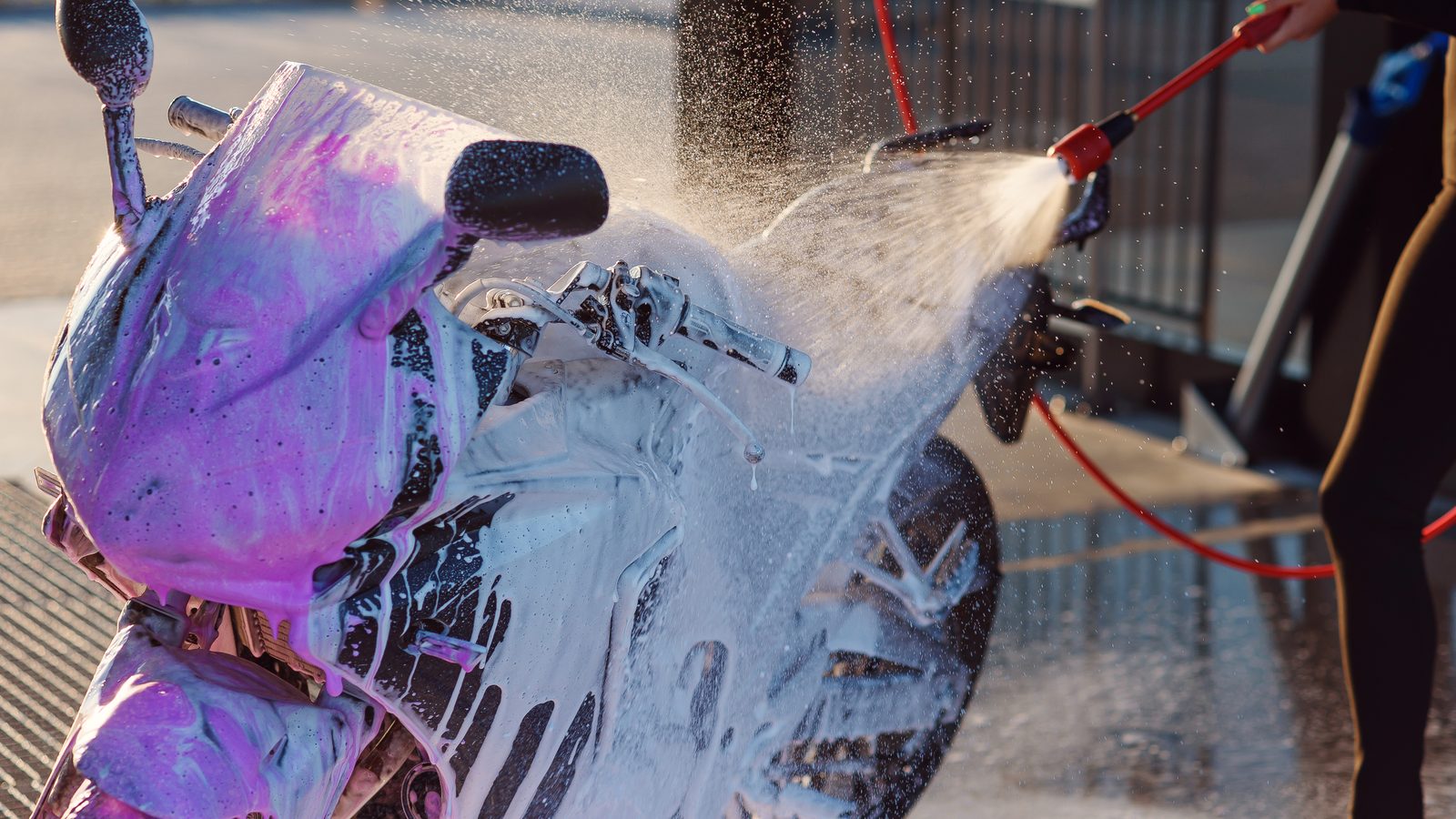
- Rinse again, still top to bottom, until the water running off is clear.
- Treat the chain separately with its own degreaser, then rinse it on its own.
- Dry with a microfibre towel, then compressed air if you have it, going after the pockets where water sits.
- Re-lube the chain, check the air filter, pull the plugs out, and note anything that looked wrong.
That last step is the one everybody skips, which is a shame, because a clean bike shows you everything. A fork seal starting to weep, a cracked plastic, a loose spoke, a bolt that has backed off. Washing is the best inspection window of your week, and it runs straight into the post-ride checklist.
Places the pressure washer never goes
Wheel bearings, steering head bearings, linkage bearings: every one of them sits behind a seal whose job is keeping grease in and water out. That seal handles splashes all day. It does not handle a lance held a few centimetres away. Water gets past, the grease turns milky, and the bearing runs dry long before it makes enough noise for you to notice.
Fork and shock seals work the same way. Firing pressurised water straight along the tube creates exactly the leak you were trying to avoid.
The air filter and airbox should see no water at all during a general wash. The filter comes out and gets cleaned on its own terms, as covered in the guide on cleaning the air filter. Same rule for electrical connectors, the wiring loom plugs and the speed sensor: gentle flow, sponge, move on.
Picking your gear without overthinking it
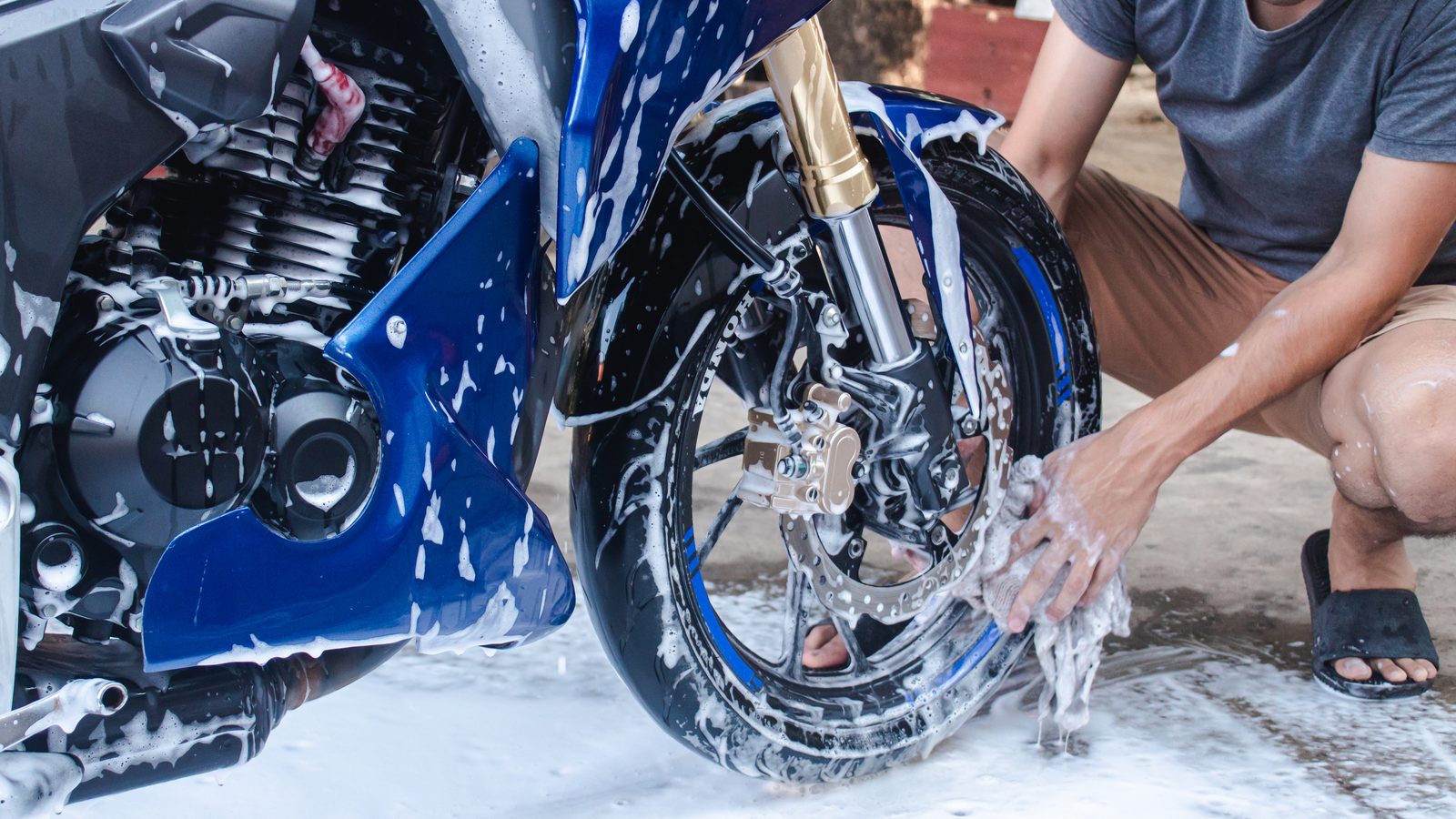
A pressure washer saves time as long as you know where not to point it. A plain garden hose is slower and far more forgiving. A bucket and a sponge stay the answer for anything delicate.
| Tool | What it does well | Where it turns risky |
|---|---|---|
| Pressure washer | Heavy mud under the fenders, in the tyres, across the frame | Bearings, fork seals, airbox, connectors, graphics |
| Garden hose | General rinsing, fresh mud, everything else on the bike | Almost nothing, short of parking it on a seal for a long time |
| Bucket, sponge, soft brush | Sensitive areas, plastics, radiators, around the engine | No mechanical risk at all, only your time |
On products, buy a degreaser made for motorcycles. Automotive and workshop degreasers attack some plastics and dull painted surfaces. Add a soft brush, a microfibre towel and a chain lube you trust, and you’re set. The rest of the basic tool kit already covers the other jobs.
How often it actually needs doing
A rough rinse after every ride, no exceptions. That’s the rule that matters, and it’s the one most riders let slide when the day has been long.
A full wash, degreaser and chain lube included, after every ride in mud or soft ground. Riding regularly on dry tracks, once a week as a minimum: dust builds up in the same places, quieter but just as certain.
Before the bike sits for a long stretch, washing stops being optional and becomes the first step, alongside the other precautions covered in the guide to winterizing a dirt bike. Storing it dirty just gives the dirt weeks of uninterrupted work.
Mistakes that do more damage than the mud
The pressure lance held against a bearing is the expensive one. You won’t see it that day. You’ll pay for it two months later, as play in the rear wheel.
Letting mud dry before you start turns a five-minute rinse into a scraping session, with scratches thrown in.
Forgetting to lube the chain after washing wears the drivetrain faster than never washing at all, because the degreaser stripped the protection and nothing replaced it. The method is in the guide on chain lubrication.
Putting the bike away wet in a closed, poorly ventilated shed pits every bare metal surface. Dry first, store second. A clean, dry bike also makes the next pre-ride check quicker and more honest.
FAQ
Can you use a pressure washer on a dirt bike?
Yes, on the lowest setting and with the lance held back. The machine isn’t what causes damage; a close jet aimed at a bearing, a fork seal or the airbox is. Switch to the hose or a sponge for those areas. The rest of the bike takes it without complaint.
Does the bike need washing after every ride?
A rinse, yes, always, even a sloppy one. The full wash with degreaser and chain lube belongs after a muddy or soft-ground session, and at least weekly if you ride often. Rinsing straight away matters more than how thorough the wash that follows turns out to be.
Why is my bike rusting when I look after it?
Almost always because it goes away wet. Water stays trapped under the seat, inside the frame, behind the side panels, and works away for days in a closed shed. Dry with microfibre, then compressed air, let the bike breathe for a while before you cover it, and the problem goes away.
Find the rest of the practical guides on the dirt bike maintenance page.
Editorial content. PiloteMX offers no on-site service, no parts or gear sales, no quotes and no bike repairs. Working on a bike and riding it carry risk: what you do with this guide is your own responsibility.